
Note: This article contains affiliate links. If you click on these links and make a purchase, we may earn a small commission at no extra cost to you. This helps support our research and content. Read our full affiliate disclosure here.
If you run a dual fuel heat pump system you need a thermostat that coordinates two heat sources without wasting energy or causing short cycling. The right thermostat keeps indoor temperatures steady, switches cleanly between the heat pump and backup fuel source, and gives you the scheduling and sensor options that match your household. This guide covers six shortlisted thermostats built to handle dual fuel control and smart scheduling, and explains the technical and practical factors that matter. Read on to understand the compatibility, control, and installation considerations we used to select these top picks.
Top Picks at a Glance
| Best Overall The best all-around choice for most situations | Google Nest Learning Thermostat (4th Gen) |  |
| Best Quality Built to a higher standard if you want something more solid | Honeywell Home X8S Smart Thermostat |  |
| Best Value The sweet spot between price and what you get | White-Rodgers 80 Series Thermostat |  |
| Best Budget The cheapest option that still gets the job done reliably | Miuputake STN601 Thermostat |  |
| Top Rated A top-rated pick with lots of positive feedback | Google Nest Thermostat |  |
| Most Popular A crowd favorite that many people choose with confidence | Honeywell Home Smart Color Thermostat RTH9600WF |  |
Google Nest Learning Thermostat (4th Gen)

| Connectivity Technology | Wi-Fi |
|---|---|
| Power Source | Corded Electric |
| Voltage | 24 volts |
| Display Type | Touchscreen |
| Controller Type | Amazon Alexa, Android, Apple HomeKit, Google Assistant, iOS |
The Nest Learning Thermostat (4th gen) is a smart wall thermostat that learns your preferences, suggests energy-saving schedule tweaks, and can be controlled from the Google Home app or by voice. It pairs with the included Nest Temperature Sensor to help manage hot and cold spots and uses features like Adaptive Eco and Natural Heating & Cooling to pause HVAC activity when outdoor conditions make that efficient. The display is larger than prior models and Dynamic Farsight shows time or weather from across the room, while System Health Monitor provides alerts if heating or cooling shows signs of trouble. Installation is intended to be DIY-friendly for most 24V systems and the unit supports app-based scheduling and remote control via Alexa, Siri, or Google Assistant. Limitations to consider are that advanced savings figures depend on usage and local systems, some integration behaviors require the Google Home app, and compatibility nuances mean checking system support for certain dual fuel or complex setups before buying.
Best for: Buyers who want a smart, app-controlled thermostat that actively learns routines and helps reduce energy use while offering easy remote and voice control.
Less Ideal for: Homes with highly specialized or uncommon HVAC control systems where precise compatibility is critical or users who prefer a simple manual thermostat without app-dependent features.
- Learns user preferences and suggests schedule adjustments to save energy
- Includes a Nest Temperature Sensor to better manage hot and cold spots
- Large, easy-to-read touchscreen with Dynamic Farsight for distant visibility
- Works with Google Home app and voice assistants for remote control
- System Health Monitor provides alerts about HVAC system issues
- Energy savings depend on home and behavior and are not guaranteed
- May require checking compatibility for complex dual fuel or nonstandard HVAC setups
- Some advanced features and notifications require the Google Home app
Verdict: Choose this thermostat if you want a learning, app-driven controller with remote sensing and smart energy features tailored for balanced everyday use.
Honeywell Home X8S Smart Thermostat

| Screen Size | 5 inches |
|---|---|
| Connectivity Technology | Wi‑Fi |
| Power Source | Hardwired |
| Compatibility | Up to 3 heat/2 cool heat pump; 2 heat/2 cool conventional systems |
The Honeywell Home X8S is a feature-rich smart thermostat aimed at precise comfort and smart-home integration. It mounts on the wall and connects to your HVAC via hardwiring, supporting up to 3 heat/2 cool heat pump systems with electric backup or 2 heat/2 cool conventional systems, so it fits common dual-fuel heat pump setups. The 5" customizable touchscreen and app control let you adjust settings locally or remotely, while the included wireless room sensor extends occupancy and temperature sensing for targeted comfort in living areas or bedrooms. It also monitors humidity and ventilation and can integrate with compatible video doorbells to show visitors on the thermostat screen. Connectivity includes Wi‑Fi and Matter certification for Alexa, Google Assistant, and Apple Home interoperability, and the package includes a voucher for a C‑wire adapter if needed. Trade-offs are that installation requires a C‑wire or adapter and some advanced IAQ or ventilation features may need additional equipment, and it is not suitable for electric baseboard heating systems.
Best for: Buyers who prioritize precise control and smart‑home interoperability for multi‑stage heat pump or dual‑fuel systems and want room‑level sensing to balance comfort across zones.
Less Ideal for: Homes that rely on electric baseboard heating or owners who need a plug‑and‑play battery thermostat without hardwiring or C‑wire work.
- Supports up to 3 heat/2 cool heat pump systems with electric backup for dual fuel flexibility
- Includes a wireless room sensor with up to 200 ft range for targeted temperature control
- Matter certified with Wi‑Fi allows broad smart‑home integration and remote app control
- Customizable 5" touchscreen improves local usability and visibility
- ENERGY STAR certified for potential energy savings and rebate eligibility
- Requires a C‑wire (or use of included voucher for adapter) which can complicate installation
- Some indoor air quality and ventilation capabilities require additional HVAC equipment to function fully
Verdict: Choose the X8S if you want a Matter‑certified, room‑sensor smart thermostat built to handle multi‑stage heat pump and dual‑fuel setups with strong smart‑home integration.
White-Rodgers 80 Series Thermostat

| Display size | 4.5 inches |
|---|---|
| Voltage | 24 volts |
| Power source | Hardwire or 2 AA batteries |
| Programmable options | 7-day or 5-1-1-day |
The White-Rodgers 80 Series is a wall-mounted programmable thermostat built specifically to control heat pump systems and dual fuel setups without an outdoor sensor. It offers 7-day or 5-1-1 scheduling with four periods per day, a large 4.5-inch backlit LCD for easy viewing, and straightforward button and touch controls. Installation is designed to be DIY-friendly with a universal back plate, pluggable terminals and a built-in level, and it can run on 24V hardwire or two AA batteries. Useful safety and convenience features include keypad lockout, temperature limits, low battery indicator and a filter change reminder. The thermostat provides precise temperature control to within one degree and supports common terminal functions for heat pump, aux/emergency heat and dual fuel control. It does not work with line-voltage baseboard heating and lacks wireless or smart-home connectivity, so it is best for buyers who want reliable, programmable control without needing Wi-Fi features.
Best for: Homeowners with a heat pump and dual fuel setup who want accurate, programmable temperature control and an easy DIY installation without needing smart-home connectivity.
Less Ideal for: Users who need Wi-Fi remote control, mobile app scheduling, or those with electric baseboard heating should look for a different thermostat.
- Designed for heat pump and dual fuel systems with dedicated terminals and dual fuel control
- Large backlit 4.5-inch LCD that is easy to read in low light
- Multiple programmable schedules (7-day or 5-1-1) with four periods per day
- Easy DIY installation with universal back plate, pluggable terminals and built-in level
- Runs on 24V hardwire or included AA batteries for flexible power
- No Wi-Fi or smart-home integration for remote control or app scheduling
- Not compatible with line-voltage (110/220V) baseboard heating systems
Verdict: A practical, easy-to-install programmable thermostat built to control heat pump and dual fuel systems reliably without smart-home features.
Miuputake STN601 Thermostat

| Controller Type | Push Button |
|---|---|
| Temperature Control Type | Manual |
| Power Source | 24VAC or 2 AAA batteries |
| Display Type | LCD |
| Additional Features | Adjustable swing, low battery indicator, compressor delay protection |
The Miuputake STN601 is a basic digital, nonprogrammable thermostat intended for straightforward heating and cooling control on single-stage systems. It installs on a universal sub-base with large terminal blocks and can be powered by 24VAC or two AAA batteries, which makes it simple to fit into many forced-air systems and some heat-only setups. The backlit LCD, push-button controls, selectable Celsius/Fahrenheit, adjustable temperature differential (swing), and compressor delay protection are practical for everyday use and modest energy savings. It also supports temperature display calibration and has a low-battery indicator. Important limitations for the article focus: it is not compatible with heat pump systems that require auxiliary or emergency heat or dual fuel/hybrid systems, so it will not manage automatic switching between gas/oil furnace and heat pump stages. For buyers on a tight budget who need a reliable manual thermostat for a single-stage forced-air system, this unit is straightforward and easy to install, but those needing dual fuel control or advanced programming should look elsewhere.
Best for: Buyers prioritizing a low-cost, no-frills manual thermostat for a single-stage forced-air or simple heating system who want an easy DIY install and straightforward controls.
Less Ideal for: Homeowners who need a thermostat to manage dual fuel heat pump systems, handle auxiliary/emergency heat, or provide programmable/smart scheduling and remote access.
- Simple push-button interface and backlit LCD for easy daily adjustments
- Dual power options: 24VAC wiring or two AAA batteries for flexible installation
- Large terminal blocks and universal sub-base speed up DIY installation
- Adjustable temperature differential and compressor delay protection help reduce short cycling
- Not compatible with heat pump systems that require auxiliary or emergency heat or with dual fuel/hybrid setups
- Nonprogrammable design lacks scheduling and remote or smart controls
Verdict: Choose this inexpensive, easy-to-install manual thermostat only if you need a simple single-stage controller and are not seeking dual fuel or heat-pump auxiliary management.
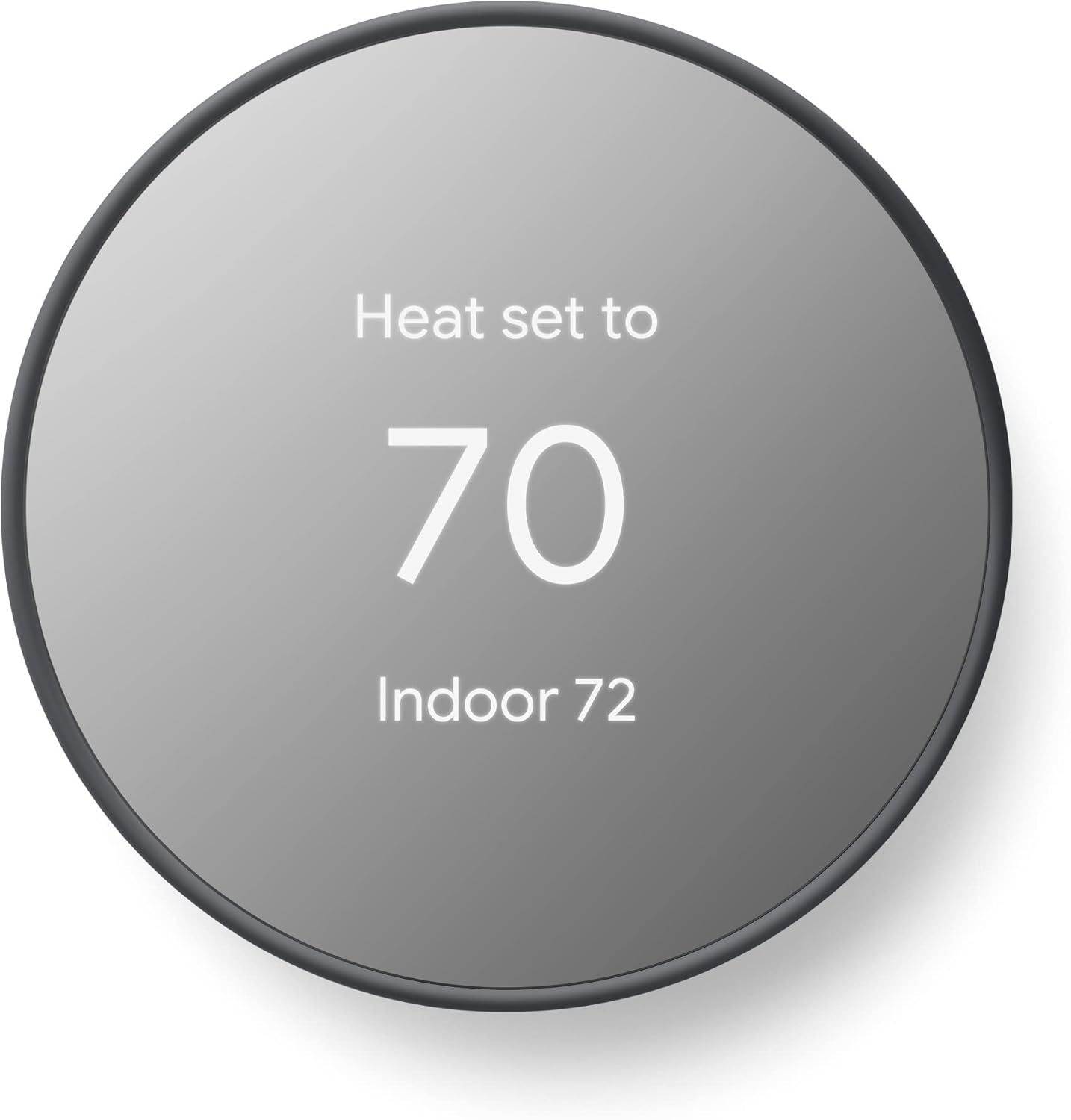
Google Nest Thermostat
| Connectivity Technology | Bluetooth, Wi-Fi |
|---|---|
| Power Source | Battery Powered |
| Display Type | LCD |
| Control Type | Remote Control, Voice Control |
The Google Nest Thermostat is a compact smart thermostat that gives remote control and basic automation through the Google Home app and voice assistants. It is typically wall-mounted to replace a standard thermostat and is used to set schedules, change temperatures remotely, and receive simple HVAC alerts. Key features include Wi‑Fi and Bluetooth connectivity, a 2-inch LCD display, programmable scheduling via the app, Savings Finder suggestions, Eco Temperatures when you leave, and system monitoring that can alert you to potential issues. Installation is aimed at DIYers and usually completes in about 30 minutes for compatible systems, and it is designed to work without a C wire in most homes. The practical benefits are straightforward energy saving opportunities, easy remote adjustments, and integration with other Google smart home devices. Limitations are that advanced learning and some Nest Renew features require other Nest models or services, voice control and remote alerts need working internet and compatible devices, and certain complex HVAC or 120V systems are not supported without additional power accessories or professional help.
Best for: Homeowners who prioritize dependable, easy-to-use smart control and energy-saving basics and want a simple, DIY smart thermostat that integrates with Google devices.
Less Ideal for: Homes with complex or high-voltage HVAC systems, or buyers who want deep learning features and advanced HVAC diagnostics built into the thermostat itself.
- Wi‑Fi and Bluetooth connectivity for remote control via Google Home app
- Savings Finder and Eco Temperature help reduce energy use automatically
- Designed for easy DIY installation and works without a C wire in most homes
- Integrates with Google Assistant and Matter-certified voice ecosystems
- Some advanced features and Nest Renew compatibility require other Nest models or services
- Not compatible with certain 110V/120V systems and some HVAC setups may need a C wire or power accessory
Verdict: A practical, reliable smart thermostat for homeowners who want straightforward remote control and automated energy-saving features with easy DIY installation.
Honeywell Home Smart Color Thermostat RTH9600WF

| Connectivity Technology | Wi‑Fi |
|---|---|
| Display Type | LCD |
| Power Source | Battery Powered |
| Voltage | 24 volts |
| Controller Type | Amazon Alexa, Android, Google Assistant, IFTTT, iOS |
The Honeywell Home Smart Color Thermostat is a wall‑mounted Wi‑Fi thermostat that combines a bright, customizable color touchscreen with remote app control and built‑in smart features. It is used to control heating and cooling systems with flexible daily schedules, smart response learning to time system cycles, and on‑screen weather, temperature and humidity readouts. Notable features include ENERGY STAR certification, compatibility with voice assistants (Alexa, Google Assistant, Microsoft Cortana), smart alerts for filter changes and connection issues, and an easy app for remote monitoring. Installation is designed for DIY with step‑by‑step guidance, but the unit requires a C‑wire and works only with low‑voltage systems; it does not support high/line voltage or electric baseboard heat. Practical benefits are clear remote management, energy tracking that can tie into utility rebates, and a readable display that you can personalize to match decor. Limitations to plan for are the C‑wire requirement and 2.4 GHz Wi‑Fi-only networking, which may require adapters or compatibility checks before purchase.
Best for: Buyers who prioritize verified energy savings, smart home integration, and a clear, customizable display for everyday remote control and visible comfort data.
Less Ideal for: Homes with high‑voltage or line‑voltage heating systems or setups without an available C‑wire unless the buyer is willing to add a power adapter or have an electrician install one.
- Customizable full‑color touchscreen for easy at‑a‑glance info and personalization
- Wi‑Fi and app control plus voice assistant compatibility for remote operation
- ENERGY STAR certification and Smart Response learning help reduce energy use
- On‑screen indoor/outdoor temp and humidity plus smart alerts for maintenance
- Requires a C‑wire and only supports low‑voltage systems, so not universal
- Supports only 2.4 GHz Wi‑Fi which can limit network compatibility
Verdict: Choose this thermostat if you want an ENERGY STAR certified, Wi‑Fi smart thermostat with a customizable color touchscreen and reliable remote and voice control for dual fuel heat pump setups that use low‑voltage wiring.
Choosing the Right Thermostat for Dual Fuel Heat Pump: Key Factors to Consider
Compatibility With Dual Fuel Wiring
Dual fuel systems require a thermostat that recognizes both the heat pump and the backup fossil-fuel or resistance heat source. Verify that the thermostat supports the specific terminal assignments and stages used by your system, including separate outputs for compressor, reversing valve, and auxiliary or emergency heat.
Mismatch here can lead to incorrect sequencing, missed changeovers, or equipment running in the wrong mode. Confirming wiring compatibility ahead of purchase reduces installation headaches and ensures the thermostat can control both systems safely.
Changeover Criteria and Control Logic
The thermostat must decide when to use the heat pump and when to switch to the supplemental heat source. Different thermostats use temperature, outdoor sensor input, or configurable thresholds to trigger changeover. Some thermostats offer a forced changeover or lockout options; others rely strictly on temperature differentials.
How the device determines changeover affects efficiency and comfort. A poorly tuned changeover can cause unnecessary fuel use or leave the home underheated. Look for clear, adjustable controls for changeover temperature and timers to avoid short cycling between heat sources.
Smart Features and Remote Control
Wi-Fi connectivity, app control, and integration with home automation platforms make it easier to monitor and adjust dual fuel systems. Remote scheduling can optimize when the backup heat engages, and learning or adaptive schedules can reduce manual adjustments.
However, smart features are only valuable if they expose the dual fuel controls you need. Ensure the thermostat's app and cloud features provide access to changeover settings, outdoor sensor inputs, and multi-stage control rather than hiding those options behind limited interfaces.
Sensor Accuracy and Placement
Temperature sensing accuracy affects both comfort and when the thermostat triggers changeover. Built-in sensors are fine for many spaces, but some installations benefit from remote or multiple sensors to avoid dead spots or temperature bias from appliance heat.
Consider whether the thermostat supports additional room sensors or an outdoor temperature sensor. Better sensing reduces false triggers and improves overall performance of the dual fuel strategy, especially in homes with uneven temperature distribution.
Installation Requirements and Professional Support
Some thermostats are designed for straightforward DIY replacement, while others assume professional installation, especially when dealing with multi-stage or proprietary control wiring. Check the required power type, common-wire needs, and whether the thermostat requires a C-wire or a power adapter.
Access to clear wiring diagrams, diagnostic indicators, and vendor or contractor support can save significant time. If your system uses nonstandard wiring or controls, plan on professional installation to ensure safe, correct operation.
Durability and Long-Term Operation
A thermostat for a dual fuel system will be handling frequent mode changes and possibly running safety interlocks. Look for well-built units with solid internal relays, good environmental ratings for temperature and humidity, and protective measures against electrical noise from compressors.
Durability matters because failures can lead to comfort loss or equipment stress. Choose thermostats with clear specs about expected operating conditions and a reputation for lasting performance in multi-stage HVAC environments.
How Dual Fuel Systems Work With Thermostats
Dual fuel systems combine a heat pump and a secondary heat source to optimize efficiency across a range of outdoor temperatures. The thermostat is the decision center that chooses which system to run based on temperature, time, or configured rules. Understanding the typical signals a thermostat sends to each system component helps you match a thermostat that can handle multi-stage outputs and changeover commands.
Most thermostats use changeover settings or an outdoor sensor to prevent the heat pump from operating below temperatures where it becomes inefficient. The device must also manage auxiliary heat stages and prevent rapid switching, which can reduce system life and comfort.
- Thermostat sends signals for compressor, reversing valve, and auxiliary heat.
- Changeover can be temperature-based or use an outdoor sensor input.
- Short-cycle protection and configurable delays help protect equipment.
Wiring and Power Considerations
Before buying, inspect your current thermostat wiring to identify terminals for stages, reversing valve, and aux or emergency heat. Many modern thermostats need a common wire for reliable power; lacking a C-wire may require a power adapter or a different model.
Also account for system voltage and whether the thermostat will interface with any equipment that uses proprietary control signals. Clear wiring diagrams and labeled terminals simplify both DIY and professional installations.
- Confirm presence of common wire or plan for alternative power.
- Match terminal functions rather than color-coding alone.
- Keep wiring diagrams handy for installer or troubleshooting.
Outdoor Sensors and When They Matter
An outdoor temperature sensor gives the thermostat a direct measure of ambient conditions, which can greatly improve changeover decisions for dual fuel systems. If you live in a climate with abrupt drops, an outdoor sensor helps avoid inefficient heat pump operation when the backup heat is more appropriate.
Not all thermostats support an outdoor sensor, and app-based workarounds that use online weather can be less precise than a dedicated sensor mounted near the unit.
- Outdoor sensors improve decision accuracy for changeover.
- Mount sensors away from direct sun, exhausts, and reflective surfaces.
- Prefer wired sensors for reliability when available.
Using Schedules and Adaptive Controls
Scheduling is a powerful tool for minimizing auxiliary heat use. Set lower occupied temperatures during away periods and use gradual setbacks to prevent the backup heat from engaging unnecessarily. Adaptive or learning thermostats can reduce manual programming, but verify they respect the changeover rules for dual fuel control.
Consider vacation modes, event-based overrides, and integration with other home systems that might affect heating demand, such as whole-home ventilation or humidity control.
- Use gradual setbacks to avoid triggering auxiliary heat.
- Ensure learning behaviors do not conflict with dual fuel thresholds.
- Remote scheduling helps preheat or precool ahead of occupancy.
Maintenance and Troubleshooting Tips
If the system switches to auxiliary heat too often, check the changeover temperature and verify the outdoor sensor reading. Look for wiring faults or faulty sensors before assuming the thermostat is the issue. Routine maintenance of both the heat pump and the backup heat source reduces false triggers and keeps the thermostat logic effective.
Document wiring before replacing a thermostat and retain photos and labels. If diagnosing is difficult, a pro can run system diagnostics to confirm relay behaviors and sensor accuracy.
- Check changeover setpoints and sensor placement first.
- Document wiring and settings before any changes.
- Schedule periodic HVAC inspections to maintain optimal control.
How We Chose the Best Thermostat for Dual Fuel Heat Pump
We focused on thermostats that explicitly support dual fuel control and can manage seamless handoffs between a heat pump and a supplemental fuel source. Key evaluation criteria included compatibility with common dual fuel wiring and control schemes, clarity and reliability of the changeover logic, user controls and scheduling flexibility, and the availability of remote or smart-home integration. We also judged installability by a typical DIYer or HVAC pro, plus the documentation and wiring diagrams provided. Long-term reliability signals such as build quality and protection against short cycling were considered as well. Exclusions included devices that only control single-stage heat pumps or that lack any documented dual fuel/auxiliary control mode. The end result is a list of thermostats that meet the functional, installation, and user-experience standards buyers need for dual fuel heat pump systems.
Our full evaluation process is outlined in our review methodology.
FAQ
Can any smart thermostat control a dual fuel heat pump?
Not all smart thermostats support dual fuel control. You need a model that offers explicit auxiliary/emergency heat and changeover settings or supports an outdoor sensor input.
Do I need an outdoor sensor for reliable changeover?
An outdoor sensor improves reliability, especially in climates with sudden temperature swings. Some thermostats use online weather data, but a dedicated outdoor sensor gives more precise local readings.
Is professional installation required for dual fuel thermostats?
It depends on your wiring and comfort with HVAC controls. Simple systems can be DIY, but multi-stage or unconventional wiring often benefits from professional installation to ensure safe and correct setup.
How do I stop short cycling between heat pump and backup heat?
Adjust changeover thresholds and add or lengthen anti-short-cycle timers if the thermostat provides them. Verify sensor accuracy and wiring to prevent false triggers that cause rapid switching.
Will a thermostat optimize for energy savings automatically?
Some thermostats offer learning and adaptive schedules that can reduce energy use, but you should confirm they handle dual fuel changeover properly. Manual tuning of changeover points and schedules may still be necessary for best efficiency.
Final Verdict
Prioritize a thermostat that explicitly supports dual fuel control, offers clear changeover logic, and fits your installation wiring. Balance smart features with the ability to adjust changeover settings and protect against short cycling. If your system lacks a C-wire or uses uncommon wiring, factor in installation needs when choosing. With the right controls in place you can maintain comfort while letting the heat pump and backup source operate efficiently.