
Note: This article contains affiliate links. If you click on these links and make a purchase, we may earn a small commission at no extra cost to you. This helps support our research and content. Read our full affiliate disclosure here.
If your home draws water from a private well, selecting the right under-sink water filter matters for health, taste, and household convenience. Well water can contain a mix of sediment, iron, sulfur compounds, bacteria, or dissolved minerals that standard municipal-focused filters do not always address. An under-sink filter gives you targeted treatment at a single drinking tap while preserving whole-house plumbing and appliances. This guide shortlists seven top under-sink water filter options for well water and explains the evaluation criteria we used, including contaminant removal capability and system maintenance. Read on to find a filter that balances filtration performance, flow rate, and ease of upkeep for safer, better-tasting water at your kitchen sink.
Top Picks at a Glance
| Best Overall The best all-around choice for most situations | iSpring CU-A4 Under-Sink Filter |  |
| Best Quality Built to a higher standard if you want something more solid | APEC Water ROES-50 |  |
| Best Value The sweet spot between price and what you get | CuZn UC-200 Under Sink Filter |  |
| Best Budget The cheapest option that still gets the job done reliably | Amazon Basics Under-Sink Water Filter |  |
| Top Rated A top-rated pick with lots of positive feedback | iSpring RCC7AK-BN RO System |  |
| Most Popular A crowd favorite that many people choose with confidence | Waterdrop WD-10UA Under Sink Filter | 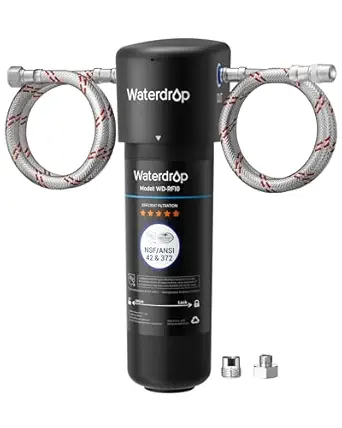 |
| Best Seller A high-volume bestseller chosen again and again | ICEPURE WFC5300A Under-Sink Filter |  |
iSpring CU-A4 Under-Sink Filter

| Purification Method | Mechanical Filtration, Chemical Absorption, Redox, and Ultrafiltration |
|---|---|
| Filter Life Cycle | 6 months |
| Capacity | 8000 gallons |
| Installation Type | Under Sink |
The iSpring CU-A4 is a tankless under-sink drinking water system that uses a four-stage filtration train—sediment, ultrafiltration membrane, KDF/GAC, and activated carbon—to cut chlorine, heavy metals, odors, and very fine particles down to 0.01 microns while retaining beneficial minerals. It installs under the sink with push-to-connect fittings and includes a brushed nickel faucet so you get filtered water at the tap without a storage tank or wastewater. The hollow-fiber ultrafiltration membrane and KDF stage make this a practical choice for reducing contaminants common in well water, and filter cartridges are twist-on/twist-off for straightforward replacement. Expect a nominal filter life of roughly 6 to 12 months depending on water quality, and note that this is not a reverse-osmosis system so it will not lower total dissolved solids. For households wanting high particulate and metal reduction without the complexity or water loss of RO, this system provides effective, low-maintenance filtration at the point of use.
Best for: Buyers who want robust particulate, chlorine, and heavy-metal reduction from a compact, easy-to-maintain under-sink system for everyday drinking and cooking water, especially where well water contaminants are a concern.
Less Ideal for: Those who need aggressive dissolved solids reduction or very low-ppm drinking water should choose a reverse-osmosis system instead.
- 4-stage filtration including 0.01μm ultrafiltration membrane for very fine particle and bacteria reduction
- Tankless design with no wastewater or storage tank simplifies installation and saves under-sink space
- Push-to-connect fittings and twist-on/twist-off cartridges make installation and filter changes user-friendly
- Includes a dedicated brushed nickel faucet so filtered water is available at the sink without modifying the main faucet
- Not a reverse osmosis system so it does not reduce TDS or mineral content
- Filter life depends on source water quality and may require replacements every 6 to 12 months
Verdict: A compact, tankless four-stage ultrafiltration system that delivers high particulate and metal reduction without wastewater, ideal for homeowners wanting strong well-water filtration without RO.
APEC Water ROES-50

| Purification Method | Reverse Osmosis |
|---|---|
| Filtration Stages | 5-Stage |
| Capacity | 50 gallons |
| Operating Pressure Range | 40-85 psi |
| Supported Water TDS Level Maximum (PPM) | 2000 |
The APEC ROES-50 is a five-stage under-sink reverse osmosis system designed to deliver very pure, great-tasting drinking water at about 50 gallons per day. It combines prefilters, an RO membrane and post-filter to reduce chlorine, lead, arsenic, fluoride, PFAS and many other impurities, and arrives with a storage tank and brushed nickel faucet for a complete installation. The system uses quick-connection fittings and color-coded tubing to make DIY installation straightforward for anyone comfortable with basic under-sink plumbing, and filters are sized for long service intervals so routine maintenance is infrequent. Performance-focused buyers will appreciate the WQA/NSF-certified construction and the system's ability to protect against microplastics and heavy metals common in well water. Important limitations are normal for RO units: it requires adequate feed pressure and a drain for wastewater, it produces waste water during purification, and the membrane and some filters need occasional replacement based on feed water quality.
Best for: Homeowners with performance-first priorities who need high contaminant rejection for drinking water from a private well and who are willing to install and maintain an RO system.
Less Ideal for: People who cannot provide adequate feed pressure or a drain connection under the sink, or those who prefer zero-waste filtration methods.
- Five-stage filtration removes a wide range of contaminants including heavy metals, fluoride, chlorine and PFAS
- Certified construction (WQA/NSF referenced) for reliable contaminant rejection
- Includes tank, faucet and installation kit for a complete under-sink setup
- Quick-connect fittings and color-coded tubing simplify DIY installation and service
- Long filter life cycles reduce frequency of replacements
- Produces wastewater during operation due to reverse osmosis process
- Requires sufficient water pressure and a nearby drain for proper operation
Verdict: Choose the ROES-50 if you want a proven, high-rejection under-sink RO system that delivers very pure drinking water suited to well water contaminants.
CuZn UC-200 Under Sink Filter

| Model Number | UC-200 |
|---|---|
| Included Components | Stainless Steel Connection Hose |
| Material Type | NSF Approved Material Components |
| Filter Life | Up to 5 years / 50,000 gallons |
| Certifications | NSF/ANSI 42 & 372 |
The CuZn UC-200 is an under-sink inline filter built for low-maintenance, long-term use. It uses a three-stage blend of micro sediment membrane, KDF-55 media and coconut shell carbon to reduce chlorine, lead, PFAS/PFOA, microplastics and unpleasant tastes and odors while leaving beneficial minerals in the water. Installation is designed to be DIY-friendly with a stainless steel connection hose and direct connect fittings so you can mount it under a kitchen or bathroom sink without drilling a new faucet. The standout feature is its rated service life — up to five years or roughly 50,000 gallons depending on water quality — which cuts replacement frequency and ongoing cost compared with typical 6-month cartridges. Limitations: it does not lower total dissolved solids so it will not replace a reverse osmosis system for hard water or TDS concerns, and real-world lifespan depends heavily on well water sediment and contaminant load so prefiltration or periodic checks may be needed for heavy sediment conditions.
Best for: Buyers looking to minimize maintenance and replacement cost while improving well or municipal tap water taste and common contaminants will appreciate this long-life under-sink option.
Less Ideal for: Homes that need significant TDS reduction, demineralization, or dedicated removal of very high sediment loads should consider a reverse osmosis system or prefilter before this unit.
- Very long rated filter life up to five years or ~50,000 gallons
- Reduces chlorine, lead, PFAS/PFOA and improves taste and odors
- Three-stage media blend (micro sediment, KDF-55, coconut shell carbon) for broad contaminant targeting
- Direct-connect under-sink installation with included stainless steel connection hose
- Does not reduce total dissolved solids (TDS) so not a substitute for reverse osmosis
- Filter lifespan will vary with incoming water quality and heavy sediment can shorten service life
Verdict: Choose the UC-200 if you want a low-maintenance under-sink filter that meaningfully reduces common contaminants and runs for years between cartridge changes.
Amazon Basics Under-Sink Water Filter

| Purification Method | Activated Carbon |
|---|---|
| Installation Type | Under Sink |
| Capacity | 11000 gallons |
| Supported Water TDS Level Maximum (PPM) | 500 |
This Amazon Basics under-sink filter is a simple, manual activated-carbon system designed to reduce chlorine, bad taste, and odor for typical household cold-water lines. It installs directly to standard 3/8" or 1/2" cold water feeds using the included push-to-connect fittings and a twist-and-lock cartridge, so most homeowners can fit it under a sink without cutting pipes or needing electricity. The unit is rated for up to 11,000 gallons or 12 months of service on municipal water and uses a polypropylene housing with a carbon block cartridge. Practical benefits include fast installation, a low-maintenance single cartridge swap, and NSF/ANSI 42 and 372 certifications for material safety and chlorine reduction. Important limitations for well-water buyers: the filter targets chlorine, taste, and odor and does not address common well-water issues such as sediment, iron, hardness, or bacteria, so it is not a substitute for multi-stage or microbial-capable systems. For simple chlorine and taste improvement on a tight budget this is straightforward, but it is limited in contaminant scope for well water applications.
Best for: Buyers who need an inexpensive, easy-to-install under-sink filter to improve chlorine taste and odor on a tight budget and prefer a low-maintenance single-cartridge solution.
Less Ideal for: Homes on untreated well water with sediment, iron, hardness, or microbial concerns should choose a multi-stage filtration system or a dedicated well-water treatment solution instead.
- NSF/ANSI 42 and 372 certified for chlorine reduction and material safety
- Twist-and-lock cartridge and push-to-connect fittings for quick tool-free installation and replacement
- High rated capacity of 11,000 gallons or 12 months between changes under typical municipal use
- Includes necessary fittings and hoses for direct connection to standard sink feed valves
- Designed for chlorine, taste, and odor only and does not remove sediment, iron, hardness, or bacteria common in well water
- Manual system with no additional filtration stages or UV/disinfection capability
Verdict: A very affordable, easy-to-install under-sink carbon filter that improves chlorine taste and odor but is not engineered for well-water contaminants.
iSpring RCC7AK-BN RO System

| Purification Method | Reverse Osmosis, Alkaline, Activated Carbon, Carbon block |
|---|---|
| Power Source | No Power Needed |
| Maximum Flow Rate | 284 liters_per_day |
| Operating Pressure Range | 70 psi |
| Filter Life Cycle | 6 months |
The iSpring RCC7AK-BN is a six-stage under-sink reverse osmosis system designed to deliver very low-TDS drinking water with a mineral boost stage to restore balanced pH and taste. It is typically installed under a kitchen sink and feeds a dedicated brushed-nickel faucet; the top-mounted fastener lets you install the faucet from above without reaching beneath the sink. The system uses sediment, carbon, carbon block, RO membrane and an alkaline remineralization stage plus a transparent first-stage housing so you can visually check the sediment filter. It is NSF/ANSI 58 certified for the full system, operates without electricity, and offers push-to-connect fittings and color-coded tubing to simplify DIY installation. For well-water use the strong contaminant reduction (including lead, fluoride, and PFAS) and clear housing help with routine maintenance, but the system requires regular filter and membrane replacement on manufacturer intervals and a storage tank adds occasional maintenance steps. Expect steady, reliable performance when filters are kept current and the unit is installed with adequate feed pressure.
Best for: Buyers who prioritize proven, certified contaminant removal and consistent long-term performance for household drinking water, especially those willing to perform scheduled filter maintenance.
Less Ideal for: People who want a zero-maintenance, instant-flow faucet solution or those unable to perform occasional filter changes and tank maintenance should consider simpler point-of-use options instead.
- Certified full-system NSF/ANSI 58 validation for reliable contaminant reduction
- Six-stage filtration including RO membrane plus alkaline remineralization for improved taste
- Transparent first-stage housing for easy visual monitoring of sediment buildup
- No electricity required and push-to-connect fittings for straightforward DIY installation
- Requires periodic filter and RO membrane replacements which add ongoing maintenance tasks
- Includes a storage tank so treated water is not instantaneous flow-through
Verdict: Choose the RCC7AK-BN when you need a certified, workhorse under-sink RO system that delivers consistent, well-suited filtration for well water when maintained on schedule.
Waterdrop WD-10UA Under Sink Filter

| Purification Method | Activated Carbon |
|---|---|
| Installation Type | Under Sink |
| Maximum Flow Rate | 2.5 gpm |
| Filter Life Cycle | 1 years |
| Supported Water TDS Level Maximum (PPM) | 700 |
The Waterdrop WD-10UA is a compact under-sink activated carbon system built for straightforward cold municipal water filtration and quick cartridge swaps. It connects to standard 3/8" or 1/2" cold water feeds with included fittings and uses a twist-and-lock cartridge that the brand rates for about 12 months of household use. The system advertises NSF/ANSI 42 and 372 components and targets contaminants such as chlorine, lead, PFAS/PFOA, and bad taste and odor while preserving beneficial dissolved minerals. Installation is tool-light thanks to push-to-connect fittings and a small footprint that fits under most cabinets. Practical benefits include a decent flow (manufacturer full-flow measured at 0.75 gpm and a 3/8" outlet claimed at 1.33 gpm) and an inexpensive replacement filter option. Important limitations: the unit is explicitly designed for municipal cold water only and is not suitable for well water or hot water, so it does not address microbiological contaminants common in wells and it lacks ultrafiltration or sediment-specific stages that some well users require.
Best for: Buyers who prioritize an easy-to-install, certified under-sink carbon filter for municipal tap water and who value clear social proof and risk reduction from NSF-verified components.
Less Ideal for: Anyone sourcing water from a private well or concerned about microbiological contamination, heavy sediment, or high TDS should choose a system with dedicated sediment, UF, or UV stages instead.
- NSF/ANSI 42 and 372 approved components for chlorine and aesthetic contaminant reduction
- Twist-and-lock cartridge and push-to-connect fittings enable quick tool-light installation and fast replacement
- Compact design fits under most sinks and includes fittings for 3/8" and 1/2" connections
- Preserves dissolved beneficial minerals while reducing lead, PFAS/PFOA, chlorine, taste and odor
- Not suitable for well water or hot water and does not protect against bacteria or viruses
- Single-stage activated carbon cartridge may not handle heavy sediment or extremely high TDS without pre-treatment
Verdict: Choose this unit if you need a compact, NSF-component verified under-sink carbon filter for municipal cold tap water that is simple to install and maintain.
ICEPURE WFC5300A Under-Sink Filter
| Filtration rating | 0.5 micron |
|---|---|
| Service life | 22,000 gallons / 3 years |
| Flow rate | 2.5 GPM |
| Certifications | IAPMO, WQA, NSF |
| Material type | Lead-free, food-grade |
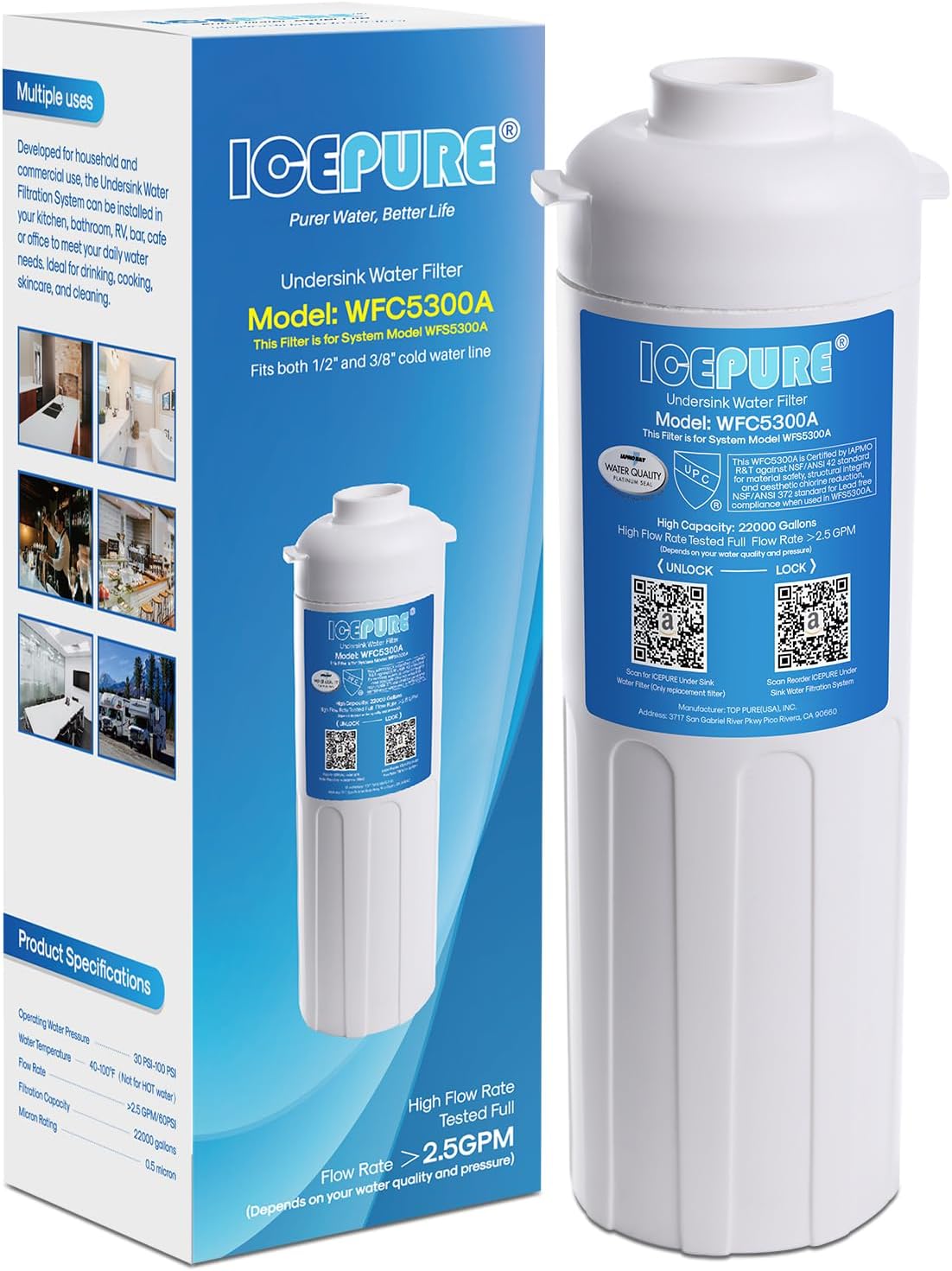
The ICEPURE WFC5300A is a single-cartridge under-sink replacement filter designed to deliver long life and broad contaminant reduction for household use. It uses a 0.5 micron element and is rated to treat about 22,000 gallons or roughly three years with typical municipal water, which reduces the frequency of changes and service visits. The cartridge is certified by IAPMO/WQA/NSF and meets several food-grade and safety standards, which supports its claims to reduce chlorine, heavy metals, rust, sediment, bad taste, and odor. Installation is intended to be user-friendly for homeowners and the product images and documentation point to simple under-sink mounting without professional help. Practical benefits include a compact footprint for tight under-sink spaces and a high advertised flow rate that should handle kitchen use without noticeable slowdown. Limitations to note for well water: the filter is positioned as a general-purpose cartridge and does not list specific certifications for iron, bacteria, or high turbidity well conditions, so pre-treatment or a specialized well water system may still be necessary.
Best for: Homeowners who prioritize tested, long-life filtration and want a low-maintenance, certified replacement cartridge for everyday drinking and cooking water.
Less Ideal for: Homes on untreated or heavily contaminated well water that need targeted iron, sulfur, or microbial treatment should consider purpose-built well-water systems or pre-treatment before relying on this cartridge.
- High rated service life of about 22,000 gallons (approximately 3 years) reduces replacement frequency
- Multiple external certifications (IAPMO, WQA, NSF) and food-grade material attest to safety and tested performance
- 0.5 micron filtration captures fine particles, rust, and many contaminants that affect taste and odor
- Compact cartridge shape fits most under-sink spaces and supports advertised 2.5 GPM flow rate
- Not specifically certified or described for common well-water issues like high iron, sulfur, or bacterial contamination
- Manufacturer compatibility is listed with ICEPURE WFS5300A systems only, which may limit direct interchangeability
Verdict: Choose this cartridge if you want a certified, long-life under-sink replacement that minimizes filter changes for everyday kitchen water.
Choosing the Right Under-Sink Water Filter for Well Water: Key Factors to Consider
Contaminant Coverage
Different wells present different problems. Some contain high sediment loads, others have dissolved iron or manganese, and some carry hydrogen sulfide that causes a rotten-egg odor. Microbial contamination is possible in certain systems, and volatile organic compounds can occur near agricultural or industrial areas.
You should choose a system whose validated reduction claims match the contaminants in your well water. Verify lab results or third-party test data when available, and consider multi-stage systems that combine sediment prefiltration, targeted media for iron or sulfur, and an activated carbon stage for taste and VOCs.
Flow Rate and Household Demand
Under-sink filters serve a single tap and must preserve enough flow for expected kitchen use. Some high-efficiency cartridges restrict flow significantly as they load with contaminants, which can make rinsing and filling tasks slow.
Look for published flow rates at realistic pressure levels and check how flow changes over cartridge life. If your household frequently fills pitchers or runs dishwashers nearby, choose a system with higher initial flow and proven flow retention to avoid performance frustration.
Filter Capacity and Replacement Frequency
Cartridge capacity determines how often you must replace media, which affects both long-term cost and convenience. High-sediment wells will shorten cartridge life, forcing more frequent changes and raising operational cost.
Assess replacement interval estimates in gallons and consider buying spare cartridges if your water has heavy loads. Systems that offer larger-capacity sediment stages or modular prefilters can extend life of downstream media and reduce total replacement frequency.
Installation and Space Requirements
Under-sink space is limited and plumbing layouts vary. Some systems are compact and mount to the cabinet wall, while others require significant clearance for multiple cartridges and tubing.
Measure available cabinet space and review mounting options before choosing. Consider whether you want a quick-connect plumbing interface or prefer systems that integrate with existing shutoff valves. Simpler installations reduce the chance of leaks and make future servicing easier.
Maintenance, Parts, and Serviceability
Routine maintenance includes cartridge changes, occasional O-ring replacement, and leak-checking. Systems that use common cartridge sizes and widely available consumables simplify upkeep and lower long-term ownership hassle.
Check how intuitive the filter-change process is, whether cartridges have clear life indicators, and if replacement parts are sold through multiple channels. Systems with tool-free access or twist-off housings make do-it-yourself maintenance faster and less error-prone.
Evidence and Certification
Claims are only useful when supported by data. Third-party test reports or independent certifications give confidence in stated contaminant reductions and capacity numbers.
While not every well-focused under-sink system will have broad certification, prioritize options with documented lab testing for the contaminants you care about. Ask for test reports that match the media configuration you will install and watch for disclaimers about specific contaminant forms.
Common Well Water Contaminants and How Under-Sink Filters Address Them
Well water can contain a mix of physical and dissolved contaminants that affect taste, safety, and plumbing. Sediment and suspended particles are typically removed with depth or pleated sediment cartridges placed as a first stage to protect downstream media.
Dissolved iron and manganese require media that oxidizes and traps those ions or specialized resin stages. Hydrogen sulfide is often tackled with catalytic carbon or advanced oxidation media. Activated carbon is effective for many organic taste and odor compounds and reduces chlorine where municipal blending occurs. Microbial risks require either validated microbiological barriers or a point-of-use disinfection step; not all under-sink filters are designed for reliable bacteria or virus removal.
- Sediment prefilters protect downstream stages and extend cartridge life
- Carbon stages improve taste and remove many organic contaminants
- Specialized media are needed for iron, manganese, and hydrogen sulfide
- Microbial protection may need separate validation or disinfection
Testing Your Well Before Buying
Before selecting an under-sink filter, obtain a water test that shows levels of common well contaminants, including iron, manganese, hardness, pH, and any detected volatile organics or coliform bacteria. Local health departments or certified private labs can provide a breakdown that lets you match filter capabilities to actual needs.
Testing clarifies whether you need a single under-sink point-of-use solution for drinking water or a broader approach such as whole-house pretreatment. Use the test results to prioritize which contaminant-reduction stages are necessary and to estimate cartridge life given your water quality.
- Order a comprehensive test that lists contaminant concentrations
- Use results to select targeted media and predict replacement intervals
- Retest after installation to verify system performance
Installation Tips for Under-Sink Systems on Well Water
Plan the plumbing route, space for replacement cartridges, and whether you need additional shutoff valves or a dedicated faucet. Install a clear sediment prefilter if your well has notable particulate; that stage can be changed frequently without affecting the rest of the system. Securely mount housings to the cabinet wall to prevent stress on fittings.
Consider adding a pressure regulator or bleed valve if your system will see pressure spikes. Follow the manufacturer torque and sealing instructions for threaded connections, and use food-grade tubing for potable runs. If you are not comfortable with plumbing work, hire a licensed installer, especially when integrating bacteriostatic or disinfecting stages.
- Leave space for cartridge removal and replacement
- Install sediment prefilter upstream to extend media life
- Use new shutoff valves and verify all connections for leaks
Extending Cartridge Life on High-Load Wells
Wells with heavy sediment or iron will shorten cartridge life. You can extend service intervals by adding a larger-capacity sediment stage or a separate backwashing filter ahead of the under-sink system if whole-house treatment is feasible. Flushing and periodic visual checks of sediment housings help detect loading before taste or flow problems develop.
Regular maintenance scheduling and keeping spare cartridges on hand reduce downtime. Track gallons used if the manufacturer provides capacity figures, and adjust replacement cadence based on observed performance rather than strictly on calendar intervals.
- Use larger-capacity sediment prefilters where possible
- Monitor flow and taste to catch clogging early
- Keep spare cartridges and maintenance tools accessible
When to Consider Point-of-Use Disinfection
If your well test shows coliform bacteria or other microbial concerns, an under-sink filter alone may not be sufficient. Some point-of-use options include validated microbiological reduction stages, but others rely on upstream disinfection or whole-house UV systems. Consider a disinfection step if the well is susceptible to surface water intrusion or if bacteriological tests are intermittently positive.
A combined approach—physical filtration for particulates and carbon plus a verified disinfection method—gives the broadest protection for drinking water. Confirm that any microbial-reduction claim includes appropriate testing data for the specific microbes of concern.
- Validate microbial claims with lab reports
- Combine filtration with disinfection when bacteria are detected
- Consider whole-house UV if contamination risk is persistent
How We Chose the Best Under-Sink Water Filter for Well Water
We prioritized systems that address the contaminants and service realities unique to private wells. Our selection filters focused on contaminant removal breadth, demonstrated capacity for common well water issues, and the physical compatibility of under-sink installations. We favored systems with clear third-party test data or manufacturer-stated performance for specific contaminants such as sediment, iron, hydrogen sulfide, chlorine (where present), volatile organic compounds, and microbial concerns when applicable. Practical considerations shaped the list: flow rate retention under typical kitchen faucet demand, ease and cost of filter changes, and the availability of replaceable cartridges with clear life ratings. Installation simplicity and durable fittings were required for inclusion, as many well owners install or maintain systems themselves. We excluded single-stage faucet-mounted units and systems intended only for municipal or soft-water conditions without well-focused testing. Systems lacking replaceable-media options or sufficient performance claims were also omitted. Overall, the editorial filters emphasized verifiable contaminant reduction, serviceability for homeowners, and hydraulic performance that preserves usable sink flow while delivering treated water.
Our full evaluation process is outlined in our review methodology.
FAQ
Can an under-sink filter remove iron from well water?
Some under-sink systems can reduce dissolved iron, but effectiveness depends on iron form and concentration. Look for media specifically rated for iron reduction and consult your water test to determine whether a point-of-use stage is appropriate or whether whole-house pretreatment is needed.
How often do I need to replace under-sink filter cartridges for well water?
Replacement frequency depends on contaminant load, cartridge capacity, and household use. High-sediment wells may require monthly changes to sediment stages, while carbon or specialty cartridges might last several months based on gallon ratings. Monitor flow and taste and follow manufacturer capacity guidelines.
Is an under-sink filter enough if my well shows bacterial contamination?
Not always. Some under-sink filters include validated microbiological barriers, but many do not. If tests show bacteria, consider a certified point-of-use disinfection stage or whole-house UV treatment and retest after remediation.
Will an under-sink filter affect faucet water pressure?
All point-of-use filters introduce some flow restriction. Systems with larger cartridges or high-flow designs retain pressure better. Expect slight pressure reduction at peak demand, and choose a system with published flow rates that match your household needs.
Do under-sink filters require special tools to replace cartridges?
Many systems are designed for tool-free cartridge changes or include a simple wrench for housing removal. Systems with threaded fittings or integrated shutoffs may need basic tools. Check the service process before purchase if you prefer minimal tooling.
Final Verdict
For well water, prioritize an under-sink filter that targets the specific contaminants your test reveals. Balance contaminant coverage with flow-rate performance and cartridge capacity so the unit delivers usable tap flow without frequent service interruptions. Plan for easy access and parts availability to keep maintenance straightforward. Choose systems that offer validated reduction data for your key concerns, and be prepared to combine point-of-use filtration with whole-house pretreatment or disinfection when needed. With the right balance of filtration stages and serviceability, an under-sink water filter can reliably deliver safer, better-tasting drinking water from a private well.