
Note: This article contains affiliate links. If you click on these links and make a purchase, we may earn a small commission at no extra cost to you. This helps support our research and content. Read our full affiliate disclosure here.
If you work with thick fabrics, layered cushions, or heavy upholstery materials, a standard domestic machine often struggles to deliver even feeding and robust stitches. A walking foot sewing machine for upholstery is designed to move multiple fabric layers in sync, reducing puckering and skipped stitches so your seams stay strong under stress. This guide gathers the top shortlisted options for upholstery use and explains the practical factors that separate machines that handle heavy canvas, leatherette, and layered foam from those that do not. Below we summarize the key decision points you should weigh, then present the six best walking foot sewing machines for upholstery based on those criteria, with clear notes on what each type of buyer should prioritize.
Top Picks at a Glance
| Best Overall The best all-around choice for most situations | CONSEW P1206RB Walking Foot |  |
| Best Quality Built to a higher standard if you want something more solid | JUKI DNU-1541S Walking-Foot |  |
| Best Value The sweet spot between price and what you get | Family Sew FS-388 Walking Foot |  |
| Best Budget The cheapest option that still gets the job done reliably | YEQIN YQ-516 Walking Foot Sewing Machine |  |
| Top Rated A top-rated pick with lots of positive feedback | JUKI DU-1181 Walking Foot |  |
| Most Popular A crowd favorite that many people choose with confidence | Consew 206RB-5 Walking Foot Sewing Machine |  |
CONSEW P1206RB Walking Foot

| Power Source | AC |
|---|---|
| Speed, Max. (S.P.M.) | 3000 |
| Presser Foot Lift | By Hand 5/16" (8 mm) / By Knee 5/8" (16 mm) |
| Stitch Length, Max | 3.6 s.p.i. (7 mm) |
The CONSEW P1206RB is a purpose-built industrial walking foot machine for upholstery, leather, canvas and other heavy fabrics. It uses a needle feed and walking foot to feed multiple layers evenly while the drop feed and locking stitch produce durable seams, and an oil pump system with adjustable flow keeps internal parts lubricated for long runs. Typical use is furniture, automotive and marine upholstery or heavy bag and canvas work where consistent long stitches and material control matter; adjustable presser foot lift and stitch length let you handle thick layers and multiple passes. The included features list practical shop-ready parts such as a large horizontal hook, side-loaded bobbin, adjustable thread tension and a servo motor option for quieter, controllable speed compared with clutch motors. Expect a robust, noisy industrial machine that ships unassembled in multiple boxes and requires bench/table setup and some mechanical familiarity to install and oil correctly.
Best for: Buyers who need a tough, workshop-grade machine for regular upholstery, leather or canvas projects and value consistent feeding and long-run reliability.
Less Ideal for: Casual sewists, occasional hobbyists, or anyone who needs a compact, quiet domestic machine for light fabric work.
- Walking foot and needle feed provide reliable feeding of multiple heavy layers
- Oil pump lubrication with adjustable flow for continuous shop use
- Adjustable presser foot lift and stitch length to handle thick materials
- Large horizontal hook and side-loaded bobbin simplify heavy-thread handling
- Arrives unassembled in three boxes and requires setup and mechanical know-how
- Industrial noise level and size make it unsuitable for quiet home studios
Verdict: Choose the CONSEW P1206RB when you need a rugged, factory-quality walking foot that handles upholstery and heavy materials reliably in a workshop setting.
JUKI DNU-1541S Walking-Foot
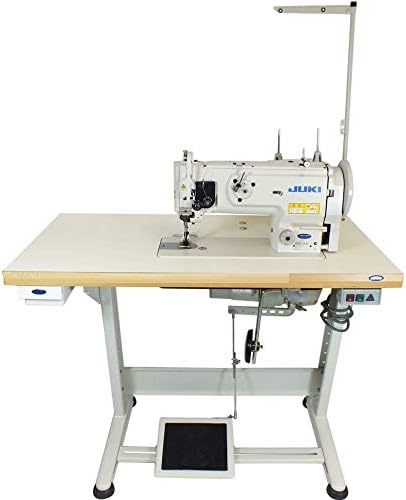
| Power Source | Corded Electric |
|---|---|
| Input Voltage | 110 volts_of_alternating_current |
| Speed, Max (S.P.M.) | 2500 |
| Needle | 135 x 17 and 135 x 16 for leather |
The JUKI DNU-1541S is a purpose-built industrial walking-foot lockstitch machine aimed at upholstery and heavy-material work; it pairs a unison feed mechanism with a large double-capacity hook to handle layered materials like leather, vinyl, canvas and coated fabrics. Typical use is shop or serious DIY upholstery where you need steady, high-volume stitching: the machine runs on 110V corded power, is rated up to 2500 S.P.M., and includes a quiet DC servo motor and a table so it arrives ready for installation. Notable practical features are the walking (needle) feed that controls heavy-stack movement, compatibility with leather needles, a long stitch length and a high-clearance presser foot to accommodate bulky seams, plus included accessories like a bobbin winder, knee lifter and lamp. Trade-offs are its weight and size which require a dedicated workspace, and that professional assembly or adjustment is recommended to get the best stitch performance. For upholstery shops or hobbyists tackling heavy materials, the DNU-1541S delivers robust, repeatable stitches and industrial-level durability.
Best for: Upholstery professionals and serious hobbyists who need a factory-quality walking-foot machine that can handle leather, vinyl, canvas and other heavy materials reliably in a shop environment.
Less Ideal for: Casual home sewers or users without a stable workspace and basic machine setup skills should consider smaller, lighter machines instead.
- Unison walking-foot feed designed for consistent feeding of multiple heavy layers
- Double-capacity hook for longer runs between bobbin changes
- Includes industrial-grade DC servo motor and table for immediate shop setup
- High maximum speed (up to 2500 S.P.M.) suitable for production work
- Very heavy and large, requiring a dedicated workspace and likely professional setup
- Assembly or tuning may be needed to achieve optimal stitch quality
Verdict: Choose the DNU-1541S if you need a robust, production-capable walking-foot machine that reliably stitches heavy upholstery materials.
Family Sew FS-388 Walking Foot

| Motor power | 150W 1.5A |
|---|---|
| Speed | 800 SPM |
| Stitch capability | Straight stitch and 5mm zigzag |
| Needle type | Upholstery needles 135×17 (sizes 18-22) |
The FS-388 is a portable, heavy-duty walking foot machine built to handle upholstery, denim, canvas and leather in a small workshop setting. It delivers up to 800 stitches per minute using a 150W motor and a dual belt drive that reduces slipping, while the high-lift walking foot and up to 12 mm foot clearance make it easier to feed thick layers. The machine supports standard upholstery needles and a 5mm zigzag for finishing, and its geared pulley system and spring-loaded reverse add control when stitching tough seams. At about 35 pounds it is more compact than industrial machines but still solidly built from metal parts, so it fits workspaces that need industrial results without a factory-sized footprint. Downsides are that it is a single-purpose straight/zigzag walking-foot machine without the multiple decorative or computerized stitch options of domestic machines, and setup or maintenance can be more hands-on than consumer models.
Best for: Buyers who prioritize durable, workshop-capable equipment for frequent upholstery or heavy-fabric projects and want a compact machine that produces industrial-quality seams.
Less Ideal for: If you need a multi-function home sewing machine with many decorative stitches, embroidery, or computer controls this focused walking-foot unit is not the right choice.
- Robust all-metal construction suitable for heavy materials
- High-lift walking foot and up to 12 mm clearance for thick upholstery layers
- Powerful 150W motor and dual belt drive for steady, non-slipping stitching
- Supports standard upholstery needles and 5mm zigzag for functional upholstery work
- Limited to straight stitch and zigzag functions so it lacks decorative/computerized stitch variety
- Heavier and more industrial in feel than typical home machines, which may require more maintenance
Verdict: Choose the FS-388 when you want a compact, workshop-grade walking foot machine that delivers reliable, heavy-duty upholstery stitching.
YEQIN YQ-516 Walking Foot Sewing Machine

| Power Source | Corded Electric |
|---|---|
| Material | Metal |
The YEQIN YQ-516 is a metal-bodied walking-foot machine built for sewing and repairing thick materials such as leather, canvas, and jeans. It supports both manual and electric use and is typically used for upholstery, heavy-duty repairs, and DIY projects where layered fabrics need steady feed. The walking foot helps move multiple layers evenly, and the all-metal construction suggests durability for workshop use. Because the unit is pre-tested, setup should be straightforward for someone familiar with industrial-style machines, and the portable form factor makes it easy to move between workspaces. Important limitations are the lack of detailed speed, stitch length, or needle system specs and the heavier weight, which makes it less convenient for frequent transport. There is also no mention of included accessories or a factory-specified warranty in the listing, so buyers should plan for basic needles, threads, and maintenance supplies. For budget-minded buyers who need a simple, robust walking-foot solution, this model covers core heavy-material sewing without extra consumer-focused features.
Best for: Buyers seeking an affordable, no-frills walking-foot machine for upholstery, leather, and canvas repairs who prioritize durability and straightforward heavy-material performance.
Less Ideal for: Users who need a lightweight travel machine, precise stitch controls, or a model with detailed factory specifications and included accessory sets.
- Walking foot design for even feeding of thick or layered materials
- Metal construction that supports heavy-duty sewing tasks
- Supports both manual and electric operation for flexible use
- Pre-tested before shipment for basic out-of-box reliability
- Key specifications like stitch length, speed, and needle type are not listed
- Relatively heavy, which reduces portability for frequent moves
Verdict: A cost-conscious, metal walking-foot machine that delivers solid performance on upholstery and heavy fabrics without extra consumer features.
JUKI DU-1181 Walking Foot

| Power Source | Corded Electric |
|---|---|
| Max. sewing speed | 2,000 RPM |
| Max. stitch length | 9MM |
| Presser foot lift | By knee 15MM |
The JUKI DU-1181 is a heavy-duty single-needle walking-foot lockstitch machine supplied with a knockdown table and a 3/4 HP electronic DC servo motor, intended for sewing thick or multilayered materials like upholstery. Its top-and-bottom feed mechanism and double-capacity hook deliver steady, even feeding through hard-to-handle fabrics, and the automatic lubrication system reduces day-to-day maintenance. The unit ships with a servo motor rated up to 3300 RPM (machine max sewing speed listed at 2,000 RPM), a knee-operated presser foot lift, and accessories including a drawer, belt, lamp and basic tools, which makes it ready for workshop setup after assembly. Practical strengths are consistent stitch quality on heavy materials and serviceable factory lubrication for longer life, but buyers should expect professional assembly and setup to fully tune the feed cams and adjustments. The machine is large and built like an industrial unit, so it requires a dedicated workspace and a user comfortable with industrial sewing equipment.
Best for: Upholstery shops or serious DIYers who prioritize a reliable, factory-quality walking-feed machine for consistent seams on heavy fabrics and multilayer projects.
Less Ideal for: Casual home sewers or those who need a small, portable machine for occasional light fabric work should look at lighter consumer models instead.
- Top-and-bottom feed walking mechanism for smooth, even feeding of thick or multilayered materials
- Comes complete with KD stand, servo motor, lamp and basic accessories for workshop setup
- Automatic lubrication system to improve maintainability and component life
- Double-capacity hook and knee-operated presser foot lift for industrial sewing workflows
- Requires professional-level assembly and tuning of feed cams for optimal performance
- Heavy industrial unit that needs a dedicated workspace and handling equipment
Verdict: Buy this JUKI if you need a workshop-grade walking-foot machine that reliably feeds heavy upholstery fabrics and reduces maintenance with automatic lubrication.
Consew 206RB-5 Walking Foot Sewing Machine

| Power Source | Corded Electric |
|---|
The Consew 206RB-5 is a commercial-grade walking-foot sewing machine built for heavy materials like upholstery, leather, canvas, and tarpaulins. It uses a compound feed (walking foot) and adjustable walking motion height to feed thick or multiple-layered material evenly, and offers a long maximum stitch length and a high presser-foot lift to handle bulky seams. The unit ships as a complete setup with a servo motor, tabletop, stand, large bobbin, and hardware, so you can assemble a production-ready workstation; assembly is required. Practical benefits include consistent stitch quality on heavy goods, a large bobbin to reduce thread changes, and a high foot lift for thick stack sewing. Important limitations are its industrial size and weight, which demand a dedicated workspace and bench, and the machine is corded only with no cordless option. Instructional videos are available from the manufacturer, but buyers should expect a short learning curve if they are used to domestic machines.
Best for: Buyers who need a reliable, production-capable sewing machine for upholstery or leather projects and who prioritize consistent feeding and stitch quality over portability.
Less Ideal for: Hobbyists with limited space or casual sewists who need a lightweight, portable machine for occasional home use should consider smaller domestic models instead.
- Walking-foot compound feed for even feeding of heavy and layered materials
- Includes servo motor, tabletop, and stand for a ready workstation
- High presser-foot lift and long stitch length accommodate bulky seams
- Large bobbin reduces frequency of thread changes
- Designed for upholstery, leather, auto, marine, and canvas applications
- Heavy and large unit requires a dedicated workspace and assembly
- No cordless or battery option and limited portability
Verdict: Choose the Consew 206RB-5 when you need a factory-quality walking-foot machine that delivers consistent, heavy-duty performance for upholstery and leather work.
Choosing the Right Walking Foot Sewing Machine for Upholstery: Key Factors to Consider
Motor Power and Torque
A strong motor with high torque matters because upholstery projects often require stitching through stacked materials, dense batting, and heavy-faced fabrics. Higher torque reduces the chance of the needle stalling or bending when you encounter bulky seams, and it maintains consistent stitch length when feeding slows under resistance.
Consider machines with motors rated for continuous heavy use rather than light intermittent sewing. Look for specifications or descriptions that emphasize torque or heavy-duty operation, and pay attention to whether the motor is belt-driven with reinforced gearing, which typically tolerates tougher jobs better.
Feed System and Walking Foot Action
The feed system determines how evenly multiple layers move through the needle. A true walking foot lifts and advances the top fabric while the feed dog moves the bottom, syncing movement to prevent layer slippage, bunching, and skipped stitches.
For upholstery, evaluate how much vertical lift the presser foot offers and whether the walking action is adjustable. Machines with stronger, more positive walking mechanisms handle foam and multi-layer assemblies with less manual repositioning and fewer start-stop hassles.
Presser Foot Clearance and Adjustment
Large seams, mattress piping, and layered cushions need generous presser foot clearance and fine adjustment. If the machine cannot raise the presser foot high enough to accept bulky seams, you will struggle to maneuver thick assemblies and maintain consistent stitch placement.
Check that the machine offers multiple presser foot heights or an adjustable presser bar. A presser foot with a wide throat and the ability to swap in specialized feet for piping or topstitching increases versatility for upholstery tasks.
Needle System and Stitch Quality
Needle strength and the machine's ability to form tight, even stitches through heavy fabric are essential for durable upholstery seams. Strong needle clamps, compatibility with heavier needle sizes, and stable tension control contribute to consistent stitch formation.
Look for machines that accept a range of industrial or heavy-duty needle types and provide simple, reliable tension adjustments. Even stitch length and secure lockstitch formation reduce the risk of seam failure under load.
Durability, Serviceability, and Parts Availability
Upholstery work increases wear on mechanical linkages, feed dogs, and motors. Machines built with metal frames, robust gearbox components, and easily replaceable parts will last longer in a workshop environment.
Prioritize models with accessible service manuals, available replacement feet and drive components, and straightforward lubrication points. Machines that can be serviced locally or have straightforward user-service procedures minimize downtime and cost over the long term.
Setting Up Your Machine for Upholstery Work
Prepare your sewing area and machine before starting an upholstery project to reduce frustration and improve stitch quality. Use a stable work table that supports your material weight and prevents the machine from tipping or shifting when you pull large panels. Secure the fabric stack with clips rather than pins to avoid multiple punctures and distorted layers.
Upgrade to heavy-duty thread and needles appropriate for your fabric weight and test stitch settings on a scrap stack that mimics the final thickness. Mark seam lines and plan entry and exit points to avoid bulk buildup at corners. Consider adding an extension table or placing supportive foam under the workpiece to keep layers flat during feeding.
- Use a stable, level work surface sized for large panels
- Clip layers together and avoid excessive pinning
- Test stitch tensions and needle size on a realistic scrap stack
Common Attachments That Help with Upholstery
Several presser feet and accessories simplify tricky upholstery tasks. A walking foot is the baseline for multi-layer alignment, but additional feet for topstitching, piping, or blind hemming can speed work and improve consistency. A roller or roller-style presser foot helps feed slick faux leathers and coated fabrics without sticking.
Other useful hardware includes a high-clearance presser foot, a Teflon or nonstick foot for sticky surfaces, and an extension table that supports heavy panels. Using the right feed and needle combination with these attachments makes complex assemblies easier and reduces material waste.
- High-clearance presser foot for bulky seams
- Roller or nonstick foot for coated or sticky fabrics
- Extension table for supporting large panels
Thread, Needles, and Tension: Practical Tips
Select thread and needles rated for upholstery load, and change needle types when switching fabric families. Polyester-wrapped core or bonded nylon threads often provide the tensile strength needed for upholstery seams, while heavy-duty needle systems in larger sizes penetrate dense stacks more reliably.
Adjust tension gradually when moving from single-layer tests to full stacks, and always test on a mock-up that matches the final thickness. If stitches are looping on the underside, increase top tension or switch to a sharper needle; if the fabric puckers, reduce tension or increase presser foot pressure.
- Use bonded or heavy-duty thread types
- Increase needle size for thicker stacks
- Test tension on a stacked mock-up before sewing final seams
Maintenance and Long-Term Care for Frequent Use
Regular maintenance keeps performance consistent when you use a machine for upholstery work. Clean lint and fibers from the feed dog area more often than for light sewing, and re-lubricate moving parts according to the machine's service guidelines to prevent stiffness and wear.
Inspect the needle bar, presser foot assembly, and walking mechanism for play or wear after intensive projects, and replace consumables like needles and feed dogs on a schedule. Keep an inventory of common spare parts to avoid losing work time waiting for service.
- Clean lint from feed area frequently
- Follow scheduled lubrication and inspections
- Stock common replacement parts like needles and feed dogs
How We Chose the Best Walking Foot Sewing Machine for Upholstery
We focused on attributes that directly affect upholstery sewing performance and long-term workshop use. Our selection criteria emphasized motor torque and stitch consistency for penetrating thick layers, feed system reliability to prevent shifting in stacked materials, and presser foot range and adjustability so machines can accommodate bulky seams and varied fabrics. We also weighed build quality and serviceability because upholstery work accelerates wear on drive trains and feed dogs, and ease of threading and maintenance to keep downtime low during production or large projects. Exclusions: machines intended only for light garment sewing or purely decorative stitching were excluded. We did not consider single-purpose industrial heads lacking a walking foot or domestic machines without reinforced drives. Eligibility required a walking foot or equivalent alternating presser mechanism and the ability to handle heavy upholstery-weight materials. Concrete evaluation dimensions included motor torque and penetration, feed accuracy under multi-layer loads, presser foot clearance and adjustment range, stitch quality on heavy fabrics, and durability/serviceability for workshop use. These same dimensions guided scoring and placement in the list.
Our full evaluation process is outlined in our review methodology.
FAQ
Can a domestic walking foot machine handle upholstery projects?
Often yes, domestic walking foot machines can handle light to medium upholstery tasks if they have sufficient motor torque, high presser foot clearance, and accept heavier needles. For very thick stacks or continuous production, look for models rated for heavy-duty use.
What needle type should I use for foam and heavy fabrics?
Heavy-duty needles sized for upholstery or leather work are usually best. Choose a strong shank and a needle point type appropriate for the fabric face; for dense foams and layered stacks, a larger size with a reinforced shank reduces breakage.
How do I prevent puckering when sewing multiple layers?
Use a walking foot to synchronize fabric movement, increase presser foot lift for bulky seams, and test tension on a stacked sample. Clipping layers and using the correct needle and thread also reduce puckering.
Is it necessary to change feet when switching between leatherette and woven upholstery fabrics?
Usually yes. Leatherette or sticky-coated fabrics feed better with a roller or Teflon foot, while woven fabrics often sew well with a standard walking foot. Switching feet helps maintain consistent feed and stitch quality.
How often should I service a machine used for upholstery projects?
Frequency depends on workload, but heavy use merits more frequent maintenance. Clean the feed area and relubricate moving parts after prolonged projects, and inspect drive components regularly for wear to avoid unexpected failures.
Final Verdict
For upholstery work, prioritize machines with strong motor torque, a true walking feed, generous presser foot clearance, and a needle system that handles heavier sizes. These features directly affect how smoothly stacked materials feed and how durable the resulting seams will be. Balance feed accuracy against durability and serviceability based on whether you need a machine for occasional projects or regular workshop use. Choose a machine that matches the thickness and frequency of your upholstery work and plan for routine maintenance to keep it performing reliably.