
Note: This article contains affiliate links. If you click on these links and make a purchase, we may earn a small commission at no extra cost to you. This helps support our research and content. Read our full affiliate disclosure here.
If your home is on municipal supply, your water will usually be treated but can still carry chlorine taste, sediment, and trace contaminants that affect plumbing and appliances. Choosing the right whole-house water filter for city water reduces unpleasant tastes and odors, protects fixtures, and keeps flow rates high enough for everyday use. This guide shortlists the top performing whole-house systems tuned for municipal supplies and explains the practical tradeoffs you should weigh. Below we cover systems that handle typical city-water issues, plus the evaluation criteria—filtration performance, flow capacity, maintenance demands—that matter most when sizing a whole-house unit.
Top Picks at a Glance
| Best Overall The best all-around choice for most situations | A. O. Smith Whole House Filter AO-WH-Filter |  |
| Best Quality Built to a higher standard if you want something more solid | iSpring WGB32B-KDS Whole House Filter |  |
| Best Value The sweet spot between price and what you get | SimPure DB10P 10" Filter Housing |  |
| Best Budget The cheapest option that still gets the job done reliably | iFilters LWH-D 2-Stage Whole House Filter |  |
| Top Rated A top-rated pick with lots of positive feedback | iSpring WGB21B 2-Stage Whole House Filter |  |
| Most Popular A crowd favorite that many people choose with confidence | Waterdrop WHF21-PG Whole House Filter |  |
| Best Seller A high-volume bestseller chosen again and again | SimPure DB20P Whole House Filter Housing |  |
A. O. Smith Whole House Filter AO-WH-Filter

| Purification Method | Activated Carbon |
|---|---|
| Other Special Features | Chlorine Reduction, NSF/ANSI 42 Certified |
| Maximum Flow Rate | 7 gpm |
| Operating Pressure Range | 20-100 psi |
| Filter Life Cycle | 6 years / 600000 gallons |
The AO-WH-Filter is a whole-house activated carbon tank that reduces chlorine taste and odor across every tap in a home, making water better for drinking, cooking, showering, and bathing. It installs inline at the main supply and ships with a shut-off valve, nipple and hose adapter for a mostly DIY setup, though basic plumbing tools are recommended. Notable features include NSF/ANSI 42 certification for chlorine reduction, a high maximum flow rate of 7 gpm to support multi-fixture households, and a long service life rated at 600,000 gallons or six years before replacement. Because it uses activated carbon, the system improves smell and taste and can reduce some organics, but it does not remove hardness, iron, sulfur long-term, or significantly lower TDS. The fiberglass tank and manual operation make it low-maintenance and water-waste free compared with backwashing systems, but users with specific contaminant concerns or severe sulfur/iron issues will need additional treatments. For typical city-water households wanting a durable, low-effort way to remove chlorine, this unit is a practical choice.
Best for: Homeowners who want an easy, low-maintenance central filter to improve taste and smell of city water across the whole house without frequent cartridge changes.
Less Ideal for: Homes with high iron, sulfur, microbial contamination, or hard water that require softening or targeted removal should choose specialized or multi-stage treatment instead.
- NSF/ANSI 42 certified to reduce chlorine taste and odor
- Long filter life rated for 600,000 gallons or six years
- Supports up to 7 gallons per minute for multi-fixture households
- Includes shut-off valve and hose adapter for mostly DIY installation
- Does not require backwashing or produce wastewater during operation
- Does not remove water hardness, iron, or reliably treat sulfur issues
- Manual operation with limited contaminant scope means additional systems may be needed
Verdict: Choose this A. O. Smith whole-house carbon filter if you want a durable, low-effort way to remove chlorine taste and odor from city water throughout your home.
iSpring WGB32B-KDS Whole House Filter

| Capacity | 250000 gallons |
|---|---|
| Maximum Flow Rate | 15 gpm |
| Inlet / Outlet | 1 inch Female NPT |
| Operating Temperature | 40-100 ºF |
| Supported Water TDS Level Maximum (PPM) | 300 |
The iSpring WGB32B-KDS+WSP50ARB is a three-stage whole-house system that pairs a reusable spin-down auto-flush sediment pre-filter with carbon/KDF and anti-scale cartridges to protect plumbing and improve water taste. It installs on the main supply line with 1 inch female NPT connections and is sized to maintain flow up to 15 gpm, so it can handle typical city supply for most homes while filtering out chlorine, lead, mercury, hydrogen sulfide, visible particulates, and many chemical contaminants. The spin-down pre-filter and touchscreen auto-flush module make maintenance easier and extend cartridge life, while the large Siliphos anti-scale media helps inhibit scale and corrosion on pipes and appliances without removing beneficial minerals. Practical limitations include no softening action for hardness removal and indoor-only installation recommendations; homeowners wanting lower TDS or true soft water will need a separate water softener or RO system. Overall this unit is a solid performance-focused choice for city water that needs broad contaminant reduction and scale protection across the whole house.
Best for: Homeowners on municipal water who prioritize robust contaminant reduction and scale protection for the entire plumbing system and want a durable, performance-focused whole-house filter they can maintain themselves.
Less Ideal for: Buyers who need true water softening or TDS reduction built into the same unit should consider a dedicated softener or reverse osmosis solution instead.
- Three-stage filtration targets sediment, chlorine, heavy metals, odors, and many chemical contaminants
- Reusable spin-down pre-filter with touchscreen auto-flush reduces maintenance and extends cartridge life
- High-capacity anti-scale Siliphos media helps prevent scale and protects plumbing and appliances
- Maintains up to 15 gpm maximum flow rate suitable for whole-house city supply
- Does not soften water or remove total dissolved solids (TDS)
- Recommended for indoor installation and may need insulation or protection if placed outdoors
Verdict: Choose this system if you want a high-capacity, performance-oriented whole-house filter that reduces chlorine, heavy metals, sediments, and scale while keeping house-wide flow rates high.
SimPure DB10P 10" Filter Housing

| Compatible Filter Dimensions | 10" x 4.5" |
|---|---|
| Inlet/Outlet | 1" NPT Brass Port |
| Maximum Flow Rate | 20 gpm |
| Applicable Water Temperature | 5-38 ℃ (41-100 ℉) |
| Working Water Pressure Range | 15-90 PSI |
The SimPure DB10P is a single-stage 10" x 4.5" whole-house filter housing designed to act as a pre-filter for municipal or well water. It accepts standard 10" cartridges such as sediment or granular activated carbon to remove sand, dirt, chlorine taste and odor before water reaches downstream appliances. The housing is molded from food-grade polypropylene with brass 1" NPT inlet and outlet threads for durable plumbing connections, and it includes a heavy-duty mounting bracket, wrench, screws and a built-in red pressure-relief button to make cartridge changes easier. Rated up to 20 gpm and tested against NSF standards, it suits a main-line installation that needs simple, serviceable protection for water heaters, dishwashers and under-sink filters. Expect straightforward DIY installation but remember cartridges and any push fittings are sold separately and the unit requires enough clearance for replacement of the 10" filter. It is a practical, lower-complexity option for homeowners who want reliable pre-filtration without a multi-stage system.
Best for: Homeowners who want a simple, durable pre-filter to protect appliances and downstream filters on city water and prefer an easy-to-service, DIY-friendly solution.
Less Ideal for: People seeking a multi-stage purification system or a point-of-use drinking water filter with integrated cartridges and advanced contaminant removal should look elsewhere.
- Fits common 10" x 4.5" replacement cartridges for easy sourcing and customization
- 1" NPT brass inlet/outlet for secure, high-flow plumbing connections
- Includes mounting bracket, wrench and screws for plug-and-play installation
- Built-in red pressure-relief button simplifies cartridge changes and reduces mess
- Food-grade polypropylene housing rated to 20 gpm and tested against NSF standards
- Filter cartridges and any push fittings are not included so total system cost is higher
- Requires sufficient clearance for cartridge removal which can limit placement options
Verdict: Buy this if you want a rugged, easy-to-install 10" whole-house pre-filter housing that lets you choose standard sediment or carbon cartridges to protect city water plumbing and appliances.
iFilters LWH-D 2-Stage Whole House Filter

| Purification Method | Granular Activated Carbon, Sedimentation |
|---|---|
| Maximum Flow Rate | 3 gpm |
| Supported Water TDS Level Maximum (PPM) | 500 |
| Power Source | Manual/Gravity-fed |
| Installation Type | Under Sink |
The iFilters LWH-D is a compact two-stage whole-house filter designed to remove sediment, rust, and chlorine taste and odor at the point of entry. It pairs a multi-layer polypropylene sediment cartridge with a coconut-shell activated carbon stage to improve water clarity and smell for drinking, cooking, bathing, and laundry. Installation uses standard 3/4" NPT inlet/outlet ports, a pressure-relief button for easier cartridge changes, and clear housings that let you visually monitor filter condition. The system supports up to about 3 gpm and is intended for small to medium homes with typical municipal water; replacement filters are user-replaceable and are recommended about every six months depending on use and water quality. Limitations are that it does not reduce total dissolved solids and flow capacity is modest compared with larger whole-house units, so very large households or homes with high demand may see reduced flow. For buyers wanting straightforward sediment and chlorine reduction on a budget, it is a practical, no-frills point-of-entry option.
Best for: Homeowners on a budget who want straightforward reduction of sediment and chlorine issues throughout a small to medium city-water household without investing in large multi-stage systems.
Less Ideal for: Homes seeking TDS reduction, heavy-duty filtration for very large households, or higher flow capacities should consider more advanced or larger-capacity systems.
- Two-stage design combines depth sediment filtration with coconut-shell activated carbon for chlorine taste and odor reduction
- Clear housings allow easy visual inspection of filter condition
- Standard 3/4" NPT ports and integrated pressure-relief button simplify installation and filter changes
- Compact footprint suited for point-of-entry installation in small to medium homes
- Does not reduce total dissolved solids (TDS)
- Maximum flow rate of 3 gpm may be limiting for larger households or simultaneous high-demand use
Verdict: A budget-friendly, compact two-stage point-of-entry filter that meaningfully cuts sediment and chlorine taste and odor for small to medium city-water homes.
iSpring WGB21B 2-Stage Whole House Filter
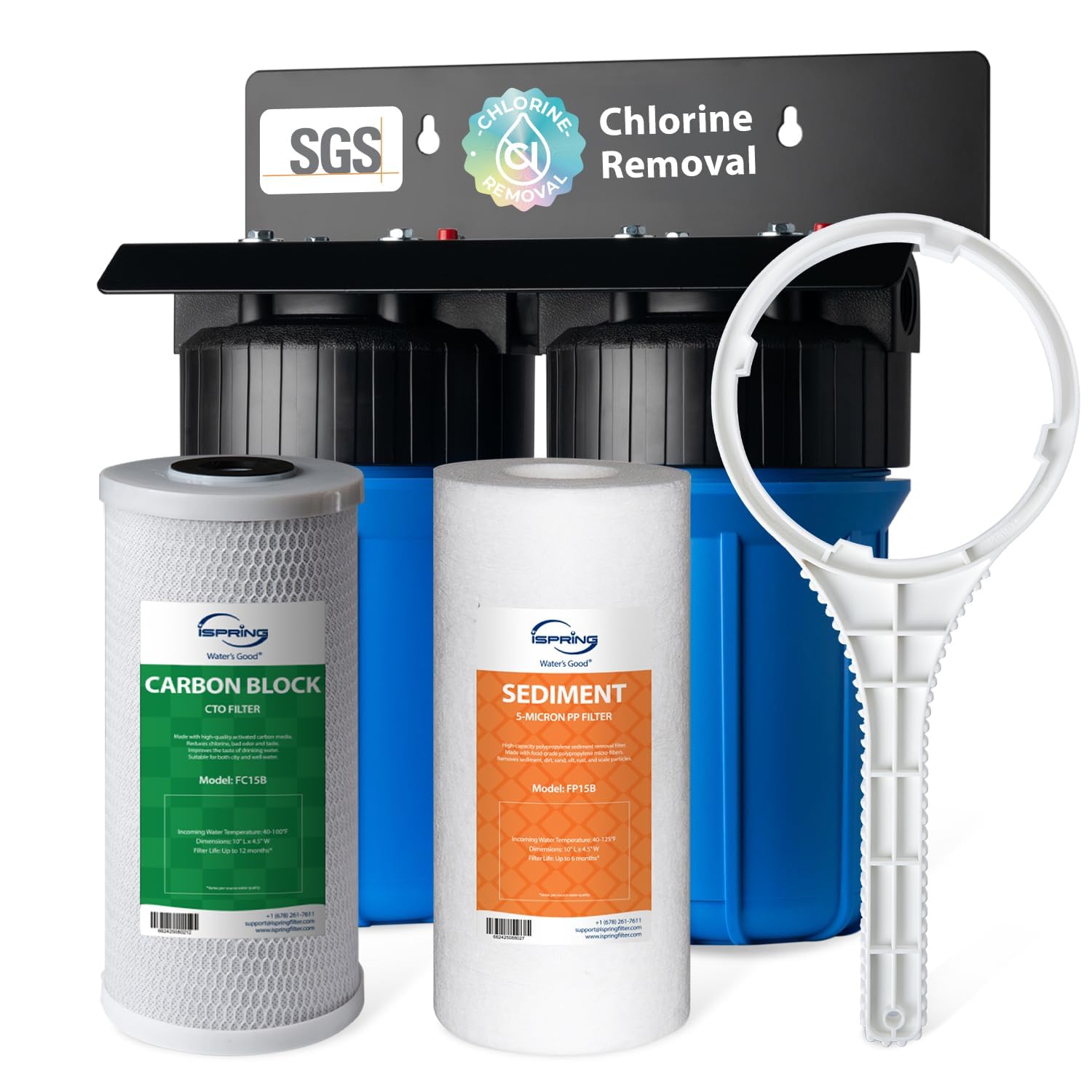
| Filter Life Cycle | 12 months |
|---|---|
| Maximum Flow Rate | 15 gpm |
| Operating Pressure Range | 25–80 psi |
| Operating Temperature | 40–100 °F |
| Inlet / Outlet | 1 inch Female NPT |
The iSpring WGB21B is a 2-stage point-of-entry filter built to improve city water by removing sediment, chlorine, and many VOCs before they reach faucets and appliances. It pairs a 5-micron polypropylene sediment cartridge with a coconut-shell carbon CTO block so it captures dirt, rust, and scale while knocking out bad tastes and odors; the manufacturer rates each set of cartridges for up to 50,000 gallons or roughly a year of service for an average household. The unit mounts on a bracket, includes a filter wrench and pressure release valve, and uses 1-inch ports to maintain high flow with minimal pressure drop, which keeps showers and irrigation running normally. Because it does not remove dissolved minerals or TDS, it preserves healthy minerals in drinking water while still protecting water-using appliances. Installation is DIY-friendly with clear instructions and videos, though homeowners who prefer a faster professional install may hire a plumber. The system is robustly built from polyethylene and steel but buyers should plan for annual filter replacements and verify inlet sizing for their plumbing.
Best for: Homeowners on municipal water who prioritize reliable, low-maintenance point-of-entry filtration to remove sediment and chlorine while preserving healthy minerals and steady household water flow.
Less Ideal for: People who need reduction of dissolved solids, heavy metals, or very small contaminants should consider an RO system or specialized media instead.
- Two-stage filtration combining 5-micron sediment and coconut-shell carbon CTO for chlorine, taste, odor, and VOC reduction
- High stated capacity up to 50,000 gallons per filter set for roughly 12 months of typical household use
- 1-inch inlet/outlet and 15 gpm max flow support strong whole-house flow with low pressure loss
- Includes mounting bracket, filter wrench, and pressure release valve for easier DIY installation and maintenance
- Constructed from durable polyethylene and steel for long-term service at normal household pressures
- Does not reduce Total Dissolved Solids (TDS) or perform reverse osmosis-level contaminant removal
- Filters require annual replacement to maintain performance
Verdict: A sturdy, high-flow two-stage whole-house filter ideal for city water users who want dependable sediment and chlorine removal with minimal impact on household water flow.
Waterdrop WHF21-PG Whole House Filter

| Purification Method | Granular Activated Carbon, Sedimentation |
|---|---|
| Maximum Flow Rate | 15 gpm |
| Operating Pressure Range | 25 psi |
| Filter Life Cycle | 6 months |
| Capacity | 50000 gallons |
The Waterdrop WHF21-PG is a 2-stage whole-house filter that pairs a 10" x 4.5" PP sediment cartridge with a granular activated carbon cartridge to cut chlorine, lead, bad tastes and debris from municipal water. It installs inline on a 1" supply and is designed for steady household flow up to 15 gpm without electricity. The GAC stage uses coconut-shell carbon to improve taste and remove odors while the sediment stage traps particles larger than 5 microns, protecting plumbing and water-using appliances. Filters are user-replaceable with the included wrench and the manufacturer recommends changing cartridges roughly every 3 to 6 months for the PP filter and about six months for the GAC cartridge, so ongoing maintenance is straightforward but recurring. The unit is rated for typical household pressure and tested against water hammer, and it claims a long cumulative capacity across cartridges, but it does not target heavy iron removal or specialized well-water contaminants. For city water users looking for basic contaminant and chlorine reduction across the whole house, this system offers an easy DIY install and reliable everyday performance.
Best for: Buyers who prioritize proven, city-water contaminant reduction with easy DIY installation and want social-proof from a well-reviewed product before committing.
Less Ideal for: Homes relying on untreated well water, severe iron or manganese issues, or buyers needing advanced mineral removal or softening features.
- Two-stage setup combining sediment and coconut-shell granular activated carbon for chlorine, odor and taste reduction
- Supports up to 15 gpm flow for stable whole-house water delivery
- Tool and parts included for DIY installation and straightforward cartridge changes
- NSF/ANSI approved components listed and rated for standard household pressure
- Filters require periodic replacement every 3–6 months which adds ongoing cost
- Not designed to reduce dissolved iron or handle highly contaminated well water
Verdict: A user-friendly, city-water focused two-stage whole-house filter that delivers reliable chlorine, lead and sediment reduction with easy DIY upkeep.
SimPure DB20P Whole House Filter Housing

| Inlet / Outlet | 1" NPT Brass Port |
|---|---|
| Compatible Filter | Fits 20" x 4.5" cartridges |
| Maximum Flow Rate | 20 gpm |
| Working Water Temperature | 41-104 °F |
| Working Pressure Range | 15-90 PSI |
The SimPure DB20P is a single-stage whole-house filter housing intended as a pre-filter for city or well water systems. It accepts universal 20" x 4.5" cartridges so you can use sediment, granular activated carbon, or CTO-style filters depending on your needs. Built from reinforced, food-grade polypropylene with brass 1" NPT inlet and outlet ports, the housing is designed for durability and a solid threaded connection to plumbing. Installation is typical for mounted housings: secure the steel bracket, plumb into the main line, and tighten the sump with the included wrench. A built-in red pressure-relief button makes cartridge changes easier and reduces splash when opening. Practical benefits include high flow capacity up to 20 gpm and compatibility with common cartridge types for chlorine, taste, and sediment control. Important limitations are that the unit is a housing only — cartridges and any fittings are sold separately — and you must allow for the physical length when locating it because 20" housings need vertical clearance for maintenance.
Best for: Buyers who prioritize a dependable, factory-quality pre-filter housing for city water that works with widely available cartridges and prefers straightforward, low-risk installation and maintenance.
Less Ideal for: People who need a complete filtration system with cartridges included or who lack the clearance for a 20" vertical housing should consider compact or integrated alternatives.
- Fits standard 20" x 4.5" cartridges so you can choose sediment or carbon media
- 1" NPT brass inlet/outlet for a secure plumbing connection
- Reinforced food-grade polypropylene body resists chemicals and impact
- Built-in pressure-relief button and included wrench/steel bracket simplify maintenance
- Maximum flow rate of 20 gpm supports typical household city water demands
- Cartridges, threaded fittings, and push fittings are not included
- Requires sufficient vertical space for cartridge removal and replacement
Verdict: A sturdy, easy-to-service 20" housing that gives risk-averse buyers a reliable, factory-quality pre-filter platform for city water when paired with the appropriate 20" cartridges.
Choosing the Right Whole-House Water Filter for City Water: Key Factors to Consider
Filtration Targets and Media
Different media handle different municipal contaminants. Activated carbon is effective at removing chlorine taste and many organic compounds that cause odors. KDF or catalytic carbon can improve chlorine reduction and reduce biofouling in the carbon bed.
If your city water has visible particulate or sand, a dedicated sediment stage with the appropriate micron rating prevents premature clogging of downstream carbon. Knowing which contaminants are present from a recent water quality report helps you choose cartridges and stages that address the right targets.
Flow Rate and Household Demand
Whole-house systems must maintain adequate gallons per minute so showers, washing machines, and faucets can operate simultaneously without pressure loss. Manufacturers rate systems by maximum recommended flow; choose a system with headroom above your household peak demand to avoid bottlenecks.
Consider the number of bathrooms and simultaneous uses. A larger household or frequent concurrent appliance use means you need higher GPM capacity or a twin-cartridge setup that shares flow to preserve pressure.
Filter Longevity and Replacement Frequency
Cartridge life affects ongoing maintenance costs and convenience. Carbon and sediment cartridges typically have clear life estimates tied to water quality and gallons processed. In city water systems with higher chlorine levels, carbon may exhaust faster.
Look for systems with readily available replacement cartridges and clear published service intervals. Longer-life cartridges often cost more upfront but lower annual maintenance time and frequency of shutoffs for servicing.
Installation and Plumbing Compatibility
Whole-house units connect at the main water inlet and must match pipe size and orientation. Standard union or threaded connections simplify installation and future servicing. Some units require a bypass valve or mounting bracket for code-compliant setups.
If you plan to install DIY, verify space for cartridge changes and whether extra fittings or a pressure reducing valve are needed. Professional installation may be wise for complex plumbing or if local code requires it.
Material Quality and Certification
Materials in contact with potable water should be rated for drinking water and resist corrosion. Look for housings and internal components made from lubricated polymers or stainless steel in higher-pressure applications.
Certification to recognized testing standards for chlorine and particulate reduction provides independent validation of performance. Even without a specific certification, clear laboratory data or stated test methods help assess claims.
Serviceability and Access
Ease of replacing cartridges, availability of a shutoff bypass, and clear maintenance instructions reduce long-term hassle. Systems that require specialty tools or tight spaces make periodic servicing harder for typical homeowners.
Consider whether the unit allows quick cartridge swaps without shutting off the entire house water, or whether an integrated bypass makes servicing a one-minute task for professionals and homeowners alike.
Understanding City Water Issues
Municipal water is treated to meet safety standards but can still carry residual disinfectants like chlorine, chloramine in some areas, dissolved organics that cause taste and odor, and fine sediment transported through distribution lines. Recognizing the most likely issues in your supply helps you choose an effective whole-house configuration.
Start with your local water quality report to identify measured contaminants and typical chlorine levels. If taste and odor are the main complaints, a carbon-based stage will be the most impactful. If sediment is visible or your plumbing experiences abrasive particles, prioritize a robust sediment prefilter to protect the rest of the system.
- Chlorine and organics affect taste and can promote pipe corrosion over time.
- Sediment accelerates wear on fixtures and can clog small-orifice appliances.
- Knowing typical contaminant concentrations helps determine filter media and micron rating.
System Configurations Commonly Used for City Water
Whole-house setups for municipal supply often combine a sediment prefilter with one or more carbon stages. A single-tank carbon system can handle chlorine taste and many organic compounds, while multi-stage systems add finer sediment removal or specialized media for chloramine.
Twin-cartridge or parallel configurations increase flow capacity and redundancy. They are useful in larger homes where simultaneous fixture use is common, because they help maintain pressure without oversizing a single cartridge housing.
- Single-stage: simple, lower cost, adequate for light sediment and chlorine taste.
- Multi-stage: sediment + carbon for more robust protection.
- Parallel/twin setups: preserve flow in larger households.
Sizing for Flow and Peak Demand
Estimate your peak simultaneous demand by counting running fixtures and appliances. Typical fixtures: sinks 1–2 GPM, showers 2–3 GPM, washing machine 2–3 GPM. Add expected concurrent uses to set a conservative flow requirement.
Choose a system rated above your peak estimate to allow margin for aging cartridges and seasonal demand. Undersized systems will show pressure drops and user frustration even if they technically remove contaminants.
- Calculate household peak GPM to select suitable flow capacity.
- Allow extra capacity for future household changes or additional fixtures.
- Higher flow ratings can require larger housings or parallel cartridges.
Maintenance Best Practices
Regularly replace sediment and carbon cartridges according to manufacturer guidance and local water conditions. Track replacement intervals and visually inspect pressure differentials if you have gauges to detect clogging early.
Flush new cartridges before use to remove loose carbon fines. Keep a simple maintenance log and store replacement cartridges on hand to avoid prolonged exposure to untreated water when a change is due.
- Follow published service intervals but adjust based on taste and pressure indicators.
- Use pressure gauges across housings to detect filter loading before flow issues appear.
- Keep spare filters and basic tools near the unit for quicker servicing.
Common Installation Considerations
Placement near the main shutoff and ease of access for cartridge changes are primary installation concerns. Leave clearance for removing housings and servicing cartridges without disconnecting plumbing.
Some systems require mounting brackets or a bypass valve so that you can service the unit without interrupting household water. Check local plumbing code for backflow, pressure, and installation requirements before proceeding.
- Allow 12 to 18 inches of clearance below housings for cartridge removal.
- Install near main water entry for whole-house coverage.
- Consider adding a sediment prefilter and pressure gauges at installation.
How We Chose the Best Whole-House Water Filter for City Water
We prioritized systems and filter types that address the most common issues with municipal supplies. Key evaluation dimensions were filtration performance against chlorine and sediment, flow capacity at realistic household demand, filter life and maintenance complexity, build quality and materials that meet plumbing code expectations, and installation flexibility for standard supply lines. We considered how well each configuration balances contaminant reduction with pressure retention so households do not suffer reduced flow at multiple fixtures. We excluded specialty units meant only for well water or systems sized for commercial use. We also excluded filters that require proprietary-only cartridges without clear third-party options for replacement. Our short list focuses on options that provide measurable chlorine and sediment reduction, clear service intervals, and compatibility with typical household plumbing so homeowners can expect consistent results without complicated plumbing changes.
Our full evaluation process is outlined in our review methodology.
FAQ
Do whole-house filters remove chlorine taste from municipal water?
Yes. Carbon-based stages are effective at reducing chlorine taste and many organic compounds responsible for odor. Effectiveness depends on the carbon type, contact time, and the cartridge condition.
How often will I need to change cartridges on a city water system?
Replacement frequency depends on cartridge type and local water quality. Sediment filters may need changing more often in lines with particulate, while carbon cartridges commonly last several months to a year under normal municipal conditions.
Will a whole-house filter reduce water pressure?
A properly sized system should not noticeably reduce pressure at normal flow rates. Pressure drop increases as cartridges load with sediment, so choosing adequate flow capacity and monitoring differential pressure helps avoid surprises.
Can I install a whole-house filter myself?
Many homeowners can install a unit if they are comfortable with basic plumbing and the system uses standard fittings. However, professional installation is recommended when local code, pipe materials, or complex shutoff/bypass needs are involved.
Do I need a bypass valve for servicing?
A bypass valve allows you to service filters without interrupting house water and is strongly recommended for whole-house systems. It makes cartridge changes faster and prevents household disruption during maintenance.
Final Verdict
For municipal supplies, prioritize systems that combine a robust sediment stage with quality carbon media to tackle chlorine taste and protect plumbing. Size the unit to handle peak household flow with margin for cartridge aging, and choose housings and connections that simplify regular servicing. Balance upfront complexity against long-term maintenance needs: a slightly larger, easy-to-service system often delivers better day-to-day performance and lower hassle. Focus on filtration targets, flow capacity, and replaceable cartridges when selecting a whole-house filter for city water.