
Note: This article contains affiliate links. If you click on these links and make a purchase, we may earn a small commission at no extra cost to you. This helps support our research and content. Read our full affiliate disclosure here.
Picking the right whole-house water filter for drinking water affects taste, safety, and everyday convenience across your plumbing. You want filters that remove the contaminants you actually care about while keeping taps and appliances supplied with steady flow. This guide covers seven shortlisted options that excel at common drinking-water goals—removing particulates, chlorine, and other common contaminants—while preserving pressure and filter life. Below we explain the evaluation criteria used and walk through practical factors to weigh so you can match a system to your home and water quality. Read on for a buyer-focused look at what matters when choosing a whole-house filter for drinking water.
Top Picks at a Glance
| Best Overall The best all-around choice for most situations | PRO+AQUA Elite Series PRO-100-E |  |
| Best Quality Built to a higher standard if you want something more solid | Aquasana Rhino WH-1000-CS-UVS-B |  |
| Best Value The sweet spot between price and what you get | Reverse Osmosis Revolution WHF-34F5 |  |
| Best Budget The cheapest option that still gets the job done reliably | Waterdrop WHF21-PG Whole House Filter |  |
| Top Rated A top-rated pick with lots of positive feedback | iSpring WGB21B 2-Stage Whole House Filter |  |
| Most Popular A crowd favorite that many people choose with confidence | Express Water 3-Stage Whole House System |  |
| Best Seller A high-volume bestseller chosen again and again | A. O. Smith Whole House Filter AO-WH-Filter |  |
PRO+AQUA Elite Series PRO-100-E

| Maximum Flow Rate | 15 gpm |
|---|---|
| Operating Pressure Range | 80 psi |
| Supported Water TDS Level Maximum (PPM) | 500 |
| Filter Life Cycle | 6 months |
| Material Type | Coconut Granulated Carbon |
The PRO+AQUA Elite Series PRO-100-E is a 3-stage whole-house filter intended for small to medium households and works on both well and city water. It installs at the main line to deliver filtered water to every outlet, with stage 1 removing sediments, stage 2 targeting heavy metals and hydrogen sulfide, and stage 3 using coconut shell activated carbon to cut chlorine, VOCs, pesticides, taste and odor. The system uses clear housings for easy visual checks and stainless steel pressure gauges to monitor filter condition and flow. It is built from pro-grade components and requires no regeneration, backwash, draining, or electricity, making maintenance straightforward: replace cartridges roughly every six months. Limitations include that it does not lower TDS and the stated maximum supported TDS is 500 ppm, so it will not replace a drinking-water RO system when low TDS is required. The unit is sized for homes with up to a few bathrooms and offers practical, chemical-free contaminant reduction for everyday household water.
Best for: Homeowners who want a straightforward, chemical-free whole-house filtration setup that reduces sediment, odors, chemicals and heavy metals across all taps without complex regeneration or electrical components.
Less Ideal for: People who need lower TDS or mineral-free drinking water, or households requiring heavy-duty softening or high-flow commercial capacity.
- Three-stage filtration that combines sediment capture, heavy-metal/odor reduction, and activated carbon for broad contaminant removal
- Clear housings and stainless steel pressure gauges make visual inspection and maintenance checks simple
- No regeneration, backwash, draining, or electricity required for normal operation
- Designed for whole-house installation to supply filtered water to all fixtures
- Does not reduce total dissolved solids (TDS), so it will not soften water or act as an RO drinking-water purifier
- Filter cartridges need replacement about every six months, which is recurring maintenance
Verdict: Pick this system if you want an easy‑to‑maintain, three‑stage whole‑house filter that reliably reduces sediment, odors, chemicals and heavy metals for a small to medium home.
Aquasana Rhino WH-1000-CS-UVS-B

| Maximum Flow Rate | 14.6 gpm |
|---|---|
| Operating Pressure Range | 20-100 psi |
| Supported Water TDS Level Maximum (PPM) | 500 |
| Filter Life Cycle | 10 years |
| Capacity | 1000000 gallons |
The Aquasana Rhino WH-1000-CS-UVS-B is a comprehensive whole-home filter built to sit at the main water line and deliver treated water to every tap. It uses a 20" pre-filter, activated carbon and copper-zinc (KDF) media, a salt-free scale control stage, a post-filter, and an NSF-tested UV module to address chlorine, sediment, organic particles, scale, and biological contaminants. That sequencing increases contact time and helps keep the media from clogging while the UV stage provides certified Class B sterilization for bacteria and viruses. Installation is intended as a permanent, pro-style hookup and the system is sized for long service life—rated for about 1,000,000 gallons or up to 10 years under rated conditions—so routine maintenance is limited to filter and UV bulb replacements on clear intervals. Practical limitations include the system's physical footprint and the need for a corded power supply for the UV lamp, and it conditions rather than softens water so it will not remove hardness minerals. For buyers focused on robust, whole-home contaminant reduction and low-frequency maintenance, the Rhino delivers a high-performance, long-life solution.
Best for: Homeowners who prioritize comprehensive contaminant reduction and long service life and want a low-maintenance whole-house system that treats water for drinking and everyday use throughout the house.
Less Ideal for: People who need a compact, temporary, or portable solution, or those seeking a system that actively softens water by removing hardness minerals.
- Multi-stage filtration combining sediment pre-filter, carbon, and KDF media for broad contaminant reduction
- Includes salt-free scale control to limit scale buildup without salt or backwashing
- Integrated UV purifier certified to NSF/ANSI Standard 55 Class B for bacteria and virus inactivation
- Long rated service life of up to 1,000,000 gallons or 10 years reduces frequency of full replacements
- Pro kit and clearly defined replacement intervals simplify professional installation and ownership
- Large physical footprint and professional-style installation requirements
- Requires electric power for the UV module, so it is not purely passive
Verdict: Choose the Rhino WH-1000-CS-UVS-B when you want a high-performance, long-life whole-house system that combines carbon/KDF media, salt-free conditioning, and UV sterilization for safer, better-tasting drinking water throughout your home.
Reverse Osmosis Revolution WHF-34F5

| Connection size | 3/4" thread |
|---|---|
| Filter stages | 3-stage |
| Capacity | 10000 gallons |
| Supported TDS max | 300 ppm |
| Filter life cycle | 5 months |
This whole-house 3-stage system installs on standard 3/4" plumbing and is built around a sediment prefilter, a granular activated carbon (GAC) stage, and a carbon block stage to reduce chlorine, VOCs, odors, and visible particulates. It is typically used as a point-of-entry filter so all household taps see improved taste and fewer odors without treating dissolved salts. The included quick-connect 5-micron sediment filter protects the downstream carbon media and helps extend service life, while the GAC and CTO carbon block stages target chlorine and many organic chemicals that cause taste and smell problems. The unit ships with two extra sets of replacement cartridges (six filters total), which makes the first year of maintenance simpler. Practical limitations are that it is not a softener or a reverse osmosis demineralizer, so it does not reduce hardness or very high TDS, and filters are rated for a few months of service depending on water quality and must be replaced regularly. For improving drinking water taste and reducing common chlorine and VOC contaminants across the whole house, it is a straightforward, serviceable option.
Best for: Buyers who want an entry-level whole-house solution to improve taste and remove chlorine and common organic contaminants across all taps without switching to a demineralizing system.
Less Ideal for: Homes needing hardness reduction, heavy iron removal, or very low-TDS drinking water should choose a softener or a dedicated reverse osmosis system instead.
- Three-stage design (sediment, GAC, carbon block) targets particulates, chlorine, odors, and many VOCs
- Ships with two extra sets of replacement filters (six cartridges) for easier first-year maintenance
- Quick-connect 5-micron sediment stage helps protect carbon media and extends filter life
- Fits standard 3/4" plumbing for whole-house point-of-entry installation
- Does not reduce water hardness or significantly lower high TDS levels
- Filter life is limited to a few months and replacement frequency depends on incoming water quality
Verdict: A simple, whole-house three-stage carbon-based system that reliably improves taste and removes chlorine and many VOCs for households wanting practical, low-effort drinking water improvement.
Waterdrop WHF21-PG Whole House Filter

| Purification Method | Granular Activated Carbon, Sedimentation |
|---|---|
| Maximum Flow Rate | 15 gpm |
| Operating Pressure Range | 25 psi |
| Upper Temperature Rating | 100 °F |
| Filter Life Cycle | 6 months |
The Waterdrop WHF21-PG is a compact two-stage whole-house filter that pairs a 10"x4.5" PP sediment cartridge with a granular activated carbon (GAC) cartridge to deliver 5-micron filtration for municipal water. It is installed inline and protects plumbing and appliances by removing sand, rust, chlorine, bad tastes and some heavy metals such as lead while maintaining up to a 15 gpm flow for normal household use. The unit is designed for DIY installation and ships with cartridges, a wrench, and mounting hardware, and the manufacturer rates the GAC life at about six months and the PP cartridge at three to six months depending on water quality. Because it uses no power and passed pressure and water hammer testing, it preserves stable water delivery without electronics to maintain. Limitations are the relatively short filter replacement intervals and the 5-micron rating, which will not remove viruses or dissolved salts, so homes needing finer or specialty contaminant removal should consider additional treatment stages or a dedicated drinking-water filter.
Best for: Buyers wanting an affordable whole-house prefilter to improve tap water taste and protect plumbing who prioritize lower upfront cost and easy DIY installation.
Less Ideal for: Households that need certified removal of very small dissolved contaminants, pathogens, or specialized contaminants should choose higher-stage or point-of-use drinking-water systems instead.
- Two-stage sediment plus GAC setup reduces chlorine, taste, odor, sediment, and some heavy metals
- Supports up to 15 gpm to preserve normal household water flow
- Includes cartridges, mounting hardware, and a wrench for straightforward DIY installation
- No electricity required and built to withstand typical household water pressure and hammering
- Filter cartridges require replacement every 3 to 6 months, increasing operating cost
- 5-micron filtration does not remove very fine dissolved contaminants or pathogens
Verdict: A budget-friendly whole-house two-stage filter that improves taste and protects plumbing while keeping installation simple and costs low up front.
iSpring WGB21B 2-Stage Whole House Filter
| Inlet / Outlet | 1 inch Female NPT |
|---|---|
| Maximum Flow Rate | 15 gpm |
| Operating Temperature | 40-100 ºF |
| Filter Life Cycle | 12 months |
| Capacity | 50000 gallons |
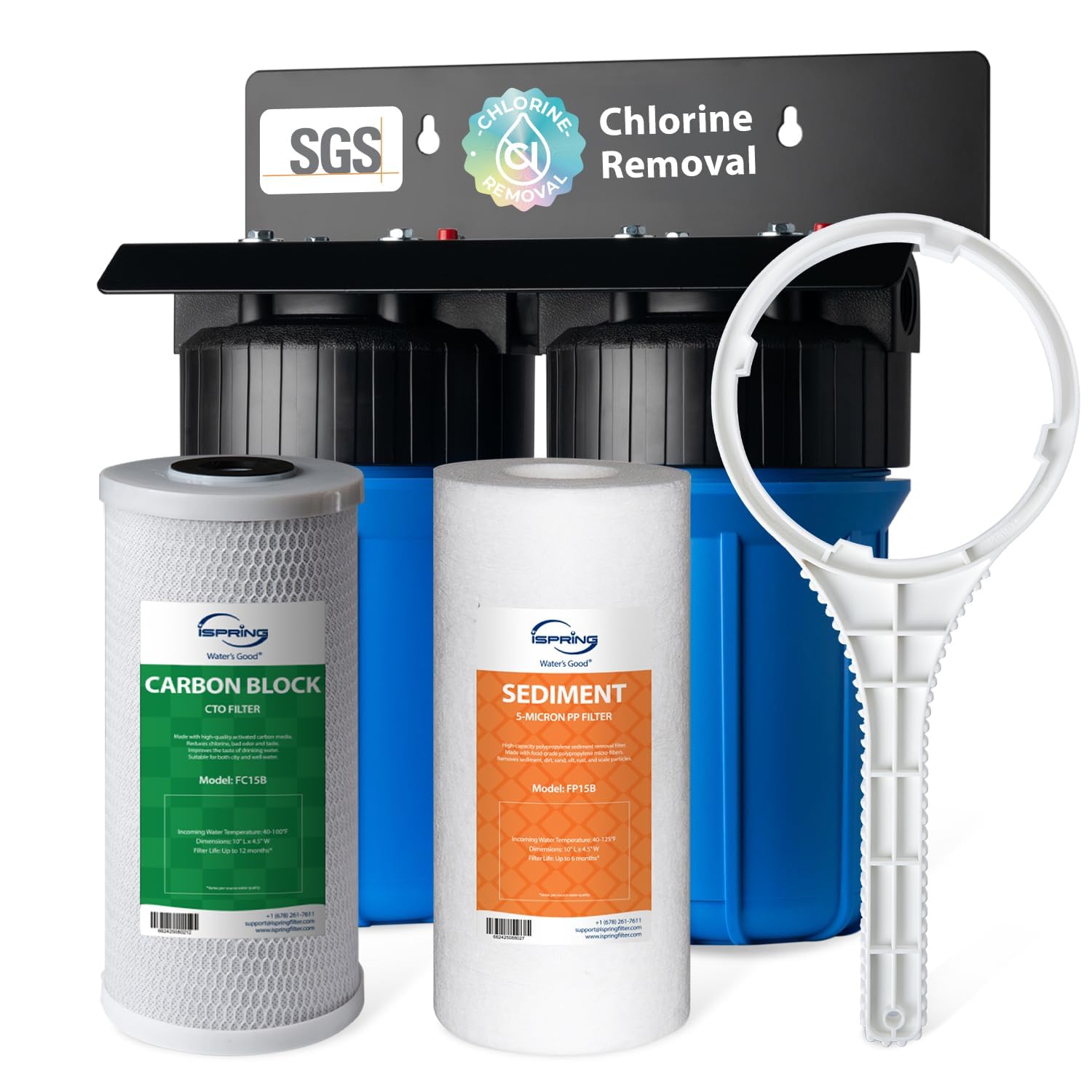
The iSpring WGB21B is a point-of-entry, two-stage system built to cut sediment and chlorine out of your household water supply and deliver cleaner-tasting water to every faucet. The first stage uses a 5-micron polypropylene sediment cartridge to trap dirt, rust, and scale, while the second stage is a coconut-shell carbon CTO block that reduces chlorine, VOCs, and common tastes and odors. It mounts on a bracket and ships with an installation kit, filter wrench, and clear instructions and videos for DIY installers, and 1-inch ports support high flow rates with minimal pressure loss. Filters are large 10" x 4.5" cartridges rated for up to about 50,000 gallons or roughly 12 months of service under typical use, which reduces maintenance frequency. The housings are made from durable materials and the unit operates without power. Limitations: it does not lower TDS or soften water, so it will not address dissolved minerals or hardness, and outdoor installs require weatherproofing. For reliable basic whole-house chlorine and sediment control, this system is straightforward and serviceable.
Best for: Buyers who prioritize a reliable, low-maintenance whole-house filter to remove sediment and chlorine across all faucets and who prefer a proven mechanical and carbon filtration solution they can install or maintain themselves.
Less Ideal for: Homes seeking scale reduction, softened water, or lower TDS should consider dedicated water softening or reverse osmosis systems instead.
- Two-stage design targets both sediment and chlorine/taste/odor for whole-house protection
- Large 10" x 4.5" filters offer long service life — up to 50,000 gallons or about 12 months
- 1-inch inlet/outlet supports high flow with minimal pressure drop for whole-house use
- Pre-assembled mounting bracket, installation kit, and online videos make DIY installation practical
- Operates without electricity and uses durable polyethylene and steel housings
- Does not reduce total dissolved solids or soften hard water
- Not rated specifically for outdoor exposure without added insulation or waterproofing
Verdict: Choose the iSpring WGB21B when you want a dependable, long-life two-stage whole-house filter that reliably removes sediment and chlorine with high flow and minimal upkeep.
Express Water 3-Stage Whole House System

| Purification Method | Activated Carbon, Granular Activated Carbon |
|---|---|
| Maximum Flow Rate | 17 gpm |
| Operating Pressure Range | 20-80 psi |
| Filter Life Cycle | 6 months |
| Capacity | 100000 gallons |
The Express Water 3-stage whole-house system is designed to filter all incoming water at the point of entry so every faucet in the house delivers reduced-chlorine, clearer-tasting water. It uses a sediment prefilter, granular activated carbon, and carbon block stages to cut chlorine, sediment, and odor while protecting plumbing and appliances from silt buildup. The unit ships on a stainless-steel free-standing frame with pressure gauges and quick-release buttons to simplify filter changes, and the filters are NSF certified for the claimed reductions. With a stated flow capability up to 17 gpm and a recommended replacement cycle around 6–12 months or 100,000 gallons, it can support typical household demand without noticeable pressure loss. Limitations to note: it does not reduce total dissolved solids, so it is not a substitute for reverse osmosis when you need TDS reduction, and replacement filters are a recurring cost. Installation requires a whole-house inlet hookup and some plumbing familiarity or pro help.
Best for: Buyers who prioritize verified contaminant reduction and want a whole-home solution that improves taste and protects pipes and appliances, and who prefer products with independent certification and visible monitoring features.
Less Ideal for: People seeking removal of dissolved solids or mineral content should choose a reverse osmosis system instead, and those who need a plug-and-play countertop solution for a single tap should consider point-of-use filters.
- Three-stage filtration (sediment, GAC, carbon block) reduces chlorine, sediment, and bad tastes or odors.
- Stainless-steel free-standing frame with pressure gauges and release buttons simplifies monitoring and filter changes.
- High flow capacity (up to 17 gpm) designed to avoid noticeable pressure loss in normal household use.
- NSF certified filters provide independent verification of performance.
- Filter life guidance up to 100,000 gallons or 6–12 months offers a clear maintenance interval.
- Does not reduce total dissolved solids (TDS), so it will not remove dissolved salts or minerals.
- Requires whole-house plumbing installation, which may need a plumber if you are not comfortable with hookups.
- Replacement filters are a recurring maintenance cost and must be sourced as compatible cartridges.
Verdict: Choose this 3-stage Express Water system when you want certified whole-house chlorine and sediment reduction with easy maintenance and high household flow capacity.
A. O. Smith Whole House Filter AO-WH-Filter

| Purification Method | Activated Carbon |
|---|---|
| Other Special Features | Chlorine Reduction, NSF/ANSI 42 Certified |
| Maximum Flow Rate | 7 gpm |
| Operating Pressure Range | 20-100 psi |
| Filter Life Cycle | 6 years |
This A. O. Smith whole-house filter uses an activated carbon tank to reduce chlorine taste and odor across every tap in the home, making water for drinking, cooking, and bathing more pleasant. It is sized for long life — rated for 600,000 gallons or about six years — and installs on a 3/4 inch line with the included shut-off valve, nipple, and hose adapter so many homeowners can do a DIY fit. The system is NSF/ANSI 42 certified for chlorine reduction and supports up to 7 gpm flow at typical household pressures, so it does not require a drain or backwash and wastes no water. Practical benefits include improved taste and reduced chlorine odor in showers and laundry plus lower chlorine off-gassing into indoor air. Limitations are that it does not soften hard water or remove iron, sulfur, or microbiological contaminants, so homes with those issues will need additional treatment. The fiberglass tank and six-year warranty support long-term use, but buyers should factor in pre-filtering needs if their water has heavy sediment.
Best for: Buyers who prioritize low-risk, proven chlorine removal for drinking water and want a low-maintenance, long-lived whole-house carbon filter they can install themselves.
Less Ideal for: Homes needing water softening, iron or sulfur removal, or pathogen disinfection should choose complementary or different treatment systems instead.
- NSF/ANSI 42 certified for chlorine reduction
- Long filter life rated at 600,000 gallons or six years
- DIY-friendly package with shut-off valve, nipple, and hose adapter included
- No backwash or drain required so it wastes no water
- Supports household flow up to 7 gallons per minute at normal pressures
- Does not remove hardness, iron, sulfur, or microbiological contaminants
- Requires correct installation and may need a pre-filter if water has heavy sediment
Verdict: Pick this unit if you want a low-maintenance, certified whole-house carbon filter that reliably removes chlorine taste and odor for years without water waste.
Choosing the Right Whole-House Water Filter for Drinking Water: Key Factors to Consider
Contaminant Reduction Targets
Know which contaminants you need to reduce before choosing a whole-house drinking-water filter. Tap water issues vary widely—common targets include sediment, chlorine and chloramine, taste and odor compounds, and some heavy metals. Different media remove different contaminants. Activated carbon excels at chlorine, taste, and many organic compounds, while specialty medias or combined-stage systems are needed for targeted heavy-metal or nitrate reduction.
Matching the system to your water test results prevents overpaying for capabilities you do not need. If you do not have a recent water quality report, start with testing for turbidity, free chlorine, and lead. That ensures the filter you pick addresses real risks to drinking water quality rather than applying a one-size-fits-all solution.
System Flow Rate and Home Water Demand
Whole-house filters must deliver enough flow for showers, irrigation, and simultaneous faucet use without causing a noticeable pressure drop. Look at the system's rated flow rate at normal residential pressure and compare it to your household peak demand. A family of four with multiple bathrooms needs a higher continuous flow rating than a single-person household.
Also consider peak flow events such as sprinkler use. Systems that list service flow rates and peak flow specs give a clearer picture of real-world performance. Oversizing the flow capacity by a modest margin protects against reduced pressure during heavy use and prolongs filter life by avoiding overtaxing the media.
Filter Lifespan and Maintenance Frequency
Filter life affects both convenience and long-term cost. Cartridge-based whole-house systems have scheduled change intervals that vary by media type and local water quality. Sediment pre-filters can clog quickly in turbid supplies, while carbon blocks often provide longer life if preceded by good sediment removal.
Consider how easy cartridge changes are, whether the system requires special tools, and whether replacement parts are commonly available. Systems that offer clear indicators or pressure-differential gauges to show when a change is needed reduce the risk of waiting too long and compromising performance.
Installation and Space Requirements
Installation complexity impacts whether you can set up the system as a DIY project or will need professional help. Check inlet/outlet connection sizes, backwashing needs, bypass valves, and clearance for removing cartridges. Some whole-house units are compact and fit neatly in small utility closets, while others need several feet of clearance and floor space.
Also think about where the system will be sited relative to the main water shutoff and existing plumbing. A unit that uses standard fittings and a simple bypass valve is easier to service without interrupting your water supply for long periods.
Material Compatibility and Plumbing Safety
Whole-house systems are connected directly to your potable water lines, so materials must be safe and compatible with plumbing codes. Look for NSF/ANSI materials safety or equivalent documentation and housings rated for typical household pressures. Avoid systems that use questionable plastics or unprotected metals that might corrode or leach under long-term exposure.
Also consider freeze protection and temperature limits where the system will be installed. Proper material choices reduce the chance of leaks, premature failure, or unexpected water quality interactions over the system lifetime.
Operating Costs and Replacement Parts Availability
Long-term affordability depends on cartridge price, recommended change frequency, and any required service procedures such as backwashing or chemical regeneration. Some media last longer but cost more to replace, while others are inexpensive but need frequent swapping. Factor in time and any special disposal considerations for spent cartridges.
Availability of replacement parts affects downtime. Systems that use common, industry-standard cartridge sizes or widely available media types make ongoing maintenance easier. Also check whether the manufacturer provides clear documentation on part numbers and service intervals so you can plan for future costs.
Why Whole-House Filtration Matters for Drinking Water
Filtering water at the point it enters your home improves the quality of water at every faucet, not just the kitchen sink. That protects plumbing, reduces taste and odor issues throughout the house, and ensures that your water used for cooking and beverages has gone through a robust treatment step.
A whole-house approach is especially useful when your municipal supply has organics or chlorine that impact flavor, or when well water brings sediment and iron that affect appearance and appliance longevity. For drinking water, combining sediment pre-filtration with targeted media for chlorine and organics produces the best balance of clarity and taste.
- Delivers treated water to every outlet
- Protects appliances and plumbing from sediment
- Improves taste and odor housewide
Matching Media Types to Drinking-Water Goals
Not all filter media are equally good for drinking-water concerns. Granular activated carbon is versatile for chlorine and many taste-and-odor compounds. Carbon blocks provide finer particle removal and more contact time, which often improves organic reduction. KDF and catalytic carbons target specific chlorine chemistry and can extend carbon life in challenging supplies.
Consider multi-stage systems that pair a sediment stage with an adsorption stage. That arrangement prevents premature fouling of the adsorption media and helps maintain flow rates for longer periods.
- Sediment first, carbon second is a common effective layout
- Specialty media may be needed for metals or chloramine
How to Read Flow and Pressure Ratings
Manufacturers typically list a service flow rate at a reference pressure, often 60 psi. Real household pressure may be lower or higher, which affects useful flow. Understand the difference between continuous service flow and short-term peak flow to avoid underperformance during simultaneous uses.
If you have a pressure tank or booster pump, account for how those systems interact with the filter. In some setups, a filter with a tight element can cause pump cycling unless a bypass or larger capacity is used.
- Compare service flow to your household peak demand
- Look for pressure-drop curves or specs at multiple flow rates when available
DIY Vs Professional Installation
Some whole-house filters are straightforward for a confident DIYer: standard pipe fittings, clear mounting instructions, and manageable weight. Other systems require soldering, unions, or electrical connections for backwash controls and are best left to a licensed plumber.
If you plan to install yourself, confirm local code requirements and permit needs. Even simple installations benefit from planning the layout to include an accessible bypass valve and space for cartridge removal.
- Confirm required tools and plumbing skills before buying
- Plan for a bypass to avoid water shutoff during servicing
Maintenance Tips to Maximize Performance
Regular inspection and timely cartridge replacement preserve filtration performance and prevent bacterial growth in aged media. Keep a maintenance log noting installation dates, pressure-drop readings, and replacement intervals. That helps you learn how local water quality affects service life and lets you optimize change schedules.
Install a simple pressure gauge upstream and downstream if the system does not include indicators. Watching the differential pressure gives an objective signal that a cartridge needs replacement rather than relying solely on calendar intervals.
- Use pre-filters to extend carbon cartridge life
- Flush new cartridges per manufacturer instructions before drinking use
How We Chose the Best Whole-House Water Filter for Drinking Water
We focused on performance and installation realities that matter for whole-house drinking-water filtration. Selection began by screening systems that use proven media types for drinking water—such as carbon adsorption, KDF, and fine sediment filtration—then prioritized those with independently verifiable contaminant reduction claims or clear lab-test support. We favored units with realistic flow-rate ratings at typical residential pressures and conservative filter-change intervals that lower ongoing maintenance burden. Build quality and serviceability were important filters: durable housings, clearly documented cartridge replacement steps, and accessible parts scored higher. We also considered installation flexibility, including standard pipe fittings and space requirements for common utility rooms. Exclusions included systems aimed solely at point-of-use treatment, untested proprietary cartridges without performance data, and whole-house devices that sacrifice pressure for filtration. Our final picks balance contaminant removal, sustained flow, ease of maintenance, and installation practicality.
Our full evaluation process is outlined in our review methodology.
FAQ
Will a whole-house filter make my drinking water safe from bacteria?
Most whole-house consumer filters focus on particulates, chlorine, and common chemical contaminants. They do not reliably disinfect water for bacteria unless they include a certified microbiological treatment stage such as UV or specialized media. If bacterial contamination is a concern, choose a system specifically rated for microbiological reduction or add a UV disinfection stage.
How often will I need to replace cartridges in a whole-house drinking-water filter?
Replacement intervals vary with media type and local water quality. Sediment pre-filters may need replacement every 1 to 6 months in dirty supplies, while carbon cartridges often last 6 to 12 months. Monitoring pressure differential is the most reliable way to time changes rather than relying only on calendar intervals.
Can a whole-house filter remove lead and other heavy metals from drinking water?
Some whole-house systems can reduce certain heavy metals when they use the appropriate media, such as specific adsorptive carbon formulations or specialty ion-exchange stages. Effectiveness depends on contact time and media type, so verify documented reduction capabilities for the specific contaminant you are concerned about.
Will installing a whole-house filter reduce water pressure in my home?
Properly sized systems maintain normal household pressure. However, tight filtration elements or undersized flow capacity can cause noticeable pressure drops during peak use. Choose a filter with a service flow rate that exceeds your household's peak demand and consider a bypass for maintenance.
Is a whole-house filter enough, or do I still need a point-of-use filter for drinking water?
Whole-house filters improve water quality throughout the house, but some homeowners still use a point-of-use device at the kitchen sink for additional polishing, finer particulate removal, or certified reduction of specific contaminants. Combining approaches can provide broad protection plus targeted treatment where you prepare drinking water.
Final Verdict
Choosing a whole-house water filter for drinking water means weighing contaminant targets against flow needs and maintenance realities. Prioritize systems that address the contaminants identified in your water test, deliver sufficient service flow for your household, and use durable, serviceable components. Expect tradeoffs between longer-lasting cartridges and upfront complexity; the right choice balances performance with an installation and maintenance plan you can commit to. With clear priorities—filtration effectiveness, steady flow, and manageable upkeep—you can select a whole-house system that reliably improves drinking water across your home.