
Note: This article contains affiliate links. If you click on these links and make a purchase, we may earn a small commission at no extra cost to you. This helps support our research and content. Read our full affiliate disclosure here.
When an emergency compromises your normal water supply, a dedicated whole-house water filter can protect your household from contaminants while keeping taps, showers, and appliances running. You want a system that balances thorough filtration with enough flow to support essential uses and simple maintenance during stressful conditions. This guide gathers the top shortlisted whole-house water filters for emergency scenarios and explains the practical tradeoffs that matter most. Below we outline how each option performs across filtration capability, flow capacity, ease of maintenance, and installation needs so you can pick the best fit for your home and emergency plan.
Top Picks at a Glance
| Best Quality Built to a higher standard if you want something more solid | iSpring WGB32B Whole House Filter |  |
| Best Value The sweet spot between price and what you get | PUREPLUS 2-Stage Whole House Filter |  |
| Best Budget The cheapest option that still gets the job done reliably | Risewin 10" Whole House Filter RW10BB-H01 |  |
| Top Rated A top-rated pick with lots of positive feedback | iSpring WGB21B 2-Stage Whole House Filter |  |
| Most Popular A crowd favorite that many people choose with confidence | SimPure DB20P Whole House Filter Housing |  |
| Best Seller A high-volume bestseller chosen again and again | Culligan WH-HD200-C Whole House Filter |  |
iSpring WGB32B Whole House Filter

| Maximum Flow Rate | 15 gpm |
|---|---|
| Inlet / Outlet | 1 inch Female NPT |
| Operating Pressure Range | 25 – 80 psi |
| Filter Life Cycle | Up to 100,000 gallons / 1 years |
| Operating Temperature | 40 – 100 °F |
The iSpring WGB32B is a tankless, 3-stage whole house filter built around large 20 x 4.5-inch industrial-standard cartridges that deliver high flow and year-long filter life. It uses a PP sediment cartridge up front to capture sand, rust, and particulate down to about 5 microns, followed by two coconut-shell carbon block CTO stages to knock out chlorine, tastes, odors, THMs, and many VOCs. With a 1-inch female NPT inlet/outlet and up to 15 gallons per minute flow, the system is sized to keep showers, appliances, and fixtures running without noticeable pressure loss in typical homes. Installation is DIY-friendly with a wrench and video guide, but the unit is intended for indoor, protected locations and needs a water softener ahead of it if hardness or TDS exceed the supported range. Filters are rated to treat roughly 100,000 gallons or about 6–12 months depending on water quality, so expect annual cartridge changes for continued performance. The WGB32B is a practical, performance-focused whole-house option when chlorine and sediment removal plus robust flow are the priority, though it does not reduce water hardness or perform RO-level contaminant removal.
Best for: Buyers who prioritize high flow and reliable chlorine and sediment removal for an entire home and want a system they can install and maintain themselves.
Less Ideal for: Homes needing softening or RO-level contaminant removal, outdoor/unprotected installs without proper insulation, or buyers seeking filtration that removes dissolved minerals.
- High maximum flow rate up to 15 gpm suitable for whole-home use
- Large 20×4.5-inch cartridges for longer run time between changes
- Three-stage filtration including PP sediment and dual carbon block CTO for strong chlorine and odor removal
- DIY-friendly installation with included wrench and online video guide
- Does not reduce water hardness or TDS; a separate softener is needed for hard water
- Designed for indoor installation and requires protection from freezing and weather
Verdict: Choose the WGB32B if you need a high-flow, three-stage whole-house filter that reliably removes chlorine, sediment, and odors while supporting year-long cartridge life.
PUREPLUS 2-Stage Whole House Filter

| Capacity | 30000 gallons |
|---|---|
| Supported Water TDS Level Maximum (PPM) | 500 |
| Purification Method | Natural Activated Carbon Block |
| Included Components | Filtration System, Cartridges, Wrench, Pressure Gauges |
The PUREPLUS 2-Stage Whole House Filter is a point-of-entry system that pairs a 5-micron polypropylene sediment cartridge with a 5-micron coconut-shell activated carbon block to reduce sediment, chlorine, taste, and odor across all household faucets. It installs in standard 10" x 4.5" housings and is supplied with the housings, cartridges, wrench, and external pressure gauges so you can monitor pressure drop across each stage. In day-to-day use it protects showers, appliances, laundry, and plumbing from sand, rust, and chlorine-related issues and makes tap water taste cleaner. The included pressure gauges are a practical touch for maintenance timing, and replacement cartridge sets are available separately. Limitations: the system is designed for general chlorine and sediment reduction so it will not address dissolved minerals, heavy metals beyond certain claims, or biological contamination, and filter life depends strongly on incoming water quality and flow rate.
Best for: Buyers who want a cost-conscious, easy-to-maintain whole-home prefilter that improves taste and protects plumbing and appliances during emergencies and everyday use.
Less Ideal for: Homes needing removal of dissolved iron, hardness, heavy metals, or microbiological treatment should choose specialized or higher-stage systems instead.
- Two-stage filtration combining sediment and activated carbon for broad reduction of chlorine, taste, odor, and particulate
- Uses standard 10" x 4.5" cartridges for easy replacement and wide compatibility with off-the-shelf filters
- Includes external pressure gauges to monitor differential pressure and spot when cartridges need changing
- Comes with housings, cartridges, wrench, and gauges so initial setup has most needed parts included
- Not designed to remove dissolved minerals, most heavy metals, or biological contaminants
- Filter life and performance will vary with water quality and may require frequent cartridge changes in poor source water
Verdict: A practical, standard-size two-stage whole-house system that provides reliable sediment and chlorine reduction with built-in pressure monitoring for emergency-ready home protection.
Risewin 10" Whole House Filter RW10BB-H01

| Maximum Flow Rate | 8 gpm |
|---|---|
| Operating Pressure Range | 30-125 psi |
| Supported Water TDS Level Maximum (PPM) | 1000 |
| Filter Life Cycle | 12 months |
| Capacity | 12000 gallons |
The Risewin 10" single-stage whole-house system is a low-tech, high-flow prefilter aimed at removing visible sediment, rust and chlorine odor before water reaches plumbing and appliances. It uses a composite cartridge with a PP sediment layer plus coconut-shell activated carbon and installs inline with the included housing, wrench, bracket and brass fittings. The 4-mode bypass valve adds practical features for home use: FLUSH reverses flow to clean the cartridge, BYPASS lets you swap the cartridge without shutting off the main supply, and simple installation parts mean many owners can do a DIY fit. Rated for up to 8 gpm and tested for cold climates, the plastic housing is freeze-resistant and built for high pressure scenarios. Expect about a 12-month cartridge life under normal conditions and straightforward maintenance when flushing or replacing the element. This is a basic, cost-focused whole-house prefilter rather than a multi-stage purification system, so it will not soften water or remove dissolved minerals or bacteria; heavy iron or very turbid well water may require upgraded or additional cartridges.
Best for: Buyers who need an affordable, install-yourself whole-house prefilter to protect appliances and reduce visible sediment and chlorine smell during emergencies or everyday use.
Less Ideal for: Homes needing water softening, microbial disinfection, or deep chemical removal should choose multi-stage or specialized treatment systems instead.
- Composite cartridge combines sediment layer and coconut-shell activated carbon for sediment and chlorine reduction
- 4-mode bypass valve with FLUSH and BYPASS allows cartridge cleaning and filter swaps without shutting off water
- 8 gpm maximum flow supports simultaneous fixtures in larger homes
- Freeze-proof, high-pressure tested housing designed for cold climates and heavy-duty use
- Single-stage design does not remove dissolved minerals, salts, or microbes
- 10" cartridge may need more frequent replacement under heavy sediment conditions
Verdict: A budget-friendly, DIY whole-house prefilter that delivers high flow and easy maintenance to keep plumbing and appliances protected during emergencies and everyday use.
iSpring WGB21B 2-Stage Whole House Filter
| Inlet / Outlet | 1 inch Female NPT |
|---|---|
| Maximum Flow Rate | 15 gpm |
| Operating Temperature | 40-100 °F |
| Supported Water TDS Level Maximum (PPM) | 2500 |
| Filter Life Cycle | 12 months / up to 50,000 gallons |
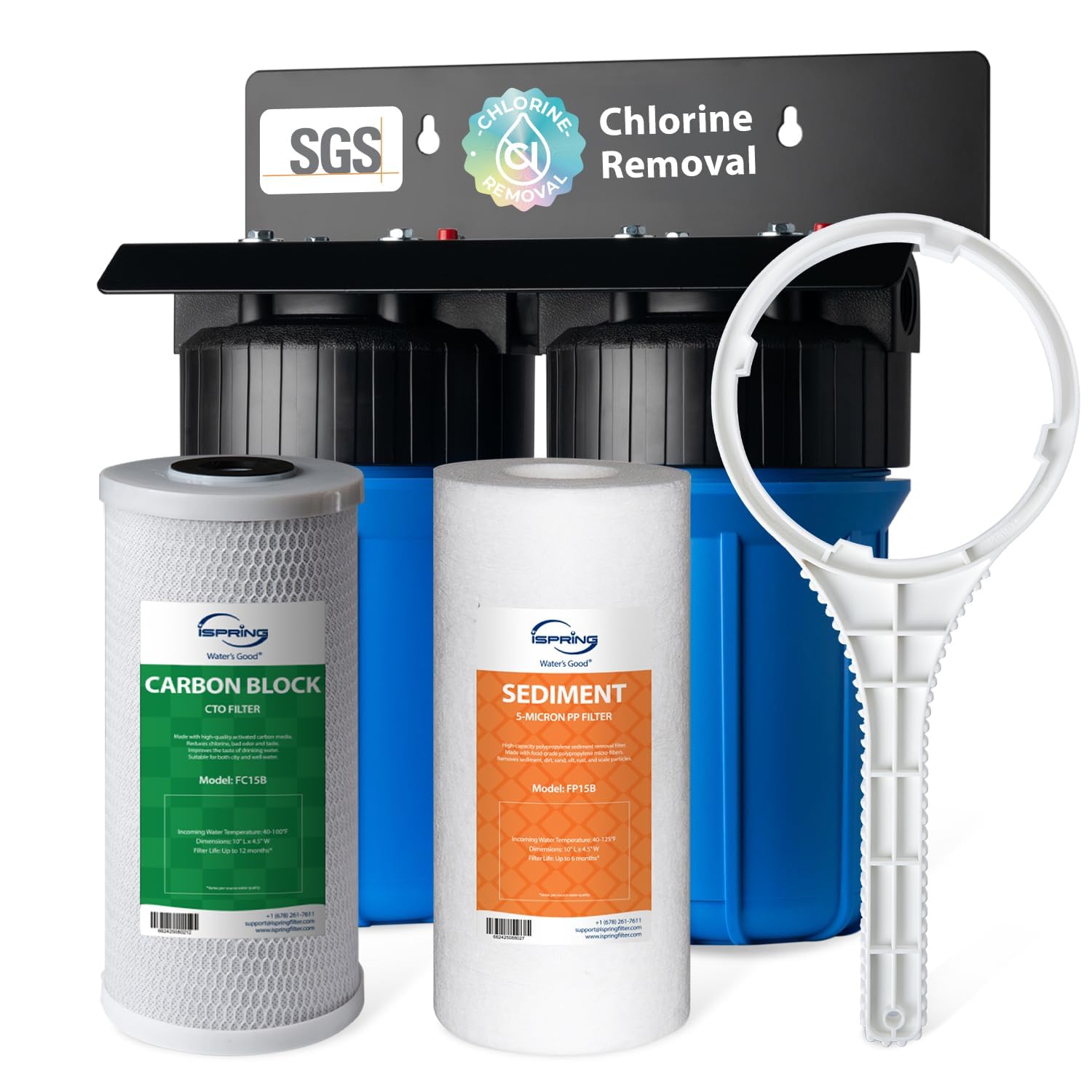
The iSpring WGB21B is a straightforward point-of-entry two-stage system designed to remove sediment and chlorine-related tastes and odors from all household water. It installs at the main supply and includes a 5-micron polypropylene sediment cartridge followed by a coconut-shell carbon CTO block, which handles dirt, rust, sand and knocks out over 90% of free chlorine plus many VOCs. The 1-inch inlet/outlet and up to 15 gpm flow rate let it serve a typical home with minimal pressure loss, and the housings are built for long-term use under normal pressure. Filter life is rated up to 50,000 gallons or about 12 months for an average family, and the kit ships preassembled with a wrench and mounting bracket for DIY installation; iSpring also provides manuals and video guidance. It keeps dissolved minerals intact since it is not an RO system, but it does not reduce TDS or remove dissolved salts, heavy metals, or microbes, so those needing deeper purification will want additional stages. Overall it is a reliable, easy-to-service whole-house prefilter and chlorine/taste reducer suited to emergency preparedness where dependable basic filtration is the priority.
Best for: Buyers who prioritize a reliable, easy-to-install whole-house solution that consistently removes sediment and chlorine to protect plumbing and improve water taste during normal use and emergency scenarios.
Less Ideal for: Homes that need removal of dissolved solids, heavy metals, or microbiological contaminants should consider systems with RO, UV, or additional specialized stages instead.
- Two-stage design combines 5-micron sediment removal with a carbon CTO for chlorine, taste, and odor reduction
- 1-inch inlet/outlet and up to 15 gpm flow support whole-house use with low pressure loss
- High-capacity filters rated up to 50,000 gallons or roughly 12 months of service for average households
- Preassembled mounting bracket and included wrench simplify DIY installation and routine cartridge changes
- Does not reduce TDS or remove dissolved salts, heavy metals, or microbes
- Housing materials and filter types limit contaminant removal to mechanical and carbon adsorption only
Verdict: Choose this two-stage iSpring system when you need a dependable, high-capacity prefilter and chlorine/taste reducer that is easy to install and service for whole-house emergency readiness.
SimPure DB20P Whole House Filter Housing

| Maximum Flow Rate | 20 gpm |
|---|---|
| Inlet / Outlet | 1" NPT Brass Port |
| Compatible Filter | Fits 20" x 4.5" cartridges |
| Working Water Pressure Range | 15-90 PSI |
| Applicable Water Temperature | 41-104 °F |
The SimPure DB20P is a single-stage whole-house filter housing designed to accept standard 20" x 4.5" cartridges for sediment or carbon filtration ahead of downstream appliances. It mounts to a wall or bracket and uses 1" NPT brass inlet and outlet threads to maintain a high flow rate up to 20 gpm while resisting leaks; the package includes a heavy-duty mounting bracket, wrench, screws, and a red pressure-relief button that makes cartridge swaps straightforward. Built from food-grade reinforced polypropylene with brass ports, the housing is meant to handle municipal or well water and reduce sand, silt, chlorine taste and odor depending on the cartridge chosen. Practical benefits include tool-assisted tightening, a raised threaded design intended to limit mounting-hole leaks, and compatibility with widely available 20" cartridges so replacements are easy to source. Important limitations are that cartridges and push fittings are sold separately and the unit requires adequate wall space for installation and future cartridge changes; it also covers only a single filtration stage so you must choose the appropriate cartridge for the contaminants you expect in emergency or everyday use.
Best for: Buyers who want a dependable, serviceable pre-filter housing to protect appliances and plumbing during normal use or emergency situations and who prefer products with strong user feedback and practical installation aids.
Less Ideal for: Those seeking a complete multi-stage purification system or a turnkey solution that removes dissolved contaminants without buying specific filter cartridges and fittings.
- Accepts standard 20" x 4.5" cartridges for wide cartridge choice and easy replacements
- 1" NPT brass inlet/outlet for higher flow and durable threaded connections
- Built-in red pressure-relief button and included wrench simplify cartridge changes
- Reinforced food-grade polypropylene body resists chemicals and impact
- Includes heavy-duty mounting bracket and installation screws for wall mounting
- Does not include filter cartridges or push fittings, so additional purchases are required
- Single-stage housing only, so it will not remove dissolved contaminants without the correct cartridge
- Requires sufficient clearance for installation and cartridge replacement
Verdict: A rugged, easy-to-service 20" filter housing that lets you add the cartridge you need to protect plumbing and appliances during everyday use or emergencies.
Culligan WH-HD200-C Whole House Filter

| Maximum Flow Rate | 10 gpm |
|---|---|
| Capacity | 16000 gallons |
| Supported Water TDS Level Maximum (PPM) | 600 |
| Material Type | Stainless Steel |
The Culligan WH-HD200-C is a clear-sump whole-house filter housing intended to sit at the water main and host a compatible heavy-duty cartridge (sold separately). It is typically installed inline at a 1-inch point of entry to capture sediment, rust, sand, silt and to improve taste and odor when paired with the correct cartridge. Practical features include a stainless steel cap, built-in shut-off and bypass valves for servicing without shutting off the entire supply, an integrated mounting bracket, a pressure relief valve and a housing wrench. The clear sump lets you visually confirm when the cartridge is dirty, and the unit is rated for up to 10 gpm and 16,000 gallons capacity with the right filter. The housing itself does not filter water until a cartridge is installed, and buyers must choose the correct cartridge for the contaminants they need removed; also it requires a 1-inch main for direct fitment. For emergency preparedness it gives a rugged, serviceable point-of-entry solution that protects downstream plumbing when stocked with appropriate replacement cartridges.
Best for: Buyers who want a rugged, serviceable point-of-entry housing to protect household plumbing and appliances and who prefer visible, easy-to-service filtration for emergency readiness.
Less Ideal for: People who need a complete filtration solution out of the box or who have a smaller than 1-inch water main and do not want to modify plumbing.
- Clear sump lets you visually monitor cartridge condition
- Built-in shut-off, bypass and pressure relief valves simplify servicing
- Stainless steel cap and bracket offer durable, home-grade construction
- Rated to handle up to 10 gallons per minute for whole-house flow
- Filter cartridge is sold separately so additional purchase is required
- Requires a 1-inch inlet so may need plumbing adapter on smaller mains
Verdict: A durable, easy-to-service whole-house filter housing ideal for protecting plumbing and appliances when paired with the right replacement cartridge for emergency preparedness.
Choosing the Right Whole-House Water Filter for Emergency: Key Factors to Consider
Contaminant Coverage
Emergency water risks can include sediment from damaged pipes, chemical runoff, and biological contaminants introduced during infrastructure failures. Verify what the system reduces or removes and whether it targets the contaminants most likely in your area. Mechanical sediment screens, activated carbon for organic chemicals and chlorine, and certified media for specific contaminants each play different roles.
Choosing broader contaminant coverage reduces the chance of unexpected hazards during an emergency. If you need microbiological protection, look for systems that include proven physical barriers or compatible post-treatment options since not all whole-house filters address bacteria or viruses directly.
Flow Rate and Simultaneous Use
Whole-house systems must maintain adequate gallons per minute so multiple fixtures can be used at once without a dangerous pressure drop. Consider the peak demands you expect during an emergency, such as running a shower while a tap or washing machine operates. Flow specifications at realistic household pressure give a practical view of performance.
A system with insufficient flow can force you to choose between critical uses and leave some fixtures unusable. If you plan to run pumps or store filtered water in tanks, account for those components when estimating the system flow you need.
Filter Lifespan and Consumable Availability
Filter element longevity matters more in emergency scenarios because supply chains may be disrupted. Longer-lasting cartridges reduce the frequency of replacements and the chance you will run out of spares. Also check whether the filter media is a common size or proprietary, and how easy it is to source replacements locally or store extras for long periods.
Consider the storage life of replacement elements and whether they require special handling. Systems that allow multiple types of media or generic replacement cartridges offer more resilience for irregular availability.
Installation Flexibility and Compatibility
During emergencies you may need a system that can be installed quickly by a homeowner or adapted to nonstandard plumbing. Look for units that offer simple connections, clear bypass valves, and straightforward mounting. Systems designed for both permanent and temporary installation provide more options when responding to sudden needs.
Also verify physical dimensions and inlet/outlet size so the unit fits your existing plumbing without complex adapters. A design that supports an easy bypass makes it possible to maintain filtered water while servicing the unit.
Maintenance Simplicity and Field Serviceability
Maintenance tasks during an emergency should be fast and low-skill. Systems with tool-free housings, clear service indicators, and easily replaceable cartridges minimize downtime. Check whether routine tasks like flushing, backwashing, or cartridge swaps can be done without specialized equipment.
Field-replaceable parts and clear documentation reduce the chance of user error. If you anticipate periods without professional support, favor systems engineered for straightforward in-home servicing.
Durability and Long-Term Storage
If the unit will be stored until needed, durability of the housing and seals is vital. Materials that resist corrosion and environmental degradation help ensure the system functions when deployed. Components that tolerate temperature swings and humidity are preferable for emergency kits kept in garages or basements.
Also consider whether the system requires pre-commissioning or periodic cycling while in storage. Options that remain serviceable after long idle periods lower the maintenance overhead of preparedness planning.
Preparing Your Home for Emergency Filtration
Start by mapping critical water uses in an emergency. Identify which fixtures must stay operational for hygiene, food preparation, and basic sanitation. That list guides the flow capacity and point-of-use strategy you need.
Plan where the whole-house unit will be installed so it protects those critical lines first and allows for an easy bypass. Determine if you have space for a pre-filter or holding tank, and whether power is needed for boosted pressure or pumps.
- Prioritize lines feeding kitchen and bathroom sinks and one shower
- Reserve space for spare filter cartridges and common tools
- Mark shutoff valves for quick isolation and service
Temporary Vs Permanent Setups
A permanent whole-house installation provides continuous protection but may require professional plumbing. Temporary or portable setups let you deploy filtration only when needed and can be easier to maintain during a crisis.
Decide whether you want a system that can be moved between homes or one that stays installed. Some systems are designed to be quickly disconnected and reinstalled, which is useful if you expect to relocate filtered water sources in an extended emergency.
- Permanent: greater integration, less frequent swapping of elements
- Temporary: faster deployment and potential reuse across locations
- Consider a hybrid approach with a permanent pre-filter and portable post-treatment
Sizing Your System for Real-World Use
Calculate typical daily water needs for drinking, cooking, basic hygiene, and minimal cleaning. Then plan for peak simultaneous flows, such as a shower plus a tap and an appliance. Use those numbers to match system flow ratings rather than relying on residence size alone.
If you plan to fill storage tanks, ensure the system can sustain the pump and achieve fill rates that meet your contingency timelines. Oversizing flow capacity by a small margin gives headroom for unexpected demand spikes.
- Estimate daily gallons needed and peak GPM simultaneously required
- Account for pump head if using gravity-fed or pressurized storage
- Allow margin for future household changes or additional users
Maintenance Routines for Emergency Readiness
Establish a maintenance checklist that includes periodic inspection of seals, flushing procedures, and a schedule for rotating or replacing stored cartridges. Treat spare consumables as part of your emergency inventory and track their shelf life.
Practice the steps required to bypass or service the system so you can perform them quickly when under stress. Clear labeling of valves and components reduces confusion for anyone assisting during an emergency.
- Store at least several replacement cartridges or media sets
- Run annual functionality checks and replace sealing parts as needed
- Keep clear, concise service notes near the installation
Integrating Additional Treatment Options
Whole-house filtration often pairs with other treatments such as UV disinfection or point-of-use filters to cover gaps. If microbiological contamination is a concern, plan for a secondary barrier that is effective against bacteria and protozoa.
Combining technologies allows you to tailor protection to specific risk scenarios. For example, activated carbon reduces chemicals and improves taste while an appropriately rated barrier element or UV system addresses biological hazards.
- Consider UV or chemical disinfection for biological threats
- Use point-of-use filters for drinking water when taste and polish matter
- Ensure downstream fittings and materials are compatible with added treatments
How We Chose the Best Whole-House Water Filter for Emergency
We prioritized systems that are explicitly suitable for emergency use where sustained safe water flow and reliable contaminant reduction are both critical. The editorial filters focused on measurable filtration performance, sustained flow rate at typical household pressures, maintenance burden and filter lifespan, and installation flexibility for rapid deployment. We also considered durability of housing and component materials for long-term storage or intermittent use. Systems were excluded if they lacked clear filtration specifications, required specialized tools or frequent consumable swaps that are impractical during emergencies, or if they only protected against a narrow class of contaminants without addressing common chemical and particulate risks. The evaluation emphasized contaminant removal ratings for sediment, chlorine and common chemical contaminants, and where relevant protozoa and bacterial reduction capability when mechanical or certified media are present. Flow capacity assessments looked at realistic gallons-per-minute at standard residential pressures and how that scales for simultaneous fixtures. Ease-of-maintenance measures considered how quickly filters can be replaced or bypassed during an outage, plus availability of generic replacement elements. We favored designs with clear installation options for both professional and competent DIY setups.
Our full evaluation process is outlined in our review methodology.
FAQ
Can a whole-house water filter remove bacteria and viruses during an emergency?
It depends on the system. Many whole-house filters remove sediment and chemicals but not all are rated for microbiological removal. If biological hazards are a concern, choose a system with a certified barrier or plan to add a disinfection step such as UV treatment or a point-of-use device rated for microbes.
How long will filter cartridges last in an emergency situation?
Cartridge lifespan varies with contaminant load and flow. In low-contamination conditions some elements last months, while heavy sediment or chemical loads shorten that life. Prepare by storing extra cartridges and monitoring pressure drop as an indicator that a change is needed.
Do whole-house emergency systems need electricity?
Some systems function passively using water pressure alone, while others rely on power for booster pumps, UV disinfection, or electronic monitoring. If power is uncertain during an emergency, prioritize passive filtration options or ensure you have a backup power plan for active components.
Can I install a whole-house emergency filter myself?
Many systems are designed for competent DIY installation, especially models with simple connections and clear bypass valves. However, permanent installations that modify plumbing or require permits may need a professional. Consider how quickly you must deploy the system and your comfort with plumbing tasks.
Should I pair a whole-house filter with storage tanks?
Pairing filtration with storage is a common strategy. Filtering water into a storage tank provides immediate access to treated water and reduces strain on the filtration system during peak draws. Ensure the system and tank materials are compatible and that you can maintain the stored water periodically.
Final Verdict
For emergency preparedness, prioritize whole-house filters that balance broad contaminant coverage with sufficient flow capacity and straightforward maintenance. Longevity of consumables and the ability to install or bypass the unit quickly are decisive factors for reliability during outages. Choose a system that aligns with the specific hazards you expect, plan for spare parts and routine checks, and integrate secondary treatment as needed to close any protection gaps. That approach ensures dependable filtered water when you need it most.