
Note: This article contains affiliate links. If you click on these links and make a purchase, we may earn a small commission at no extra cost to you. This helps support our research and content. Read our full affiliate disclosure here.
If your hair feels dry, brittle, or coated after every shower, the quality of your home water supply could be the culprit. Choosing the right whole-house water filter for hair can reduce hardness minerals, chlorine, and other contaminants that strip natural oils and weigh hair down. In this guide we shortlist the top whole-house water filters for hair concerns and explain the technical points that matter when evaluating options for whole-home installation. You will find picks that balance contaminant reduction, flow rate retention, and maintenance requirements. Read on to see which types of systems and features are most important for healthier, more manageable hair.
Top Picks at a Glance
| Best Overall The best all-around choice for most situations | A. O. Smith Whole House Filter AO-WH-Filter |  |
| Best Quality Built to a higher standard if you want something more solid | Aquasana Rhino WH-1010-CT-LM |  |
| Best Value The sweet spot between price and what you get | Max Water 3-Stage Whole House Filter |  |
| Best Budget The cheapest option that still gets the job done reliably | XINSHUO 2-Stage Whole House Filter |  |
| Top Rated A top-rated pick with lots of positive feedback | iSpring WGB32BM 3-Stage Whole House Filter |  |
| Most Popular A crowd favorite that many people choose with confidence | Culligan WH-HD200-C Whole House Filter |  |
| Best Seller A high-volume bestseller chosen again and again | SimPure DB10C 10" x 4.5" Housing |  |
A. O. Smith Whole House Filter AO-WH-Filter

| Purification Method | Activated Carbon |
|---|---|
| Filter Life Cycle | 6 years |
| Capacity | 600000 gallons |
| Maximum Flow Rate | 7 gpm |
| Operating Pressure Range | 20-100 psi |
The A. O. Smith AO-WH-Filter is a single-tank whole-house carbon filter designed to cut chlorine taste and odor from city or well water and deliver treated water to every tap. It uses activated carbon in a fiberglass tank and is installed inline at the home main; the package includes a shut-off valve, nipple and hose adapter to support a DIY fit. The unit is sized for high capacity use with a 600,000-gallon rating and a six-year filter life, so it suits families who want low-maintenance filtration rather than frequent cartridge swaps. It handles up to 7 gpm at typical household pressures and does not require power or produce wastewater during operation. Key limitations are that it does not soften water or remove dissolved minerals, sulfur long-term, or iron, so it will not fix hard-water scale or all odor issues; some users may still want a pre-filter for heavy sediment. For hair-focused buyers the chlorine reduction can improve water softness perception and reduce drying effects, but pairing with a conditioner or specific softening treatment is necessary for mineral-heavy water.
Best for: Buyers who want a low-maintenance, factory-quality whole-house carbon filter that reduces chlorine exposure across the house and prefers a long-life, DIY-install solution to improve skin and hair outcomes.
Less Ideal for: Homes primarily seeking water softening, iron removal, or complete contaminant remediation should consider complementary systems instead of this single carbon tank.
- Reduces chlorine taste and odor with NSF/ANSI 42 certification
- High service life rated for 600,000 gallons or about six years
- DIY-friendly package includes shut-off valve, nipple and hose adapter for inline installation
- No electricity or wastewater required during normal operation
- 7 gpm maximum flow suitable for typical whole-house use
- Does not remove hardness, dissolved minerals, iron, or reliably eliminate sulfur odor
- May require a pre-filter for heavy sediment or particulate-laden supply
Verdict: Choose this A. O. Smith whole-house carbon filter when you want long-lasting, low-maintenance chlorine reduction across every tap to help protect hair and skin.
Aquasana Rhino WH-1010-CT-LM

| Maximum Flow Rate | 7 gpm |
|---|---|
| Operating Pressure Range | 20-100 psi |
| Filter Life Cycle | 10 years |
| Supported Water TDS Level Maximum (PPM) | 500 |
| Upper Temperature Rating | 90 °F |
The Aquasana Rhino WH-1010-CT-LM is a high-flow whole-house filter designed to reduce chlorine and improve water quality at every tap. It combines a 20" pre-filter, a large filter tank with carbon and copper-zinc (KDF) media, a tall conditioner for salt-free scale control, and a 10" post-filter to cut chlorine, sediment, and inhibit bacteria while leaving healthy minerals in the water. With a rated 1,000,000-gallon capacity or 10 years of life and up to 7 gpm operating flow (14.5 gpm peak stated by the brand), it supports multiple showers and household uses without frequent cartridge swaps. The system is installed on the main line with included plumbing components and runs on water pressure so it needs no electricity. For hair and skin, reducing chlorine and controlling scale means gentler showers, less drying, and better retention of natural oils and color. Limitations include the lack of active softening since it does not remove hardness minerals, and real-world performance can vary with local water chemistry and flow rates.
Best for: Buyers who prioritize steady, whole-home chlorine reduction and low-maintenance filtration to protect hair and skin across multiple bathrooms and heavy household use.
Less Ideal for: Households that need active water softening or have very hard or high-iron well water should consider systems with dedicated softening or iron-removal stages instead.
- Reduces up to 97% of chlorine using combined carbon and KDF media to improve shower water quality
- Long service life rated for 1,000,000 gallons or 10 years, lowering maintenance frequency
- Includes pre- and post-filters plus installation kit for main-line hookup, simplifying setup
- Salt-free scale control conditions water to help protect plumbing and reduce mineral buildup without chemicals
- Does not soften water or remove hardness minerals, so scale from calcium/magnesium may persist
- Performance depends on inlet water chemistry and flow rates, so reductions may vary from lab values
Verdict: Choose this system if you want long-lasting, whole-home chlorine reduction and salt-free scale control that gently improves shower water for healthier hair and skin.
Max Water 3-Stage Whole House Filter

| Filtration stages | 3 Stage (PP sediment, GAC, CTO) |
|---|---|
| Maximum flow rate | 10 gpm |
| Operating pressure range | 20-90 psi |
| Supported TDS maximum | 500 ppm |
| Filter life cycle | 6 months |
The Max Water 3-Stage Whole House Filter installs at the main water entry to treat water for the entire home using a 5-micron polypropylene sediment stage followed by granular activated carbon (GAC) and a carbon block (CTO) post-carbon stage. It is typically used to remove visible sediment, chlorine, taste and odor before water reaches faucets, showers, and appliances, and the clear housings make visual inspection simple. The system supports up to about 10 gpm flow for a 3/4" inlet and works on normal household pressures within the 20–90 psi operating range. Filters are sized for roughly 6 to 12 months of service depending on water quality, and replacement cartridges plus a wrench are included. Limitations are that it is a mechanical/carbon system so it does not soften water or remove dissolved minerals, heavy metals, or bacteria, and it requires periodic filter changes and wall or bracket space at the entry point. For households focused on reducing chlorine and sediment to protect hair and appliances, it provides practical, low-maintenance whole-house filtration without chemicals.
Best for: Buyers who want a straightforward, budget-conscious whole-house filter that reduces chlorine, sediment, and odors to improve shower and tap water for hair and everyday use.
Less Ideal for: Homes needing hard water treatment, microbial disinfection, or removal of dissolved metals should consider a dedicated water softener, RO, or specialty treatment instead.
- Three-stage filtration (sediment + GAC + CTO) that removes chlorine, taste, odor, and visible particles.
- Clear housings for quick visual inspection of cartridge condition.
- Designed for whole-house point-of-entry use so treated water reaches showers and faucets.
- Includes replacement filters and an opening wrench to simplify maintenance.
- Handles typical household flow up to 10 gpm for 3/4" plumbing.
- Does not soften water or remove dissolved minerals, heavy metals, or microorganisms.
- Filter life depends on incoming water quality and needs replacing every 6 to 12 months.
- Requires dedicated space and basic plumbing work for point-of-entry installation.
Verdict: A practical point-of-entry system that reliably cuts chlorine, taste, odor, and sediment across the whole house to help protect hair and plumbing without complex equipment.
XINSHUO 2-Stage Whole House Filter
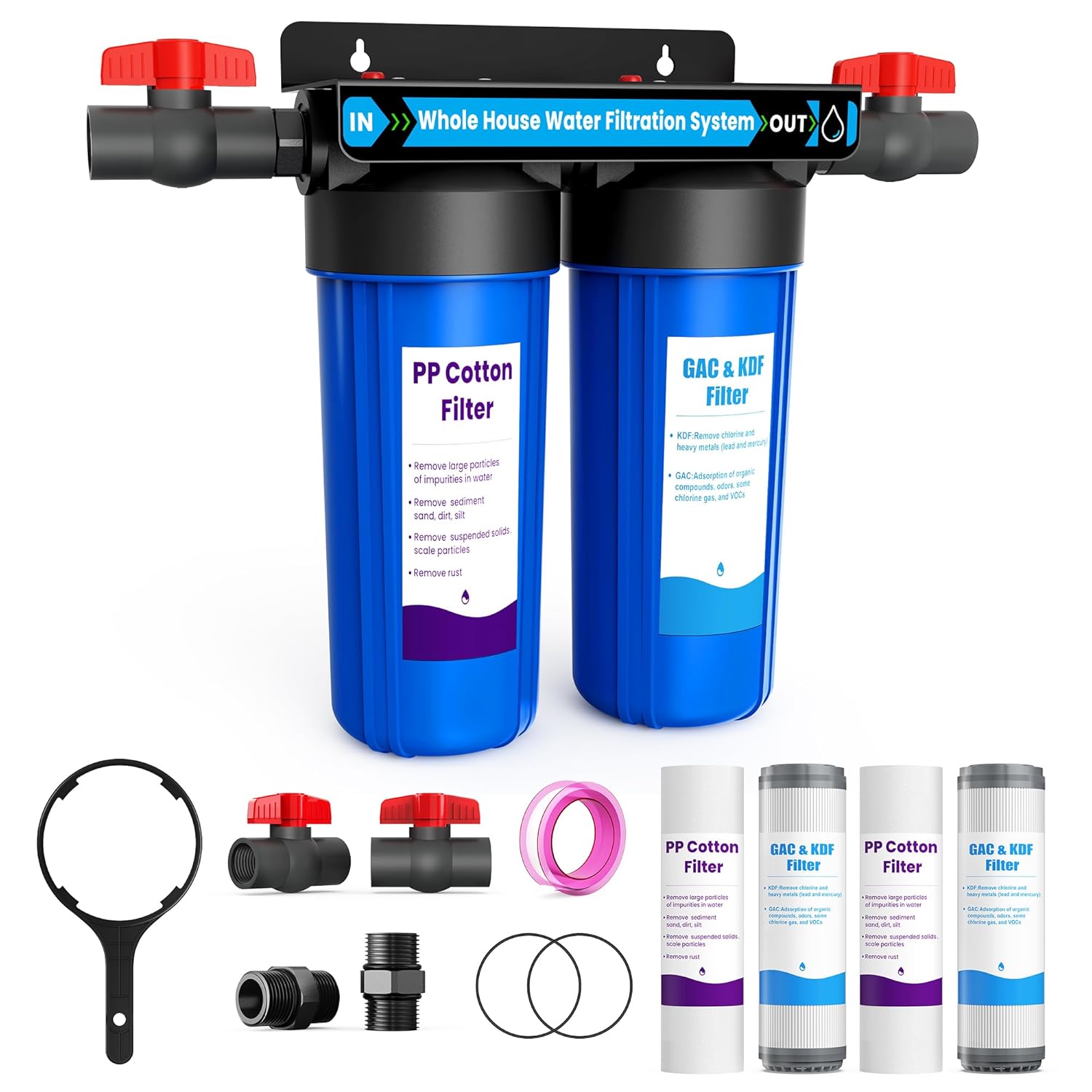
| Filtration Method | PP+GAC&KDF 2-stage |
|---|---|
| Micron Rating | 0.5 micron |
| Maximum Flow Rate | 15 gpm |
| Capacity | 8000 gallons |
| Filter Life Cycle | 24 months |
This XINSHUO two-stage whole-house system uses a PP sediment stage plus a GAC&KDF stage to cut chlorine, heavy metals and odor at every faucet. It is installed inline on the main water feed and sized for 3/4" connections, and the dual-valve housing lets you change cartridges without shutting off the whole house. With a manufacturer-rated 15 GPM maximum flow it can keep water pressure steady for showers, laundry and appliances while the included spare filter sets extend functional life between purchases. The 0.5 micron composite element targets fine particulates and the seller recommends replacing cartridges every 4 to 6 months for drinking and bathing quality, or up to 12–24 months depending on use and spare sets. Practical limits: it does not soften water like a salt-based softener and a TDS meter may not show changes because beneficial minerals are retained. Installation is straightforward for a DIYer familiar with plumbing fittings but professional help may be desired for complex setups.
Best for: Buyers looking for an affordable whole-house filter that improves shower and tap water quality on a budget and who want an easy-to-maintain system with spare cartridges included.
Less Ideal for: Homes needing a dedicated water softener or those seeking certified lab-tested removal of every contaminant should consider other specialized systems.
- Two-stage PP+GAC&KDF filtration removes chlorine, odors and many heavy metals.
- High 15 GPM flow rate suitable for whole-house use without noticeable pressure drop.
- Includes two extra replacement filter sets so you can swap cartridges without immediate repurchase.
- Dual independent shutoff valves let you replace filters without turning off the main water supply.
- 3/4" standard fittings and included connectors simplify installation with common household plumbing.
- Not a water softener so it will not reduce hardness or replace a salt-based softener.
- TDS readings may not change because beneficial minerals are left in the water, which can confuse some buyers.
Verdict: A budget-friendly whole-house two-stage system that reliably reduces chlorine and heavy metals while maintaining high flow and including spare filters for easy upkeep.
iSpring WGB32BM 3-Stage Whole House Filter
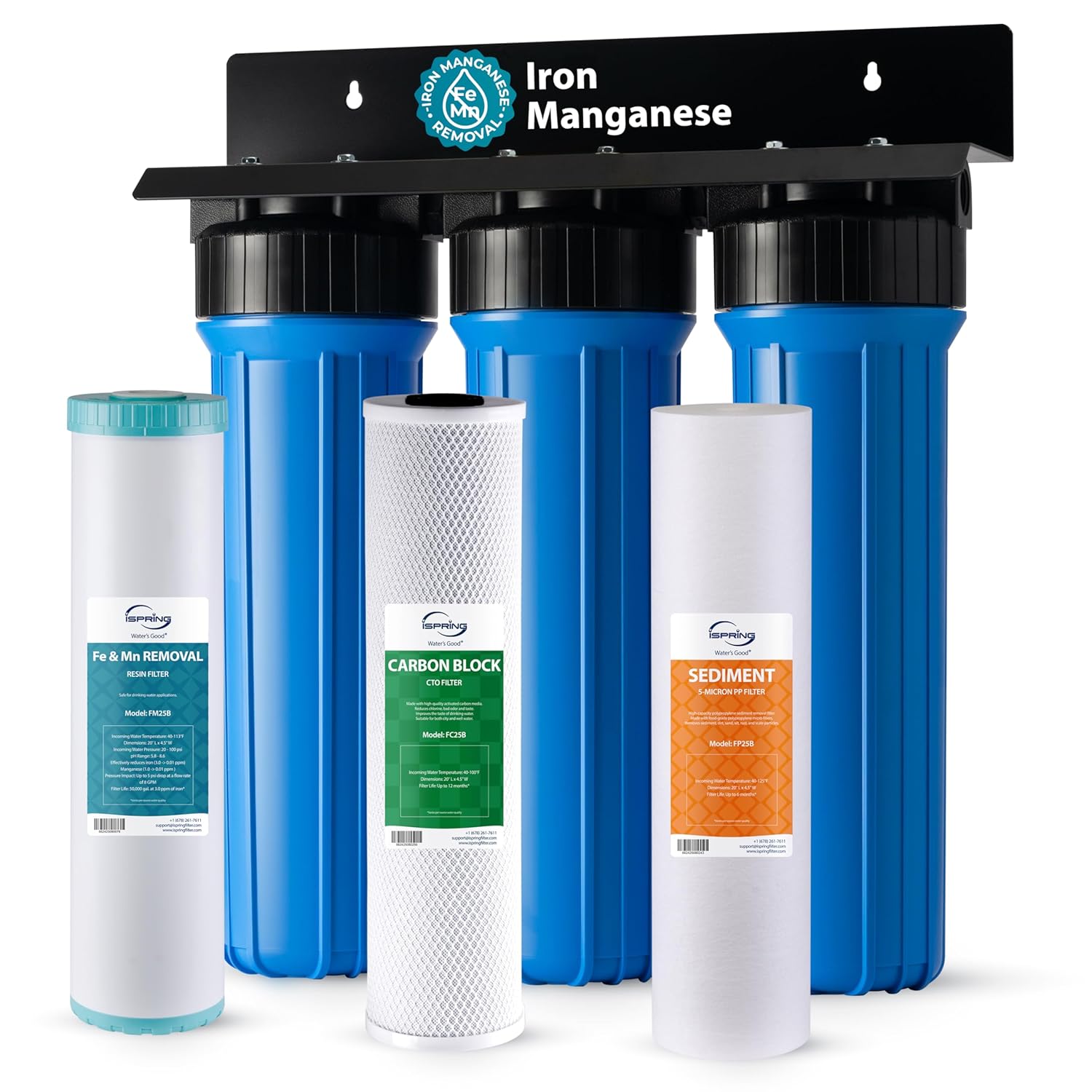
| Maximum Flow Rate | 15 gpm |
|---|---|
| Operating Pressure Range | 25 – 80 psi |
| Operating Temperature | 40 – 100 °F |
| Inlet / Outlet | 1 inch NPT |
| Filter Life Cycle | 1 years |
The iSpring WGB32BM is a three-stage, tankless whole-house filter designed to treat incoming municipal or well water at the main line. It uses a 20-inch big blue polypropylene sediment cartridge, a coconut-shell carbon block, and a catalytic iron/manganese stage to remove visible particulates, chlorine, odor and reduce iron and manganese to low levels; the carbon and sediment cartridges are rated for up to 100,000 gallons and the iron stage is rated for 50,000 gallons at the stated iron concentration. With a 1-inch NPT inlet/outlet and a peak flow capacity up to 15 GPM, the system can support typical household demands without noticeable pressure loss. Installation is intended as a permanent, indoor setup and is described as DIY-friendly with online videos and support. Limitations to note: it does not soften water or lower TDS, so hard-water minerals that affect hair texture will require a separate softener, and the iron/manganese reduction has specified maximum influent levels for guaranteed performance. Replacement cartridges and occasional maintenance are required to maintain effectiveness.
Best for: Buyers who prioritize a reliable, high-flow whole-house filter to cut chlorine, sediment, and moderate iron/manganese for healthier hair, skin, and household plumbing.
Less Ideal for: Homes with very hard water or iron/manganese above the stated limits should pair this with a softener or choose a system rated for higher contaminant loads.
- Three-stage filtration targeting sediment, chlorine/taste/odor, and iron/manganese for broad contaminant reduction
- High-capacity cartridges (up to 100,000 gallons for sediment and carbon) reduce replacement frequency
- Designed for high household flow with up to 15 GPM and minimal pressure loss
- DIY-installable with 1-inch NPT connections and manufacturer support resources
- Does not remove hardness or lower TDS so it will not replace a water softener
- Iron and manganese reduction is limited to specific influent concentrations and may be insufficient for very high levels
Verdict: Choose the iSpring WGB32BM if you want a dependable, high-capacity whole-house filter that reduces chlorine, sediment, and moderate iron/manganese while keeping strong household water flow.
Culligan WH-HD200-C Whole House Filter

| Maximum Flow Rate | 10 gpm |
|---|---|
| Supported Water TDS Level Maximum (PPM) | 600 |
| Capacity | 16000 gallons |
| Material Type | Stainless Steel |
The Culligan WH-HD200-C is a stainless-steel capped whole-house filter housing that mounts at your water main and works with compatible 1-inch replacement cartridges (sold separately) to remove sediment, rust, sand, silt and improve taste and odor. It is typically installed at the point of entry to protect appliances, water-using fixtures and downstream plumbing by stopping coarse and fine particles before they circulate through the home. Notable features include a clear sump so you can visually inspect the cartridge, an integrated bypass and built-in shut-off and pressure relief valves for easier cartridge changes, and a mounting bracket with a housing wrench included. Because the unit is a housing only, you must choose the right cartridge for the contaminants you care about and replace it on schedule; flow rate and effectiveness depend on the cartridge selected. The heavy-duty construction and simple manual valves make it a durable, serviceable choice for homes that need dependable sediment protection rather than chemical or specialty contaminant removal.
Best for: Homeowners who want a robust point-of-entry sediment and particulate solution and who prefer to inspect and service a visible, serviceable housing rather than a sealed or turnkey system.
Less Ideal for: People seeking a complete chemical, taste or microbiological treatment solution out of the box or those unwilling to select and replace separate cartridges regularly.
- Stainless steel cap and durable housing engineered for heavy-duty residential use
- Clear sump lets you visually check cartridge condition without disassembly
- Built-in shut-off, bypass and pressure relief valves simplify cartridge changes
- Supports up to 10 gpm maximum flow rate for typical household demand
- Filter cartridge is sold separately so additional purchases are required to treat specific contaminants
- Does not remove chemicals or microbes by itself; performance depends on cartridge selection
Verdict: Choose the WH-HD200-C if you want a heavy-duty, visible whole-house housing that protects plumbing from sediment and is easy to service with the right replacement cartridge.
SimPure DB10C 10" x 4.5" Housing
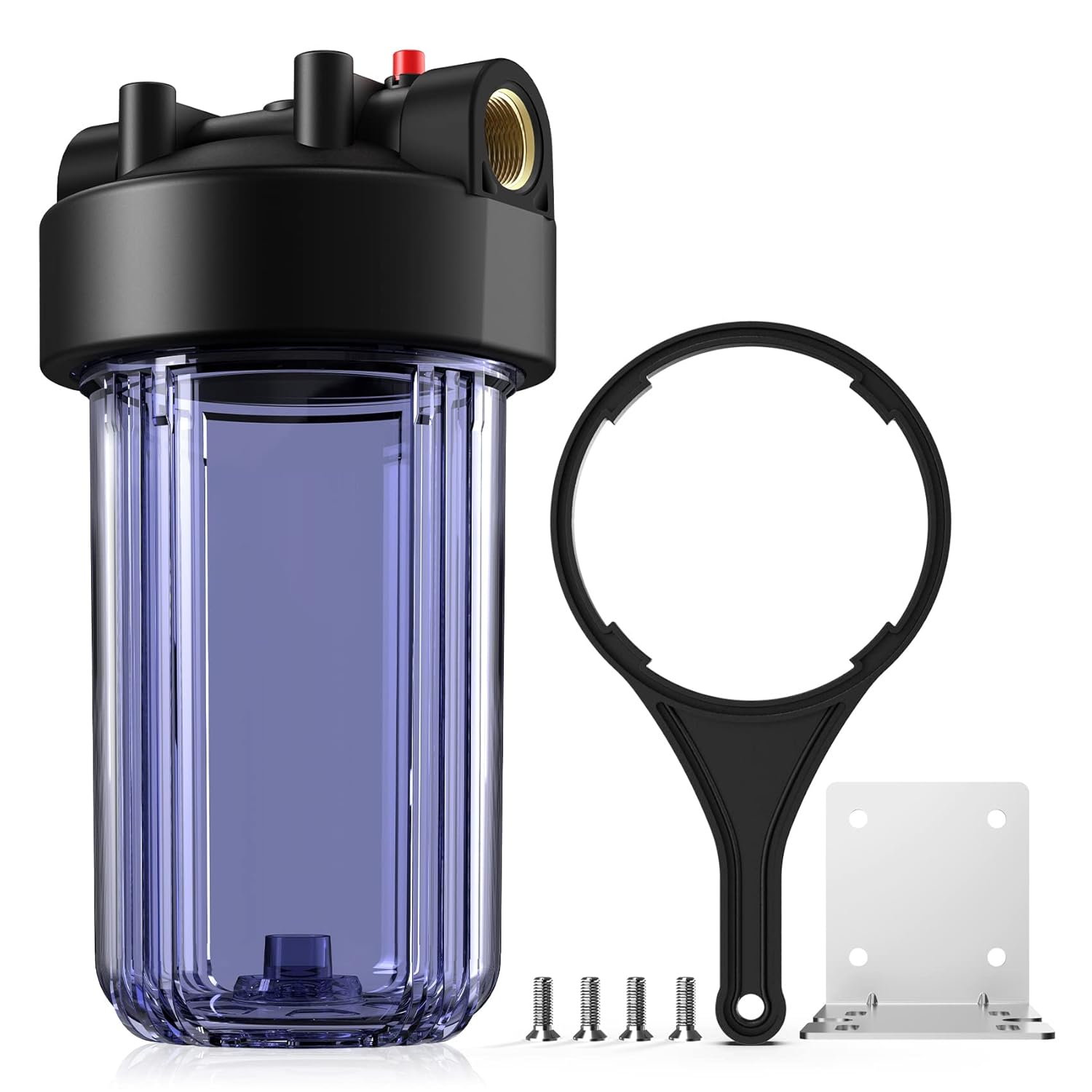
| Inlet/Outlet | 1" NPT Brass Port |
|---|---|
| Compatible Filter Dimensions | 10" x 4.5" |
| Maximum Flow Rate | 20 gpm |
| Applicable Water Temperature | 41-104 °F |
| Working Water Pressure Range | 15-90 PSI |
The SimPure DB10C is a standalone whole-house filter housing built to hold 10" x 4.5" filter cartridges for pre-filtration of municipal or well water. It installs inline on a 1" NPT supply using the included mounting bracket and wrench, and the clear polypropylene bowl makes it easy to see cartridge condition without disassembly. The brass inlet and outlet and double O-ring design improve sealing compared with lower-end plastic housings, and a built-in red pressure-relief button simplifies cartridge changes. It supports common cartridge types such as sediment and granular activated carbon so you can address chlorine, sediment, and basic taste and odor issues that affect hair and skin. The housing is rated for up to 20 gpm and works across typical household pressures, but cartridges are sold separately so you must choose the correct filter media for softening or more advanced contaminant removal. Also allow clearance for the larger housing when planning installation and replacement.
Best for: Buyers who want a dependable, easy-to-service pre-filter housing to reduce sediment and chlorine that can dull hair and increase styling issues, and who prefer visible, serviceable components and robust brass fittings.
Less Ideal for: Those seeking a single product to remove hardness, heavy metals, or perform conditioning should consider dedicated softeners or multi-stage filtration systems instead.
- Clear housing lets you visually monitor cartridge condition
- 1" NPT brass ports and double O-ring design for improved leak resistance
- Includes mounting bracket and wrench for straightforward installation
- Built-in pressure-relief button eases cartridge replacement
- Compatible with standard 10" x 4.5" sediment and carbon cartridges
- Filter cartridges are not included so additional purchase is required
- Does not remove hard water minerals or perform softening without appropriate cartridges or additional equipment
Verdict: Choose the SimPure DB10C when you want a sturdy, easy-to-service whole-house housing to host sediment or carbon cartridges that help protect hair and downstream appliances.
Choosing the Right Whole-House Water Filter for Hair: Key Factors to Consider
Contaminants That Affect Hair
Hard water minerals and chlorine are the two primary contaminants that change hair feel and appearance. Dissolved calcium and magnesium deposit on strands, causing stiffness, dullness, and reduced manageability. Free chlorine and chloramines can strip natural oils, fade color-treated hair, and irritate the scalp.
When evaluating whole-house systems for hair, look for credible performance data or third-party testing showing significant reduction of these specific contaminants. A filter that targets particles alone will help with visible sediment but will not address mineral scale or oxidizing disinfectants that cause most hair issues.
Flow Rate and Household Demand
Whole-house filters must deliver adequate gallons per minute to serve showers, faucets, and appliances simultaneously without a noticeable pressure drop. If a system cannot maintain adequate flow at peak usage, showers will feel weak and user experience will suffer.
Choose systems rated for your household peak flow. Consider how many bathrooms run at once and whether you have high-flow showerheads. Some media or softening systems are available in different flow capacity models; match capacity to the home to avoid throttling water delivery.
Filter Type and Mechanism
Different technologies address hair issues in different ways. Activated carbon is effective for chlorine and many organic contaminants, while ion exchange and template-assisted crystallization target hardness minerals to reduce scale buildup. Reverse osmosis is not practical for whole-house use but excels at point-of-use treatment.
Understanding the mechanism helps set expectations. Carbon will improve chlorine-related effects quickly. Scale-control media or softening will reduce mineral deposits but may require salt or specialized media and change water mineral content. Some systems combine multiple stages to treat both chlorine and hardness.
Maintenance Frequency and Consumables
Regular maintenance affects the long-term cost and convenience of a whole-house water filter. Cartridge changes, media replacement, and salt or resin regeneration intervals vary widely between systems. Frequent replacements increase ongoing effort and expense, which can reduce the practical benefit of a high-performing system.
Assess how easy it is to access housings, whether tool-free changes are possible, and how long replacement elements last. Availability of standard-sized cartridges and clear service intervals makes upkeep predictable for homeowners.
Installation and Plumbing Compatibility
Whole-house systems are installed at the main water line and must match pipe size, water pressure, and space constraints. Some systems are designed for straightforward homeowner installation while others require a licensed plumber. Incorrect installation can cause leaks, pressure loss, or bypassing of treatment.
Confirm inlet/outlet sizes, required clearances for replacement, and whether bypass valves are included. If you rent, check whether the property permits permanent alterations. For homes with specific water heaters or pressure setups, verify the system will integrate without special adapters.
Water Use and Household Preferences
Your household water usage patterns affect which system makes the most sense. A family with multiple morning showers needs higher flow capacity and longer-lasting media, while a single-person household may prioritize lower upfront cost and compact size. Preferences for mineral content also matter; some owners prefer softened water, while others want mineral reduction without fully softening to retain a natural feel.
Consider whether you want a system that changes total dissolved solids significantly or one that reduces specific irritants while keeping most minerals intact. That decision will influence the technology you select and the maintenance regimen required.
How Different Filter Technologies Affect Hair
Not all whole-house treatments work the same way on hair. Activated carbon absorbs chlorine and many organic compounds that can strip oils and cause odor. Systems that include dedicated carbon stages often provide the most immediate improvement in hair softness and scent.
Water softening technologies, including ion exchange and newer salt-free scale-control media, reduce the formation of mineral deposits on hair. Ion exchange replaces calcium and magnesium with sodium or potassium, which noticeably reduces scaling. Salt-free options alter the way minerals crystallize so they do not adhere to surfaces, which can lessen buildup without adding sodium.
Combination systems that pair a carbon stage with a hardness control stage are common for hair-focused installations because they address both oxidative disinfectants and scale-forming minerals.
- Carbon stages target chlorine and many organics that dry hair
- Ion exchange provides strong scale reduction but changes mineral composition
- Salt-free scale control reduces buildup without adding sodium
- Multi-stage systems treat multiple causes of hair damage
Sizing a System for Your Home
Match system capacity and flow rating to your household peak demand. Check the rated gallons per minute at a realistic pressure range rather than single-figure marketing claims. Under-sizing can result in low shower pressure when multiple fixtures run.
Also consider filter throughput and media capacity. Homes with hard water will process more mineral load and may require larger or more frequent media replacements. If a system lists service life in gallons, divide that by your average daily usage to estimate actual replacement intervals.
- Estimate peak simultaneous fixture use to determine flow needs
- Convert media life in gallons to expected months between service visits
- Allow clearance around the unit for cartridge or media access
Maintenance Best Practices
Follow the manufacturer-recommended replacement schedule to preserve performance for hair-related contaminants. Clogged carbon or exhausted softener resin reduces effectiveness and can increase pressure drop. Keep a simple maintenance log to track replacement dates and avoid reactive changes only when issues appear.
Inspect pre-filters and housings periodically for visible sediment. If you have higher sediment loads, adding a sediment pre-filter can protect downstream media and extend the life of carbon or softening stages. For ion exchange softeners, monitor regeneration cycles, salt levels if applicable, and perform annual brine tank inspection.
- Record installation and replacement dates
- Add sediment pre-filter in turbid supplies
- Check pressure drop as an early sign of clogged elements
Common Installation Considerations
Plan location near the main water line where you have space for service clearances and a bypass valve. Bypass loops are useful for servicing the unit without interrupting water to the house. Ensure the system connections match local plumbing materials and code requirements.
Some systems require electrical power for pumps or electronic controls. Confirm proximity to an outlet and ensure outdoor or basement installations account for freezing risk. If you are unsure about plumbing modifications, engage a professional to avoid warranty or code issues.
- Install near main shutoff with a bypass valve
- Verify electrical needs and freeze protection
- Follow local plumbing codes for materials and connections
How To Measure Effectiveness For Hair
Track a few simple metrics after installation to gauge hair-related improvements. Note changes in hair softness, ease of detangling, and how often you need clarifying treatments or heavy conditioners. Also pay attention to reduced scale on showerheads and bathroom fixtures.
On the technical side, test water for residual chlorine and hardness before and after installation. Reduced chlorine and a measurable drop in hardness or scale formation correlates with better long-term hair condition. If you perform color treatments, monitor color retention as an indirect sign of reduced oxidative damage.
- Observe tactile changes in hair and detangling effort
- Inspect shower fixtures for reduced scale buildup
- Use water tests for chlorine and hardness to confirm performance
How We Chose the Best Whole-House Water Filter for Hair
We focused on filtering solutions that directly address the contaminants and factors known to affect hair texture and manageability. Our editorial filters prioritized systems with documented effectiveness at reducing chlorine and chloramines, scale-forming minerals, and particulate matter that contribute to buildup on hair and scalp. We also considered flow retention and capacity because whole-house systems must preserve household water pressure and deliver sufficient liters per minute for simultaneous fixtures. Key criteria included contaminant reduction performance for chlorine and hardness minerals, filter lifespan and maintenance frequency, system flow rate and pressure drop at typical residential demand, and installation complexity for standard plumbing. We excluded point-of-use devices and treatments that only address water smells or taste but do not materially change mineral or chlorine content. Systems that require frequent consumable replacement with high ongoing maintenance burdens were deprioritized unless they offered superior contaminant control. Finally, durability of housings and availability of standard replacement elements were factored into selection to ensure practical long-term ownership.
Our full evaluation process is outlined in our review methodology.
FAQ
Will a whole-house filter remove chlorine that damages hair?
Often yes. Systems with an activated carbon stage typically reduce free chlorine effectively. Performance depends on contact time and carbon quantity, so choose a system sized for your flow and chlorine concentration.
Do I need a water softener to prevent mineral buildup on hair?
It depends on hardness levels. Softeners or scale-control media reduce mineral deposition and are most useful in truly hard water. In moderately hard supplies, a carbon-plus-scale-control combination may be sufficient.
How often will I need to replace filters or media?
Replacement intervals vary by system, water quality, and household use. Cartridge-based carbon filters often need changing every 6 to 12 months, while media beds or resins can last longer with periodic regeneration or multi-year replacement cycles.
Can a whole-house system change the feel of tap water for other uses?
Yes. Systems that reduce chlorine and minerals will alter water feel for showers and laundry and may affect soap lather and appliance scale. That can be beneficial for fabric softness and appliance longevity, but expectations should be set based on the chosen technology.
Is installation complicated for a whole-house hair-focused system?
Installation ranges from straightforward to complex depending on unit size and plumbing. Many units are plumbed in by a homeowner with basic skills, but larger systems or those needing electrical connections or drain lines should be installed by a professional.
Final Verdict
Prioritize reduction of chlorine and management of hardness when choosing a whole-house water filter for hair. Carbon stages address oxidative chemicals that strip oils while softening or scale-control media prevent mineral buildup that makes hair stiff and dull. Balance your household flow needs, maintenance tolerance, and installation constraints when selecting a system. The right approach depends on your local water chemistry and daily routines. Focus on verified contaminant reduction, realistic flow ratings, and predictable maintenance intervals to get the most consistent hair benefits from a whole-house solution.