
Note: This article contains affiliate links. If you click on these links and make a purchase, we may earn a small commission at no extra cost to you. This helps support our research and content. Read our full affiliate disclosure here.
If you spend long stretches outdoors or maintain a basecamp near backcountry water sources, a whole-house water filter for hiking can keep your group fed, cleaned, and healthy. These systems focus on removing sediment, microbes, and common contaminants while delivering steady flow to tents, showers, and camp kitchens. Choosing the right unit matters because poor filtration risks illness and an inadequate flow can complicate everyday camp tasks. This guide shortlists the top picks suited to hiking and basecamp use, explaining the attributes that matter in the field. We evaluated durability, filtration performance, and how easy units are to transport and maintain to help you pick the best option for your outdoor setup.
Top Picks at a Glance
| Best Overall The best all-around choice for most situations | Waterdrop WHF3T-PG Whole House Filter |  |
| Best Quality Built to a higher standard if you want something more solid | Express Water 3-Stage Whole House System |  |
| Best Value The sweet spot between price and what you get | iSpring WGB32BM 3-Stage Filter |  |
| Best Budget The cheapest option that still gets the job done reliably | Culligan WH-S200-C Sediment Filter |  |
| Top Rated A top-rated pick with lots of positive feedback | iSpring WGB21B 2-Stage Whole House Filter |  |
| Most Popular A crowd favorite that many people choose with confidence | Culligan WH-HD200-C Whole House Filter |  |
| Best Seller A high-volume bestseller chosen again and again | SimPure DB10P Filter Housing |  |
Waterdrop WHF3T-PG Whole House Filter

| Purification Method | Activated Carbon, Ion Exchange |
|---|---|
| Maximum Flow Rate | 15 gpm |
| Supported Water TDS Level Maximum (PPM) | 1000 |
| Filter Life Cycle | 12 months |
| Capacity | 100000 gallons |
The Waterdrop WHF3T-PG is a three-stage whole-house filter designed to remove sediment, chlorine taste and odor, and some heavy metals using a combination of PP cotton, KDF, granular activated carbon, and carbon fiber media. It sits on the main supply line and is intended to protect plumbing and appliances while improving water for showers, laundry, and general household use. Notable features include NSF/ANSI 372 lead-free certification, a rated 15 gpm maximum flow that supports typical household demand, and a suggested filter life of about 12 months or 100,000 gallons under normal conditions. Installation is straightforward for someone handy but the unit requires 1" plumbing connections and enough clearance for cartridge changes, and the manufacturer recommends professional help if you are unsure. This is not a water softener or an RO system, so it will not reduce TDS or soften hard water. For a balanced buyer seeking improved everyday water quality across a whole home, it offers durable construction and long service life, though homes with very hard water or unusually high contaminant loads may need complementary systems.
Best for: Buyers who want a durable, low-maintenance whole-house filter to improve tap and shower water quality across an average household without adding a softener or RO system.
Less Ideal for: Homes primarily seeking scale control, TDS reduction, or drinking-water-level purification should consider a dedicated water softener or reverse osmosis system instead.
- Three-stage filtration combining sediment, KDF and granular activated carbon for broad chlorine, odor, and particulate reduction
- NSF/ANSI 372 certified lead-free components for material safety
- High flow capacity up to 15 gpm to support normal household simultaneous use
- Long rated service life (about 12 months or up to 100,000 gallons) reduces replacement frequency
- Does not reduce total dissolved solids or soften hard water
- Requires 1" plumbing connections and sufficient clearance for cartridge changes
Verdict: A robust, certified three-stage whole-house filter that delivers reliable chlorine and sediment reduction with high flow for everyday household use.
Express Water 3-Stage Whole House System

| Purification Method | Activated Carbon, KDF, Polyphosphate |
|---|---|
| Maximum Flow Rate | 17 gpm |
| Operating Pressure Range | 20-80 psi |
| Filter Life Cycle | 6 months |
| Capacity | 100000 gallons |
This Express Water 3-stage system is built as a heavy-duty, point-of-entry filter that treats all water entering a house. It uses sediment and activated carbon stages plus KDF/polyphosphate treatment to cut chlorine, bad tastes and odors, reduce heavy metals, and add anti-scale protection before water reaches pipes and appliances. The unit mounts on a stainless steel free-standing frame and includes pressure gauges and pressure-release buttons to simplify monitoring and filter changes. With a rated flow capacity up to 17 gpm and support for up to 100,000 gallons between major service intervals, it can handle robust household demand without noticeable pressure loss when installed within the specified pressure range. Trade-offs are that it does not lower TDS and filters should be replaced roughly every 6 to 12 months depending on usage and water quality, so ongoing filter cost and maintenance are considerations. For performance-focused buyers who want whole-home contaminant reduction and scale control, this system delivers professional-style components and serviceable cartridges.
Best for: Buyers who prioritize whole-house performance and want a robust, serviceable system to reduce chlorine, heavy metals and scale across every tap in a home.
Less Ideal for: People who need TDS reduction or reverse osmosis-quality drinking water at the tap should instead consider dedicated RO systems or point-of-use filters.
- Three-stage filtration combines sediment, activated carbon and KDF/polyphosphate for broad contaminant reduction
- Stainless steel free-standing frame with included pressure gauges for easy installation and monitoring
- High flow capacity (up to 17 gpm) suitable for full-house use without noticeable pressure drop
- Anti-scale polyphosphate stage helps protect plumbing and appliances from scale buildup
- Rated for up to 100,000 gallons and a 6–12 month filter replacement cadence depending on use
- Does not reduce total dissolved solids (TDS) or perform reverse osmosis-level filtration
- Requires periodic cartridge replacement and basic maintenance to retain performance
Verdict: A high-flow, serviceable 3-stage whole-house system for performance-minded homeowners who want broad contaminant reduction and scale protection across the entire house.
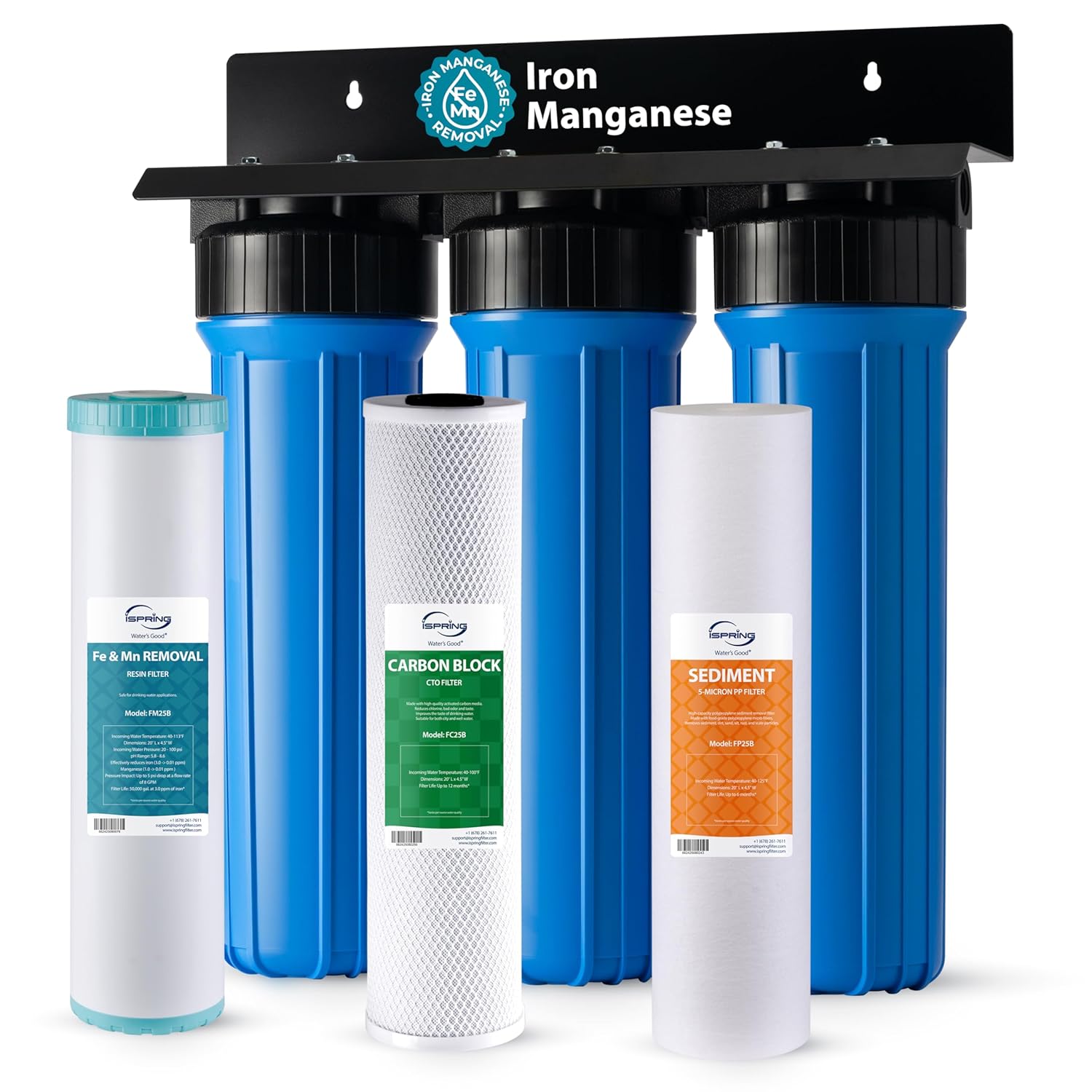
iSpring WGB32BM 3-Stage Filter
| Maximum Flow Rate | 15 gpm |
|---|---|
| Operating Pressure Range | 25 – 80 psi |
| Operating Temperature | 40 – 100 °F |
| Inlet / Outlet | 1 inch NPT |
| Capacity | 100000 gallons |
The iSpring WGB32BM is a tankless, 3-stage whole-house filter built to sit on the main water line and treat all water entering a home. Water first passes a polypropylene sediment cartridge that traps sand, rust and large particles, then through a coconut-shell carbon block that reduces chlorine, taste and odor, and finally through a catalytic iron and manganese stage that lowers iron and manganese to near 0.01 ppm within the system's rated limits. It is sized for high flow use with a 1-inch inlet/outlet and a peak flow rate up to 15 gpm, so it can support multiple fixtures without noticeable pressure loss. Filters are rated to last up to 100,000 gallons or about 12 months for the carbon stages and 50,000 gallons for iron at specified contaminant levels, and replacement cartridges are straightforward to swap. The system will not remove hardness or dissolved solids, so houses with very hard water should add a softener ahead of this unit. Installation is intended to be DIY-capable but requires plumbing connections and indoor mounting in a protected area.
Best for: Buyers who want a practical, high-capacity whole-house filter to improve water taste and remove visible sediment and modest iron or manganese for everyday household use.
Less Ideal for: Homes with very hard water, very high iron/manganese levels, or buyers seeking reverse-osmosis level TDS reduction should consider a softener, a different iron-specific system, or an RO system instead.
- Three-stage filtration targets sediment, chlorine/taste/odor, and iron/manganese
- High peak flow rate (up to 15 gpm) suitable for whole-house use with minimal pressure loss
- Long service life per cartridge (up to 100,000 gallons or ~12 months for carbon stages)
- 1-inch NPT plumbing connections and tankless design simplify integration with home plumbing
- Does not reduce water hardness or total dissolved solids
- Not rated for iron or manganese levels above the specified maximums without upgrading to a different model
Verdict: A durable, high-flow 3-stage whole-house filter that delivers clearer, better-tasting water and removes modest iron and manganese for practical year-round household protection.
Culligan WH-S200-C Sediment Filter

| Maximum Flow Rate | 4 gpm |
|---|---|
| Upper Temperature Rating | 100 °F |
| Supported Water TDS Level Maximum (PPM) | 1000 |
| Capacity | 16000 gallons |
| Installation Type | Whole House Water Tank |
The Culligan WH-S200-C is a simple whole-house sediment filter housing that keeps sediment out of plumbing and appliances by holding replaceable cartridges (compatible with Culligan P5, CW-F, CW-MF and S1A-D). It installs on a 3/4" inlet/outlet and uses water pressure to operate, with a valve-in-head bypass and built-in pressure relief button to make cartridge changes easier. The clear housing lets you visually monitor cartridge condition so you can swap filters before flow suffers, and the stainless-steel material and NSF/ANSI testing for material safety suggest durable, safe construction. With a stated maximum flow of 4 gpm and capacity information tied to cartridge life, it is best for point-of-entry sediment control rather than fine chemical or microbiological treatment. Buyers should plan on periodic cartridge replacements and confirm cartridge choice for their sediment load, since the housing itself does not filter without an appropriate cartridge installed.
Best for: Practical buyers focused on keeping sediment out of plumbing and appliances who want an affordable, easy-to-maintain point-of-entry housing that accepts common Culligan cartridges.
Less Ideal for: People needing high-flow whole-house treatment, chemical removal, or microbial disinfection should choose a different multi-stage or specialized system.
- Clear housing allows quick visual checks of cartridge condition
- Valve-in-head bypass and pressure relief button simplify cartridge changes
- Compatible with several Culligan cartridge types for flexible sediment removal
- Stainless-steel construction and material safety certifications add durability and safety
- Maximum flow rate of 4 gpm limits use on larger whole-house systems
- Housing requires compatible cartridges to perform filtration and does not treat chemicals or microbes
Verdict: A budget-friendly, easy-to-service sediment filter housing ideal for hikers and outdoors-oriented homeowners who need reliable point-of-entry sediment protection for gear and plumbing.
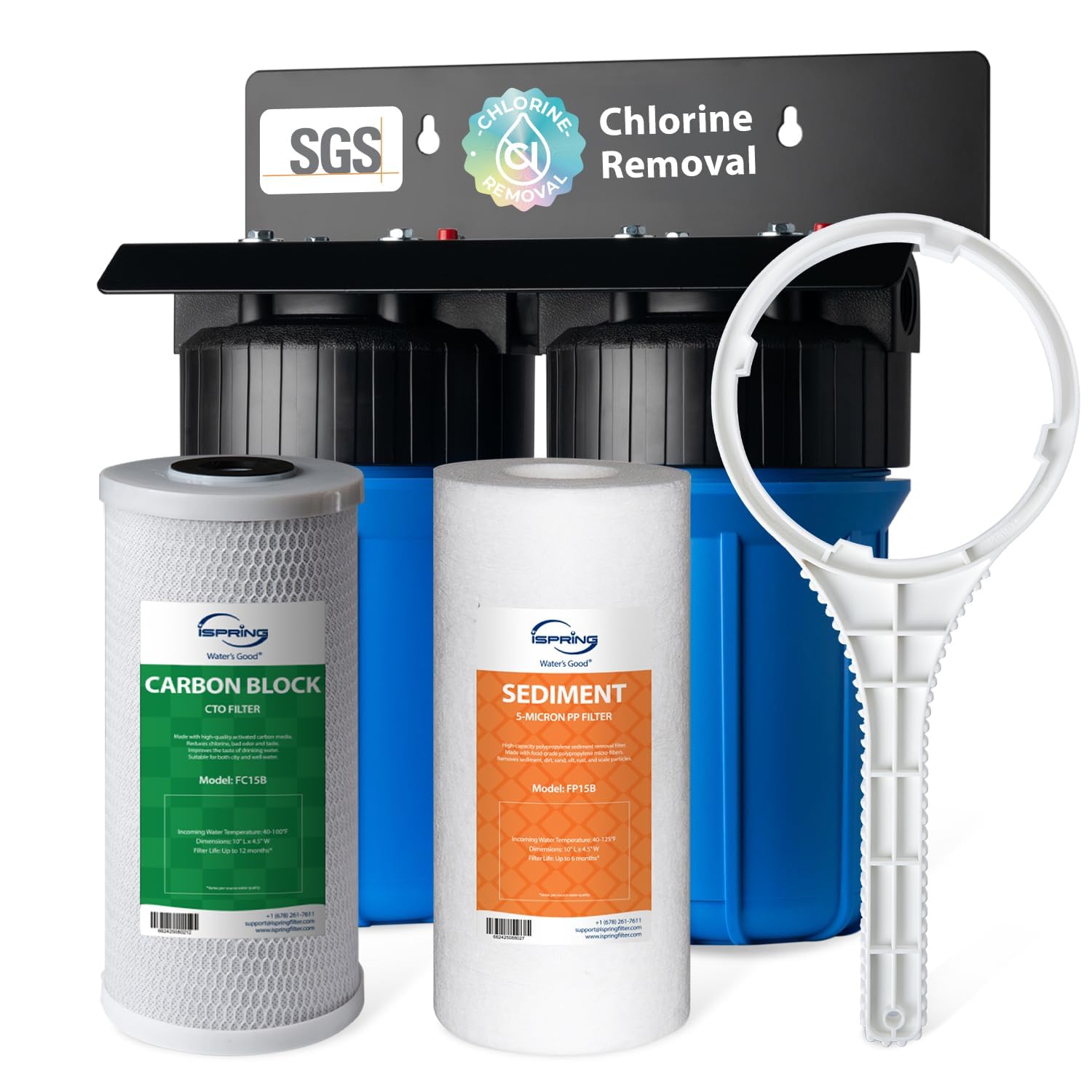
iSpring WGB21B 2-Stage Whole House Filter
| Filter Life Cycle | 12 months |
|---|---|
| Maximum Flow Rate | 15 gpm |
| Operating Pressure Range | 25 – 80 psi |
| Operating Temperature | 40 – 100 °F |
| Inlet / Outlet | 1 inch Female NPT |
The iSpring WGB21B is a two-stage point-of-entry filter that combines a 5-micron polypropylene sediment cartridge with a coconut-shell carbon CTO block to protect plumbing and improve water taste across a home. It is designed for straightforward DIY installation with preassembled housings, a mounting bracket, a filter wrench, and video/manual guidance, and it includes a pressure-relief valve to make cartridge changes safer and easier. The filters are rated to treat up to 50,000 gallons or about 12 months for an average family, and the 1" ports support high flow rates with minimal pressure loss, which helps avoid snarling faucets or appliances. Because it does not remove dissolved solids, it preserves healthy minerals while tackling chlorine and many VOCs. Limitations to consider are the annual filter replacement interval under typical conditions and the need to install the unit indoors or properly weatherproofed outdoors to avoid freezing or UV exposure; for sediment-heavy supplies you may need a more aggressive prefilter setup. For buyers prioritizing a durable, no-power whole-house prefilter and chemical/odor reduction, this is a practical, reliable choice.
Best for: Buyers who need a dependable, low-maintenance whole-house prefilter that reliably removes sediment and chlorine to protect plumbing and improve water taste without electrical parts or complex servicing.
Less Ideal for: Anyone seeking a system to remove dissolved solids, salts, or heavy metals as their primary goal, or people who require an under-sink or portable filtration solution for trail or campsite use.
- Two-stage filtration targets sediment first then chlorine and VOCs for clearer, better-tasting water
- High nominal capacity up to 50,000 gallons or ~12 months under normal use
- Preassembled mounting bracket and included filter wrench simplify DIY installation and routine service
- 1" inlet/outlet and up to 15 gpm flow rating minimize pressure loss for whole-house use
- Pressure relief valve and clear installation guidance reduce maintenance mistakes
- Does not reduce Total Dissolved Solids (TDS) or soften water
- Housings should be protected from freezing and direct sunlight when installed outdoors
Verdict: Choose the iSpring WGB21B when you want a rugged, factory-quality whole-house prefilter that consistently reduces sediment and chlorine with straightforward DIY installation and annual servicing.
Culligan WH-HD200-C Whole House Filter

| Maximum Flow Rate | 10 gpm |
|---|---|
| Supported Water TDS Level Maximum (PPM) | 600 |
| Capacity | 16000 gallons |
| Material Type | Stainless Steel |
The Culligan WH-HD200-C is a stainless-steel capped whole-house filter housing meant to sit at the point of entry on a 1-inch water main and hold a compatible sediment cartridge (sold separately). It is typically installed inline where you need to remove rust, sand, silt and coarse sediment before water reaches appliances and faucets. Notable features include a clear sump so you can visually monitor cartridge condition, an integrated mounting bracket, a built-in bypass and shut-off valve for service without shutting the house off, and a pressure relief valve plus the housing wrench for easy cartridge changes. Because it is a housing only, performance depends on the cartridge you choose, and you will need to pick the correct filter media for the contaminants you want removed. The unit is robustly built and aimed at reducing particulate and aesthetic issues rather than chemical contaminants, so use it as the first stage in a whole-house purification setup or where sediment is the main problem.
Best for: Buyers who prioritize a durable, serviceable point-of-entry sediment solution and want visible cartridge monitoring to make replacement decisions based on real-world condition and local feedback.
Less Ideal for: People needing chemical, taste-and-odor, or microbiological treatment as a single unit should look at multi-stage or specialized systems instead.
- Clear sump for visual monitoring of cartridge condition
- Built-in shut-off, bypass and pressure relief for easier servicing
- Stainless-steel cap and heavy-duty housing for durability
- Fits standard 1-inch inlet housings and supports 10 gpm maximum flow
- Filter cartridge sold separately so additional purchase and selection required
- Designed for sediment removal only and not a standalone solution for chemical contaminants or pathogens
Verdict: Choose this heavy-duty housing if you need a durable, easy-to-service point-of-entry sediment filter with visual cartridge monitoring as the first stage of a whole-house setup.
SimPure DB10P Filter Housing

| Maximum Flow Rate | 20 gpm |
|---|---|
| Inlet/Outlet | 1" NPT Brass Port |
| Compatible Filter Dimensions | 10" x 4.5" |
| Working Water Pressure Range | 15-90 PSI |
| Applicable Water Temperature | 5-38 °C (41-100 °F) |
The SimPure DB10P is a single-stage 10" x 4.5" filter housing intended as a pre-filter for whole-house systems to catch sediment and host a carbon or sediment cartridge. It mounts in-line with 1" NPT brass inlet and outlet ports and is built from reinforced, food-grade polypropylene with a brass-threaded top to reduce leaks. Typical use is as the first stage before downstream appliances and point-of-use filters, protecting water heaters, washing machines, and plumbing from sand, dirt, and chlorine. Installation is straightforward: the package includes a mounting bracket, screws and a wrench, and the built-in red pressure-relief button makes cartridge changes easier. The housing accepts standard 10" x 4.5" cartridges, so you can choose sediment, granular activated carbon, or pleated options depending on water quality. Limitations are that cartridges and push fittings are not included, and the unit needs adequate clearance for replacing filters; it also only provides single-stage filtration so it will not remove dissolved minerals or bacteria on its own.
Best for: Buyers who prioritize a durable, leak-resistant pre-filter to protect home plumbing and appliances and who prefer a simple, serviceable in-line housing.
Less Ideal for: People who need multi-stage purification, RO-level contaminant removal, or a complete portable treatment solution for backpacking or off-grid water treatment.
- Accepts standard 10" x 4.5" cartridges for flexible cartridge choices.
- 1" NPT brass inlet/outlet for higher flow and reliable threaded connection.
- Reinforced food-grade polypropylene body resists corrosion and physical stress.
- Includes mounting bracket, wrench and screws plus a pressure-relief button for easier service.
- Does not include filter cartridges or push fittings, so additional purchases are required.
- Single-stage housing only and will not address dissolved contaminants or microbiological hazards.
Verdict: A sturdy, easy-to-service 10" pre-filter housing that gives risk-averse buyers reliable protection for home plumbing by accepting common sediment and carbon cartridges.
Choosing the Right Whole-House Water Filter for Hiking: Key Factors to Consider
Filtration Efficiency
Filtration efficiency determines what contaminants the system will remove and is the single most important safety factor. Look for rated micron levels and verified pathogen reduction where possible. A lower micron rating typically removes more fine sediment and many bacteria, while specialized media or activated carbon layers address chemicals, tastes, and odors.
Understanding the kinds of water you expect to treat affects which efficiency specs matter. Clear mountain streams have different microbial and particulate concerns than silty river water, so choose a system whose documented capabilities align with the likely contamination profile.
Flow Rate and Pressure
A system with inadequate flow can make basic camp tasks slow and frustrating. Flow rate is typically measured in gallons per minute and varies with input pressure and filter loading. For a multi-person camp, prioritize models that sustain usable flow at low-field pressures or that include a gravity or pump-assisted option.
Consider peak usage scenarios such as simultaneous dishwashing and showering. Systems that maintain pressure or come with pressure regulators and surge protection will provide a steadier user experience in variable outdoor conditions.
Portability and Weight
Portability matters when your water treatment system must be transported to and from campsites. Weight, packed volume, and the ability to break down into smaller components affect how practical a system is for hiking trips. Some whole-house units feature modular housings or compact cartridge designs to reduce bulk.
Also factor in how easily the system mounts or stabilizes in camp. Lightweight mounts, removable brackets, or standalone housings that sit securely on uneven ground will save setup time and reduce the chance of damage in transit.
Durability and Materials
Outdoor use exposes equipment to UV, impacts, and temperature swings. Durable housings, reinforced fittings, and corrosion-resistant materials extend service life. Look for robust seals and fasteners that tolerate repeated assembly and disassembly without leaking.
Ease of sourcing replacement parts is part of long-term durability. Choose systems built with standard-sized cartridges and fittings when possible, so you can repair or refresh components even on extended trips.
Maintenance and Field Servicing
Regular maintenance keeps filtration working and prevents contaminants from bypassing media. Evaluate how easy it is to change cartridges, clean housings, and backflush or sanitize components in the field. Systems that require specialized tools or complex procedures are less practical for hiking.
Also note lifespan indicators such as cartridge life estimates by gallons or a visible sediment gauge. Clear maintenance intervals and simple replacement steps reduce the chance of user error and downtime at camp.
Compatibility and Setup Flexibility
How a system integrates with your campsite water sources and distribution matters. Check whether units support gravity feed, pump connections, or direct inline setups to supply taps and showers. Flexible inlet and outlet fittings or adapters help connect to different hose sizes and pump types commonly used in outdoor scenarios.
The ability to configure a system for either short-term stays or longer basecamps increases utility. Systems that can be quickly converted from transport mode to deployed mode will save time and reduce the need for extra gear.
Why Choose a Whole-House System for Hiking Use
Whole-house water filters for hiking are designed to treat all water entering a campsite distribution system rather than just a single cup or bottle. That makes them a better fit when you need safe water for cooking, washing, and multiple people at once. They are especially useful at remote basecamps, guide camps, and long-term field operations where repeated small treatments would be impractical.
These systems prioritize steady flow and comprehensive contaminant removal. While they are larger than personal filters, the tradeoff is convenience and reduced per-person effort when more than one person relies on a common water source.
- Treats all camp taps and spigots downstream
- Reduces repeated individual filtering tasks
- Supports multi-person camps and longer stays
Common Filtration Types and What They Do
Whole-house systems often combine multiple media layers to address sediment, microbes, and chemical contaminants. Typical arrangements include a sediment pre-filter, a microbiological membrane or cartridge, and activated carbon for taste and chemicals. Understanding these layers helps you match a system to the likely contaminants in your area.
Some units emphasize microfiltration for particles and bacteria, while others include media to reduce volatile organic compounds or heavy metals. For backcountry water sources, ensure the microbial barrier is adequate and that the carbon stage is compatible with the expected chemical load.
- Sediment filters protect subsequent media and improve flow
- Microbial membranes reduce protozoa and bacteria
- Activated carbon improves taste and removes some chemicals
Setting Up a Camp-Friendly Filtration System
Plan your setup around water source location and camp layout. If you rely on gravity, position the source container higher than the filter and distribution points. For pump-fed arrangements, use short, straight runs of hose and avoid elevations that exceed pump capacity. Keep the filter elevated and protected from rocks and direct sun when possible.
Ensure all connections are tight and use hose clamps or threaded adapters suitable for temporary installations. Label inlet and outlet lines so you avoid cross-connection errors during busy camp activities.
- Use gravity when pump power is limited
- Protect filters from UV and physical damage
- Short, straight hose runs preserve flow and pressure
Transport Tips and Packing Checklist
Break systems into their modular parts and pack cartridges separately to protect seals and media. Wrap housings in padding and stow fittings in a dry, accessible pocket so you can perform swaps without digging through gear. Carry basic spare parts such as O-rings and hose clamps to handle leaks or accidental damage.
Record the order of removal when you disassemble the unit so reassembly in the field is quick. Keep a small set of nonmetallic tools for clearing sediment and performing modest repairs.
- Pack cartridges in sealed bags to prevent contamination
- Bring spare O-rings and clamps
- Store instructions and a basic tool kit with the system
Sanitizing and Winter Care
Sanitize filter housings and replace cartridges on a schedule appropriate to usage and source water quality. Simple bleach solutions or manufacturer-recommended sanitizers are effective between seasons or when a contamination event occurs. After sanitizing, flush the system thoroughly before use.
If you expect freezing temperatures, drain housings completely and store components in insulated containers. Ice expansion can crack housings and fittings, so do not leave water in the system when temperatures will drop below freezing.
- Sanitize periodically and after contamination events
- Flush thoroughly after sanitizing
- Drain and store indoors in freezing conditions
How We Chose the Best Whole-House Water Filter for Hiking
We selected products that match the real-world demands of hikers who establish semi-permanent camps or need reliable water treatment on extended treks. Our editorial filters prioritized systems that combine proven contaminant reduction with rugged construction and practical transport considerations. We examined published performance data for particle and microbial removal, evaluated flow rates at realistic campsite pressures, and reviewed how filters handle common backcountry water sources like streams, lakes, and springs. Key exclusions included stationary residential units designed only for permanent plumbing, and devices intended solely for backpacking-sized personal filters. We also excluded systems without replaceable cartridges or without clear maintenance procedures. The dimensions and weight of each system, the availability and capacity of replacement cartridges, and the ease of field servicing were central to inclusion. Safety features such as backflow protection and clear contamination indicators were considered, as were compatibility and mounting options for temporary camp setups.
Our full evaluation process is outlined in our review methodology.
FAQ
Can whole-house filters remove bacteria and protozoa from natural sources?
Many whole-house systems include microbial barriers that reduce bacteria and protozoa, but not all provide the same level of protection. Check for verified microbial reduction ratings and consider a secondary treatment like UV or chemical disinfection if the source is high-risk.
How often do I need to replace filter cartridges in the field?
Replacement intervals depend on water quality and usage volume and are usually expressed in gallons or months. In silty conditions you may need to change sediment cartridges more frequently. Monitor flow decline and any visible discoloration as cues to swap media.
Are whole-house systems practical to carry on multi-day hikes?
Whole-house units are generally more practical for basecamps or extended stays rather than for lightweight day hikes. Some modular designs focus on portability, but you should weigh the added weight against the benefits of treating all camp water at once.
Can I use a whole-house filter with a gravity system or manual pump?
Yes, many units are compatible with gravity feed or manual pump setups. Confirm the minimum operating pressure and recommended inlet height for gravity use, and make sure pump output matches the filter's flow requirements.
What maintenance tools should I carry for field repairs?
A small kit with spare O-rings, hose clamps, a strap wrench or nonmetallic pry tool, and a basic cleaning brush covers most common issues. Including a small bottle of food-grade silicone lubricant can help maintain seals during repeated assemblies.
Final Verdict
Choosing the right whole-house water filter for hiking comes down to matching filtration performance with portability and serviceability. Prioritize systems with verified microbial protection if you treat natural sources, plus a flow rate that supports your camp's daily needs. Balance durable construction and easy maintenance against weight and packed volume to find a system that fits your travel style. For basecamp-focused hikers, favor devices that are rugged, easy to service in the field, and offer modular packing. Those tradeoffs will help you maintain safe drinking water and keep camp routines efficient on extended outdoor trips.