
Note: This article contains affiliate links. If you click on these links and make a purchase, we may earn a small commission at no extra cost to you. This helps support our research and content. Read our full affiliate disclosure here.
If your home draws from a well and you see rust stains, metallic taste, or staining on fixtures, a whole-house water filter designed for iron removal can make daily life better. The right system treats incoming water at the point of entry so every faucet and appliance gets cleaner water without repeated point-of-use workarounds. This guide covers seven shortlisted whole-house water filters selected for well water with iron, focusing on how effectively each handles iron alongside flow rate, maintenance demands, and installation needs. Below you will find practical guidance to match system capacity and treatment style to your household size and well water chemistry before the product details.
Top Picks at a Glance
| Best Overall The best all-around choice for most situations | DuraWater Fleck 5600 SXT 48K |  |
| Best Quality Built to a higher standard if you want something more solid | DuraWater Air Injection Iron Eater 1.0 cu ft |  |
| Best Value The sweet spot between price and what you get | PUREPLUS 2-Stage Whole House Filter |  |
| Best Budget The cheapest option that still gets the job done reliably | PUREPLUS 1-Stage Whole House Filter |  |
| Top Rated A top-rated pick with lots of positive feedback | iSpring WGB21BM Whole House System | 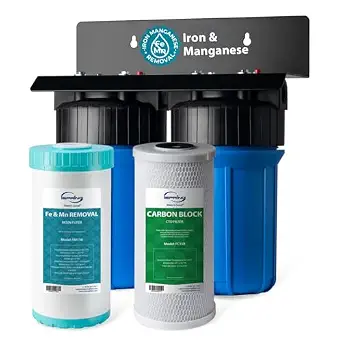 |
| Most Popular A crowd favorite that many people choose with confidence | iSpring WGB32BM 3-Stage Whole House Filter |  |
| Best Seller A high-volume bestseller chosen again and again | SimPure DB10P Filter Housing |  |
DuraWater Fleck 5600 SXT 48K

| Purification Method | Ion Exchange |
|---|---|
| Maximum Flow Rate | 14 gpm |
| Supported Water TDS Level Maximum (PPM) | 8 |
| Capacity | 1.5 cubic feet |
This combination unit pairs a fine-mesh ion exchange resin softener with an iron filtration stage and a Fleck 5600SXT digital metered valve to treat both hardness and dissolved iron for a household. It is designed for residential installations serving 2 to 5 people and 2 to 3 bathrooms and uses a meter-based regeneration that triggers only when water use requires it, which can save salt and water compared with time-clock systems. The 1.5 cubic foot resin tank and 48,000-grain capacity make it suitable for medium-sized homes, and the included bypass valve and DIY instructions simplify installation for homeowners comfortable with basic plumbing. Practical benefits include reduced scale on fixtures, fewer iron stains, and a programmable valve for convenient operation. Limitations are that it is a freestanding, corded electric system sized for typical homes on well water rather than very large households, and installation may still require space and occasional maintenance like salt refills and media replacement over time.
Best for: Homeowners on well water who want a single, programmable system that reduces both hardness and iron staining for a typical 2–5 person household.
Less Ideal for: Large homes, very high-flow households, or users with very high iron or TDS levels who need a commercial-grade or higher-capacity treatment solution.
- Combined softener and iron filtration removes hardness and reduces iron staining in a single system
- Fleck 5600SXT digital metered valve provides programmable, usage-based regeneration to save water and salt
- 48,000-grain capacity with 1.5 cu ft fine mesh resin suits medium-sized homes
- Includes bypass valve and DIY instructions to simplify homeowner installation
- Freestanding, corded electric unit requires installation space and an electrical connection
- Sized for 2–5 person homes so may be undersized for large households or very high iron/TDS conditions
Verdict: A practical, programmable whole-house softener and iron filter that treats hardness and iron for typical medium-sized well-water homes.
DuraWater Air Injection Iron Eater 1.0 cu ft

| Filter media volume | 1.0 cu ft |
|---|---|
| Tank size | 10 x 54 inches |
| Bypass connection | 1 inch plastic |
| Included components | complete system |
| Control | digital control valve |
This DuraWater Air Injection Iron Eater is a full-packaged water treatment system meant for whole-house use on well water with iron, manganese and H2S problems. The kit includes 1.0 cu ft of specialized filter media, a 10×54 inch mineral tank, a plastic 1-inch bypass, and a digital control valve so the system can oxidize contaminants via air pockets and then filter them out. In practice it is used as a point-of-entry treatment ahead of plumbing fixtures to reduce staining, odor, and sediment caused by dissolved iron and sulfur. The air injection approach helps convert dissolved iron and manganese into particles the media can trap, and the digital valve simplifies timed backwashes. Installation is intended for DIYers with basic plumbing skills, but correct setup and periodic media regeneration or replacement are required to maintain performance. The system is focused on contaminant removal rather than polishing to drinking-water taste, and it requires space for the tall tank and access for servicing.
Best for: Buyers who prioritize strong iron and sulfur removal on well water and want a factory-quality, whole-house system they can install themselves and maintain for reliable contaminant reduction.
Less Ideal for: People seeking a compact countertop or point-of-use drinking water filter, or buyers who need a system focused on taste and dissolved solids rather than iron and H2S removal.
- Complete kit includes media, mineral tank, bypass and digital control valve for a ready-to-install system
- Air injection oxidation improves removal efficiency for dissolved iron and manganese
- Digital control valve provides automated backwash cycles to keep media effective
- 1.0 cubic foot media offers substantial capacity for residential whole-house flow rates
- Requires space for a 10×54 inch tank and periodic media service or replacement
- Not designed as a final drinking-water polishing filter for taste or dissolved solids removal
Verdict: Choose this system if you need a ready-made, air-injection whole-house solution that reliably oxidizes and removes iron, manganese, and H2S from well water.
PUREPLUS 2-Stage Whole House Filter

| Capacity | 30000 gallons |
|---|---|
| Supported Water TDS Level Maximum (PPM) | 500 |
| Purification Method | Polypropylene, Iron Removal, Natural Activated Carbon Block |
| Included Components | Filtration System, Cartridges, Wrench, Pressure Gauge |
The PUREPLUS 2-stage whole-house filter is a compact inline system that pairs a dual-function PP plus iron-removal cartridge with a carbon block cartridge to target sediment, iron, chlorine, odors, and organic compounds for all household taps. It is typically installed at the main water line or point of entry for well or municipal supplies and is sized to accept standard 10"x4.5" replacement cartridges. The included pressure gauge makes it easy to monitor flow resistance and know when cartridges need swapping, and the set ships with cartridges, a wrench, and mounting hardware to simplify initial installation. Because the first stage combines sediment and iron reduction, this system is a practical space- and cost-saving choice for homes with moderate iron and sediment issues, while the carbon block improves taste and removes chlorine and odors. Expect routine cartridge changes as the main maintenance task and understand the system is a pre-filter style solution rather than a full iron-oxidation or softening treatment for heavy iron loads or dissolved iron.
Best for: Buyers who want a compact, easy-to-install whole-house prefilter that improves taste and reduces visible iron and sediment for well water without committing to complex treatment systems.
Less Ideal for: Homes with high concentrations of dissolved iron, severe staining, or manganese should consider a dedicated iron-removal or water-softening system instead.
- Two-stage design targets both sediment/iron and chlorine/organics
- Includes pressure gauge for visible flow monitoring
- Uses standard 10"x4.5" cartridges so replacements are widely available
- Ships with wrench and components for easier installation
- Not a chemical oxidation or water-softening system so heavy dissolved iron may require additional treatment
- Capacity and service life depend on local water quality and will require regular cartridge replacements
Verdict: A space-saving two-stage whole-house prefilter that practically reduces sediment, iron particulates, and chlorine for well-water households seeking a straightforward maintenance solution.
PUREPLUS 1-Stage Whole House Filter
| Purification Method | Sedimentation, Iron Removal |
|---|---|
| Upper Temperature Rating | 100 °F |
| Supported Water TDS Level Maximum (PPM) | 500 |
| Material Type | Food-grade Polypropylene, Iron Removal Media |
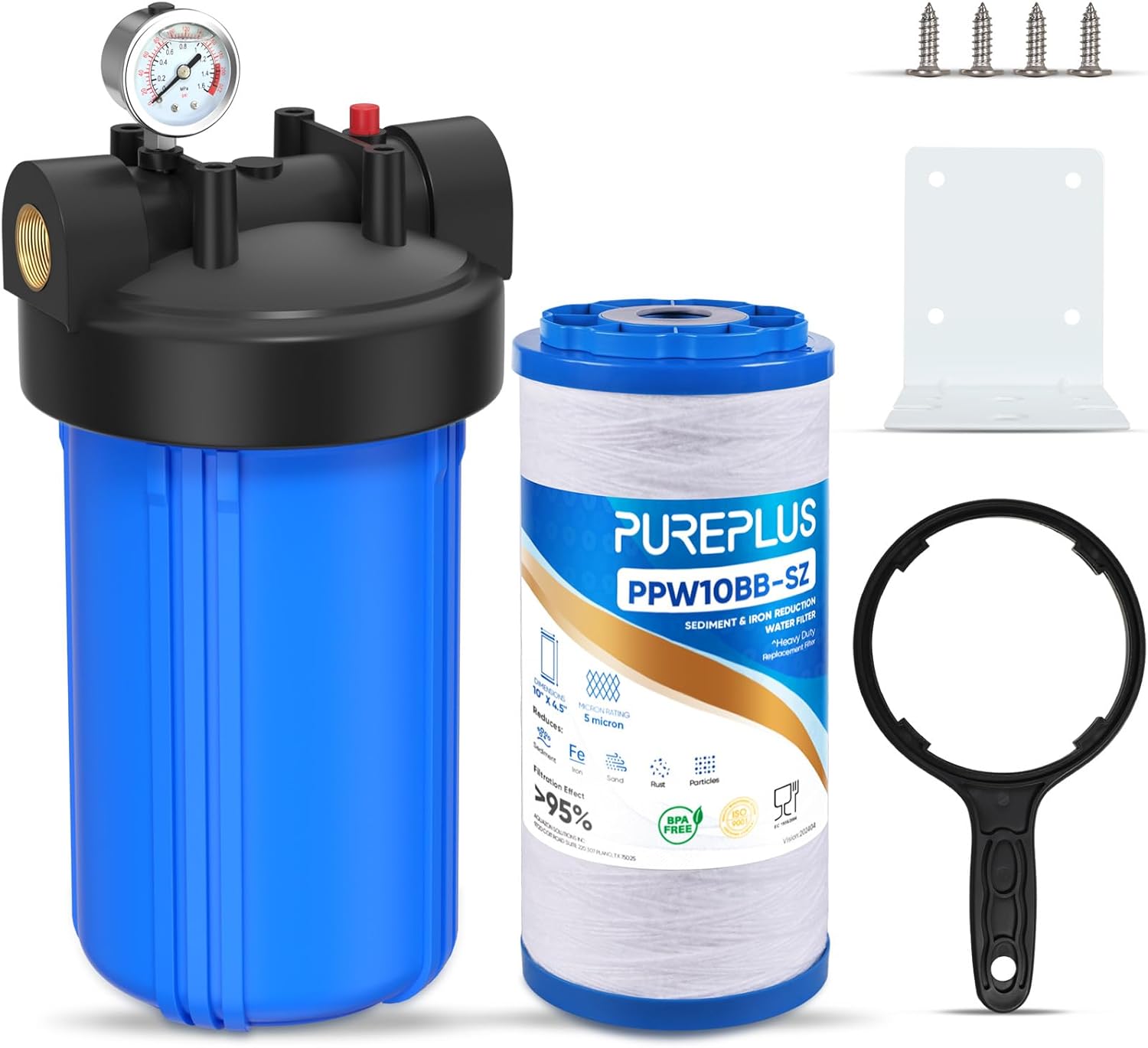
The PUREPLUS 1-Stage Whole House Filter is a standard 10"x4.5" housing packaged with a composite cartridge formulated for iron and sediment reduction in well water. It installs at the main water line and is intended as a pre-filter to protect downstream appliances, water heaters, and fixtures. The kit includes a mounting bracket, wrench, O-ring and a pressure-release valve for straightforward cartridge changes, and the unit is built from food-grade polypropylene for durability. It is optimized for faster flow than some heavy media systems, so you should not see a significant pressure drop during normal household use. Limitations: as a single-stage system it focuses on sediment and iron reduction but will not remove dissolved minerals, hardness, or all heavy metals as multi-stage or specialized media systems do, and its iron-reducing performance depends on feed water chemistry and contact time. For many budget buyers with mildly iron-stained well water, it offers an economical, easy-to-install option to reduce visible iron and protect plumbing without the complexity of a multi-stage setup.
Best for: Buyers on a tight budget with well water that shows visible iron or sediment who want an affordable, easy-to-install point-of-entry filter to protect plumbing and appliances.
Less Ideal for: Homes with high dissolved iron, severe staining, or complex water chemistry that require multi-stage treatment, oxidation, or water softening should consider a more advanced system.
- Designed for standard 10"x4.5" cartridges so replacements are widely available
- Includes installation hardware and a wrench for DIY setup
- Food-grade polypropylene housing for corrosion resistance and durability
- Pressure relief valve and mounting bracket simplify cartridge changes and service
- Single-stage design limits contaminant removal compared with multi-stage systems
- Not intended to remove dissolved iron or soften very hard water
Verdict: A practical, budget-friendly single-stage whole-house housing that reduces visible iron and sediment and protects downstream plumbing without the complexity of larger multi-stage systems.
iSpring WGB21BM Whole House System

| Maximum Flow Rate | 15 gpm |
|---|---|
| Filter Life Cycle | 1 years |
| Capacity | 50000 gallons |
| Inlet / Outlet | 1 inch Female NPT |
| Operating Temperature | 40-100 ºF |
The iSpring WGB21BM is a two-stage point-of-entry system designed to remove chlorine, bad tastes and odors with a coconut shell carbon block and to reduce iron and manganese with a catalytic iron-reducing media. It mounts at the main supply and supports up to 15 gpm flow, so it treats water for the entire house without noticeably restricting faucets or appliances. The unit ships pre-assembled on a bracket and includes a filter wrench and clear installation guides and videos, which helps homeowners handle DIY installation or hand off a quick job to a plumber. Filters are standard 10" x 4.5" cartridges with an advertised combined life up to 50,000 gallons for typical use, and the metal housings are built for long service under normal household pressures. This system does not lower TDS and is not a replacement for reverse osmosis if you need dissolved solids removed, and very high iron concentrations from some wells may require a custom solution or pretreatment, so test your water before buying.
Best for: Homeowners who prioritize a reliable, point-of-entry solution to remove chlorine and reduce iron and manganese from well water and want a durable system that supports whole-house flow rates.
Less Ideal for: Buyers focused on lowering TDS, desalination, or heavy water softening needs should consider an RO or dedicated softener instead, and those with very high iron levels should consult for a customized treatment plan.
- Two-stage design targets chlorine, taste/odor and reduces iron and manganese effectively.
- High flow capacity up to 15 gpm suitable for whole-house service without major pressure drop.
- Pre-assembled mounting bracket and included wrench simplify installation and routine filter changes.
- Carbon block and catalytic media offer long filter life up to advertised 50,000 gallons for typical household use.
- Metal housings and compatibility with standard 1" NPT piping give a durable, plumber-friendly installation.
- Does not reduce total dissolved solids so it will not soften water or remove salts.
- May be insufficient for wells with extremely high iron or manganese without additional pretreatment.
Verdict: Choose the iSpring WGB21BM when you need a durable, whole-house two-stage system that reliably removes chlorine and reduces iron and manganese for well water.
iSpring WGB32BM 3-Stage Whole House Filter
| Maximum Flow Rate | 15 gpm |
|---|---|
| Operating Pressure Range | 25 – 80 psi |
| Operating Temperature | 40 – 100 ºF |
| Inlet / Outlet | 1 inch NPT |
| Filter Life Cycle | 1 years |
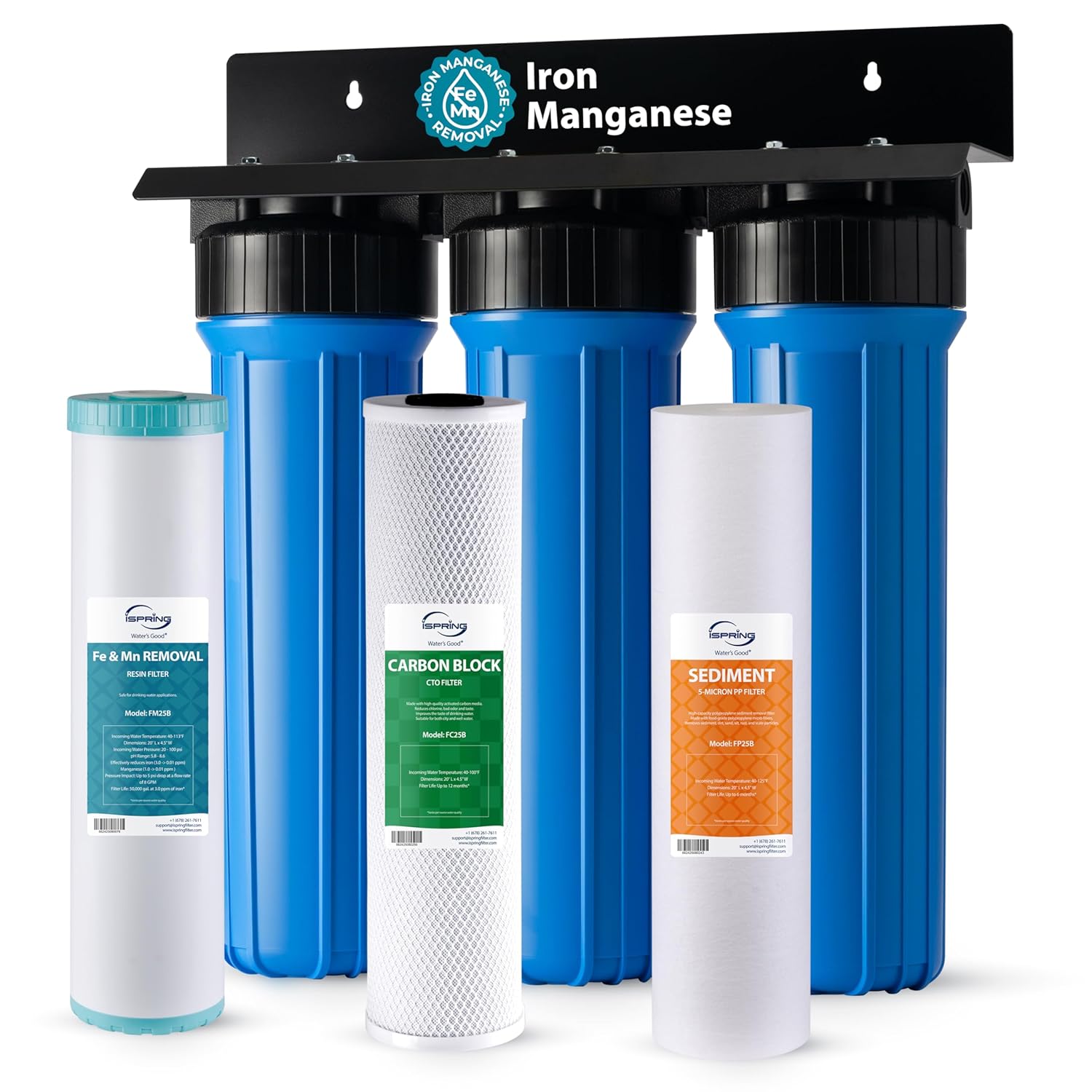
The iSpring WGB32BM is a tankless, point-of-entry filtration system built for well water with iron and common municipal contaminants. It uses a three-stage cartridge layout: a polypropylene big-blue sediment filter up front to trap sand, rust, and large particles, a coconut-shell carbon block for chlorine, taste, and odor reduction, and a catalytic iron/manganese media cartridge that lowers iron (tested up to 3.0 ppm) and manganese (up to 1.0 ppm). The system is sized for high flow applications with a peak flow rating of 15 gpm and installs on 1-inch NPT plumbing; iSpring documents DIY install steps and provides a wrench and replacement cartridge SKUs. Practical benefits include long cartridge life (up to 100k gallons for the sediment and carbon stages, 50k gallons for the iron stage at certain levels), minimal pressure loss, and indoor installation guidance. Important limits: it does not soften water or remove dissolved solids, and it is not rated for iron or manganese concentrations above the stated maxima, so very high-iron wells need a different model or pretreatment. Expect annual filter changes under typical household use and indoor mounting with freeze protection if placed outdoors.
Best for: Buyers who want a proven whole-house filter focused on removing iron, manganese, sediment, and chlorine from well water and who value long-lasting cartridges and documented DIY installation.
Less Ideal for: Homes that need water softening or treatment for iron/manganese levels above the system's stated limits should choose a softener or a higher-capacity iron removal solution instead.
- Three-stage filtration targeting sediment, chlorine/taste/odor, and iron/manganese for well water
- High capacity cartridges rated up to 100,000 gallons for the sediment and carbon stages
- 15 gpm peak flow and 1-inch NPT connections support whole-house flow with minimal pressure loss
- Includes three filters and a wrench and is designed for DIY installation with documented instructions
- Does not reduce water hardness or total dissolved solids
- Iron/manganese reduction is limited to specified maximums and not suitable for very high levels
Verdict: A high-capacity, DIY-friendly three-stage whole-house filter that specifically targets iron and manganese while keeping flow high for well-water households.
SimPure DB10P Filter Housing

| Maximum Flow Rate | 20 gpm |
|---|---|
| Inlet/Outlet | 1" NPT Brass Port |
| Compatible Filter Size | 10" x 4.5" |
| Working Water Pressure Range | 15-90 PSI |
| Applicable Water Temperature | 5-38 ℃ (41-100 ℉) |
The SimPure DB10P is a single-stage whole-house filter housing intended as a pre-filter to trap sediment and accept carbon or specialty cartridges for additional contaminant reduction. It mounts to piping with 1" NPT brass inlet and outlet ports and is made from reinforced, food-grade polypropylene with a built-in red pressure-relief button and included wrench and mounting bracket for straightforward installation. In real-world use it serves best as first-line protection for water heaters, washing machines, and downstream filters by removing sand, silt, and larger particles and by holding a carbon cartridge to reduce chlorine taste and odor. The 20 gpm maximum flow supports typical household flow rates, but you must buy cartridges separately and pick media suited for well water iron reduction because this housing alone does not remove dissolved iron. The brass threads are robust but installers should avoid overusing Teflon tape to prevent thread damage. For risk-averse buyers this housing's NSF-tested construction and heavy-duty mounting hardware make it a conservative choice as part of a staged treatment system for well water.
Best for: Buyers who want a reliable, factory-quality pre-filter housing to protect plumbing and downstream systems and prefer a conservative, easy-to-install component as part of a staged well-water treatment setup.
Less Ideal for: Homes that need a single-unit solution for dissolved iron or advanced contaminant removal should look at multi-stage systems or specialty iron filters rather than this standalone housing.
- Accepts standard 10" x 4.5" cartridges for easy cartridge selection and replacement
- 1" NPT brass inlet/outlet for higher flow and durable connections
- Reinforced, food-grade polypropylene body tested against NSF standards
- Includes wrench, heavy-duty mounting bracket, and screws for installation
- Built-in pressure-relief button simplifies cartridge changes
- Sold as housing only so appropriate filter cartridges for iron removal must be purchased separately
- Single-stage housing cannot remove dissolved iron or dissolved contaminants without proper cartridge selection
Verdict: A sturdy, NSF-tested 10" housing that gives risk-averse buyers a durable, easy-to-install pre-filter platform for building a staged treatment system for well water.
Choosing the Right Whole-House Water Filter for Well Water with Iron: Key Factors to Consider
Iron Removal Method
Different iron removal methods work through distinct mechanisms and perform differently depending on whether iron is dissolved (ferrous), oxidized (ferric), or present as organic-bound iron. Oxidation followed by filtration traps particulate iron after converting dissolved forms to solid particles. Catalytic media can accelerate oxidation without chemical additives in some cases, while media that rely on backwashing clear trapped iron and extend service life.
Choosing the correct method matters because it affects effectiveness, maintenance, and whether additional pretreatment like aeration or pH adjustment is required. Match the removal method to your water test results to avoid ineffective treatment and unnecessary upkeep.
System Flow Rate and Household Demand
Flow rate determines whether the system will supply enough water for showers, laundry, and simultaneous taps without noticeable pressure drop. Whole-house filters are rated by peak or continuous flow capacity; continuous gallons per minute ratings are most relevant for steady household use.
Under-sizing a system can cause low pressure during peak use, while over-sizing increases upfront complexity and cost. Estimate your household peak demand and include a safety margin for larger appliances to pick a system that maintains acceptable pressure.
Media Life and Maintenance Requirements
Media life and maintenance routines dictate ongoing time and costs. Some iron filters use backwashing media tanks that require periodic automatic or manual backwash cycles to clear accumulated iron. Others use replaceable cartridges that must be changed on a schedule. Frequency depends on iron concentration and water usage.
Consider how often you are willing to perform maintenance or hire service, and whether the system offers convenient indicators or automated cycles to reduce hands-on upkeep.
Pretreatment Needs and Water Chemistry
Well water often varies in pH, manganese, hydrogen sulfide, and dissolved oxygen, all of which affect iron treatment success. Some iron removal systems work best when pH is within a certain range or when dissolved oxygen is present to aid oxidation. In cases of high manganese or hydrogen sulfide, additional pretreatment steps such as aeration, chlorination, or specialized media may be necessary.
Testing your well water for a full panel of common contaminants informs whether a standalone iron filter is sufficient or whether a multi-stage approach is required.
Installation Location and Plumbing Compatibility
Whole-house systems are typically installed at the point where water enters the building. Space constraints, pipe size, and available clearances affect which systems will fit and how easily they can be serviced. Some units require vertical clearance for media tanks and backwash plumbing, while cartridge-style housings need access for filter changes.
Confirm your plumbing diameter and available installation footprint before selecting a system to avoid compatibility issues or costly plumbing modifications.
Operating Costs and Long-Term Ownership
Operating costs include replacement media or cartridges, salt for water softening if part of the system, energy for powered components, and water used in backwashing. High-frequency backwashing or short filter life increases household water and replacement part consumption.
Estimate annual running costs based on your water test and expected service intervals to compare systems on total cost of ownership rather than upfront expense alone.
Understanding Iron in Well Water
Iron in well water shows up as clear water that stains brown on exposure, metallic taste, or orange-brown deposits on fixtures. Knowing whether iron is dissolved or particulate helps determine which treatment approach will work. Simple field tests and a lab water analysis can distinguish forms and measure concentrations.
Concentration and form control which technologies are appropriate. Low concentrations of dissolved iron may respond to catalytic media or oxidation-filtration, while higher concentrations often need more robust backwashing media or a multi-stage approach that removes both iron and sediment.
- Ferrous iron is dissolved and often requires oxidation before filtration
- Ferric iron appears as particulates and is removed by particulate filters
- Organic iron and manganese often need specialized media or pretreatment
Typical System Configurations
Whole-house iron systems are commonly configured as single-tank backwashing filters, multi-tank treatment trains, or cartridge-based filters used as pretreatment. Backwashing media tanks are effective for particulate iron and are often paired with sediment prefilters to prolong media life.
Multi-stage setups combine sediment filters, iron-specific media, and sometimes softening or activated carbon to address taste and hardness. Cartridge systems are easier to install but generally require more frequent replacement when iron loads are high.
- Backwashing tanks: good for higher iron loads and continuous service
- Cartridge filters: easier maintenance for low-to-moderate iron levels
- Combination systems: address iron plus sediment, sulfur, or hardness
Sizing a System for Your Home
To size a system, calculate peak household flow in gallons per minute and compare that with the system's continuous flow rating. Include simultaneous uses like showers and washing machines when estimating peak demand. Choose a unit that maintains desired pressure at that rate.
Also size the media or cartridge capacity relative to iron concentration and daily water use to estimate how often maintenance or media replacement will be required. Larger tanks or higher-capacity cartridges reduce service frequency but require more space and potentially more complex installation.
- Estimate peak GPM by adding typical simultaneous fixtures
- Match continuous flow rating, not just peak surge rating
- Account for media capacity based on measured iron concentration
Installation and Service Considerations
Plan for accessible placement where the system can be isolated and serviced. Systems with automated backwash cycles need drain access and adequate clearance for piping and valves. Cartridge systems need room for filter changes without disconnecting plumbing.
Factor in whether you will perform routine maintenance yourself or rely on a service provider. Some systems have simpler user maintenance, while others benefit from periodic professional servicing to calibrate controls and verify media condition.
- Ensure drain availability for backwash systems
- Verify clearance for media tanks and valve access
- Check whether replacement parts are user-serviceable
Testing Your Water Before and After Installation
Start with a comprehensive well-water test that includes iron speciation, manganese, pH, hardness, and total dissolved solids. These parameters directly influence which system components are necessary and whether pretreatment is required. Keep a copy of the lab results to share with any installer.
After installation, retest periodically to confirm the system is meeting removal goals. Tracking iron levels and observing visual indicators like staining or taste will show whether adjustments or additional stages are needed over time.
- Request iron-form analysis from your lab
- Test pH and manganese to identify pretreatment needs
- Retest after commissioning and annually thereafter
How We Chose the Best Whole-House Water Filter for Well Water with Iron
We selected systems that address the specific challenges of well water containing iron while balancing household flow needs and practical upkeep. Our evaluation prioritized measurable iron removal methods such as oxidation-filtration, backwashing media, and catalytic filtration performance. Capacity and flow rate were considered to ensure systems can support typical household demand without causing pressure loss. Maintenance factors included media longevity, backwash requirements, cartridge replacement intervals, and ease of service. Construction quality, warranties, and compatibility with common well pump pressures were also reviewed to gauge long-term reliability. Systems that only target sediment without iron treatment, or that lacked clear serviceability, were excluded. The result is a list of options that meet real-world iron reduction goals while keeping everyday use and maintenance manageable for homeowners with well water.
Our full evaluation process is outlined in our review methodology.
FAQ
How can I tell if my well water iron is dissolved or particulate?
A lab test that specifies ferrous versus ferric iron is the most reliable method. A simple home check is to let a sample sit exposed to air; dissolved iron often forms visible particles after oxidation, while particulate iron remains visible immediately.
Will a whole-house filter remove all iron without pretreatment?
It depends on iron concentration and form. Low-to-moderate particulate iron is often handled by backwashing media, but dissolved iron frequently requires oxidation or catalytic media and sometimes pH adjustment or aeration as pretreatment.
How often do iron filter systems need maintenance?
Maintenance frequency varies with iron load and system type. Backwashing systems usually run automatic cycles and need media replacement infrequently, while cartridge filters may need replacement every few months under higher iron levels.
Does iron removal affect water pressure?
A properly sized system should maintain household pressure. Systems rated below your peak demand can cause pressure drops, so sizing for continuous flow and keeping sediment prefilters clean helps preserve pressure.
Should I test water after installing a filter?
Yes. Post-installation testing confirms the system achieves expected iron reduction and helps identify any adjustments or additional treatment stages needed for long-term performance.
Final Verdict
Choosing a whole-house water filter for well water with iron requires matching treatment method to the iron form and household flow needs. Prioritize systems that demonstrate reliable iron removal, adequate continuous flow capacity, and manageable maintenance routines. Balance installation constraints and long-term operating costs against desired performance. With proper water testing and the right system size, you can reduce staining and taste issues and maintain consistent water pressure throughout the home.